Pallet racking in Caerphilly, for the estates strung along the A468 and the A469.
Most industrial floor space around Caerphilly sits in older, mid-sized units: Pantglas in Bedwas, the Western Industrial Estate off the town's western edge, and Penallta and Dyffryn either side of Ystrad Mynach. Those buildings were let to bakers, fabricators and component makers who now need more stock, more production lines and more office space than the original footprint allows.
We plan the racking, shelving and mezzanine floors that let a Caerphilly business grow upwards instead of moving out. We come over the Heads of the Valleys road and down the A470, survey within five working days, and stay on as your SEMA inspector afterwards.
- Drive from Seven Sisters
- 50 to 60 min
- Road distance
- 38 miles
- Survey lead time
- Within 5 working days
- Mezzanine steelwork on site
- 1 to 3 weeks
Where Caerphilly makes and stores things.
Caerphilly County Borough has a population of more than 175,000 and its industry is spread across a string of estates rather than one big logistics park. Pantglas Industrial Estate, about two miles east of the town centre at Bedwas, is marketed as a manufacturing location with direct access to the A468 and A469, the A470 dual carriageway and junctions 29, 30 and 32 of the M4. Agents' particulars for one 46,445 sq ft unit there quote a minimum eaves height of 5.3m, a useful guide to what the estate's older units offer.
Up the Rhymney Valley, the local development plan treats Dyffryn Business Park, south of Ystrad Mynach, as a key employment site and protects the employment land at Penallta about a mile to the north. Both are fed by the A469 spine road and the A472 cross-valley route to Newbridge. Penallta now hosts a cold steel rolling mill making stud and track for steel-framed construction, built with Welsh Government support. The Western Industrial Estate in town is made up of smaller blocks: fastenings, coatings, vehicle repair and trade counters.
What links these sites is food production, engineering and component manufacture in buildings that are full. The usual request we get from Caerphilly is not a new distribution shed, it is a way to fit more into the shed you already lease.
Pantglas Industrial Estate, Bedwas
Food manufacturing and trade suppliers in units from around 6,000 to 46,000 sq ft, with eaves of around 5 to 6m.
Penallta Industrial Estate, Ystrad Mynach
Steel rolling, refrigeration engineering and a broad mix of industrial units on South Road and East Road.
Dyffryn Business Park, Ystrad Mynach
Primary employment site in the local plan, with units from about 1,500 to 10,700 sq ft off the A469 dual carriageway.
Western Industrial Estate, Caerphilly
Small blocks holding fastenings stock, coatings, motor trade parts and flexible workshops.
Bedwas House Industrial Estate
Small light industrial, workshop and trade counter units off Greenway, from about 1,400 to 11,000 sq ft, beside established food production.
Racking and storage work we do in Caerphilly.
Listed in the order Caerphilly operators usually ask for them, starting with ways to win floor area inside a building you already occupy.
Racking safety on a Caerphilly production site.
Under PUWER 1998 your pallet racking is work equipment, and HSG76 expects the business to appoint a person responsible for racking safety. On a Caerphilly manufacturing site that is often a production or engineering manager rather than a warehouse manager, because the racking stands among the lines and feeds them. Their job is to make sure staff report knocks, recorded visual checks happen weekly or at whatever interval your risk assessment sets, and an expert inspection by a SEMA Approved Rack Inspector is carried out at least every 12 months.
Food producers in Bedwas and Ystrad Mynach face a second layer: hygiene and supplier audits that look at the racking too. Auditors want to see damaged, rusted or flaking components removed from food areas, load notices in place and a dated inspection report on file. We time inspections around your audit calendar, record the findings in a format your technical team can attach to their own records, and quote repairs the same week so actions are closed before the auditor returns.
Mezzanine floors that add space inside Caerphilly units.
Many Caerphilly businesses are tied to their building. Moving a bakery or a component line means revalidating equipment, retraining staff and taking a hit on output, and the supply of modern units in the borough is limited. So the cheaper move is often upwards. A structural mezzanine can turn dead air above a packing bench into offices, a canteen, a quality lab or a second assembly cell, and the ground floor goes back to production or pallet storage. We look at clear height under the haunch, column positions, floor slab condition, existing sprinkler and lighting runs, and how people and goods will get up and down.
Units on Pantglas and Penallta vary a lot. Some 1970s buildings have eaves around 5m, enough for a single deck with useful headroom both above and below; newer bays at Dyffryn can take a deck with racking underneath. We draw the floor around your process rather than a standard grid, specify the staircase, pallet gate and edge protection, and coordinate building regulations and fire separation questions with your consultants early so the steel goes in once.
Measure the building first
Offices without an extension
Storage under and on top
Short time on site
Getting to Caerphilly from Seven Sisters.
From our base at Seven Sisters we run up the A4109 to Glynneath, east along the A465 to Merthyr Tydfil and south on the A470. Bedwas and the Western Industrial Estate are then reached on the A468, and Penallta and Dyffryn are a short hop off the A472 at Ystrad Mynach. It is about 38 miles and 50 to 60 minutes in normal traffic, which means a crew is on site before most early shifts have taken their first break.
Surveys are booked within five working days. Installs and inspections at food and manufacturing sites are often done early mornings, on Saturdays or during planned shutdowns, and we agree the order of bays with your production planner so lines keep running. Larger mezzanine and racking jobs run on consecutive days with the same fitters throughout.
- Route
- A465 and A470
- To Penallta
- About 45 min
- Typical racking install
- 4 to 8 weeks from order
- Out of hours
- Evenings, weekends, shutdowns
A typical Caerphilly job: a deck and a reorganised ground floor.
A typical project here starts with a manufacturer in a Bedwas or Penallta unit whose office has crept onto the shop floor and whose raw materials are stacked on the floor around the line. We survey the building and propose a mezzanine over one end for offices, meeting space and welfare, with a staircase near the existing entrance. Underneath it, longspan shelving holds packaging and small components.
The space released on the ground floor then takes a run of adjustable pallet racking for incoming materials and finished goods, set out for the counterbalance trucks the site already owns, with column guards at the aisle ends. We install the steel first, the racking second, and hand over with load notices and a first inspection record so the appointed person starts with a clean baseline.
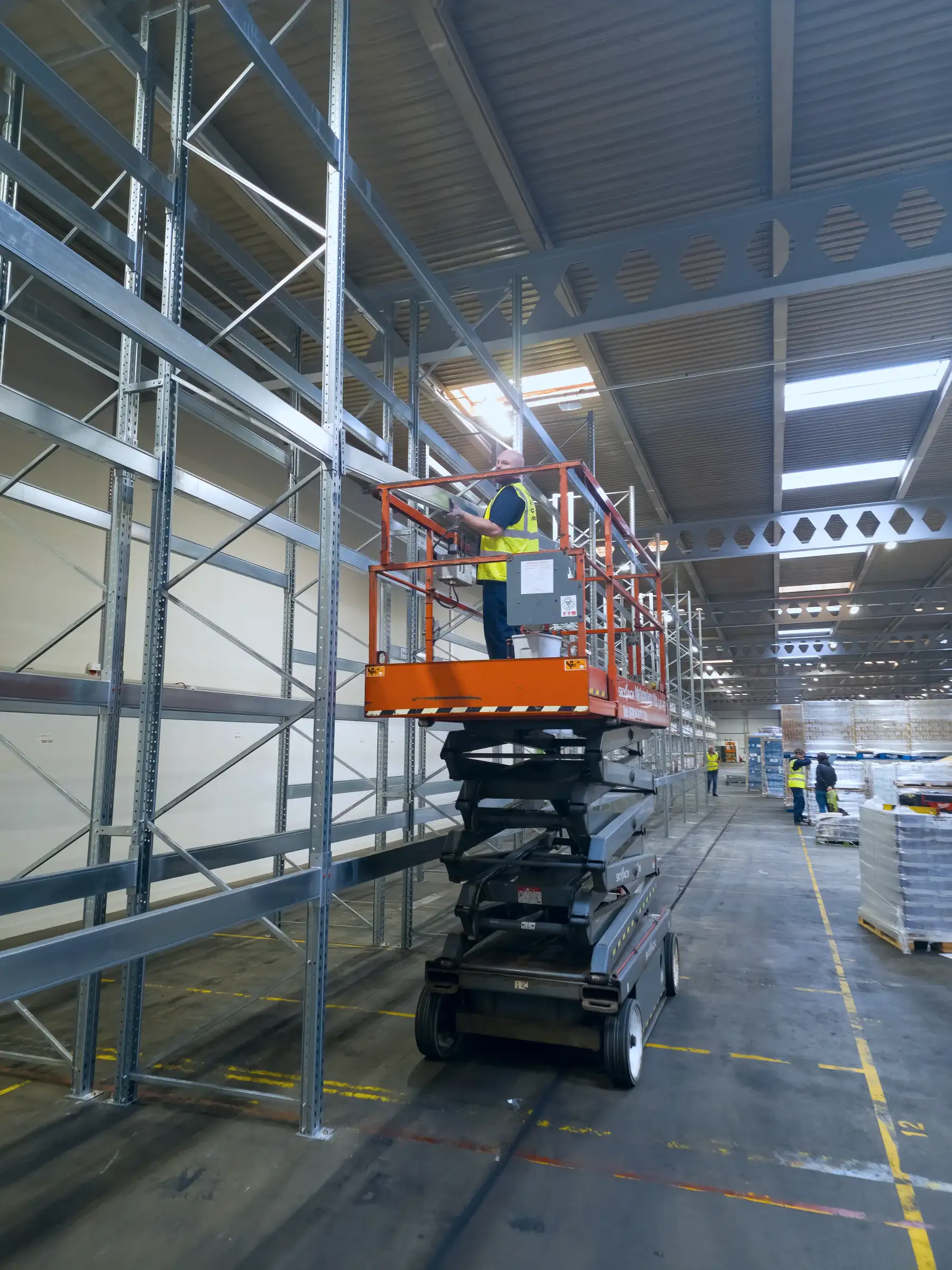
Standard racking and shelving delivered to Caerphilly
Bays, beams, shelving, protection and handling kit are in stock on the online store and delivered to Caerphilly. Designed systems still come through the free survey, because a layout has to be measured before it can be priced.
- Racking & shelving (opens the online store in a new tab)
- Storage (opens the online store in a new tab)
- Safety & premises (opens the online store in a new tab)
- Trucks & trolleys (opens the online store in a new tab)
- Steps & ladders (opens the online store in a new tab)
- Lifting, drum & cylinder (opens the online store in a new tab)
- Workshop & environment (opens the online store in a new tab)
- Office & mailroom (opens the online store in a new tab)
Questions from Caerphilly.
Often, yes. Units on Pantglas have been marketed with minimum eaves of around 5.3m, and that is usually enough for a single deck with working headroom above and below. The real limits are the haunch height, roof bracing, lights, heaters and sprinkler runs. We measure all of those on a free site survey in Bedwas, check the slab and column positions, and tell you plainly whether a deck works before you spend anything on drawings or building regulations.
Yes. We plan the inspection bay by bay with your production team, start with areas that are quiet at the time, and work around hygiene rules: hair nets, overshoes, no loose items and hand washing at each entry. A typical Caerphilly food site takes one or two days to inspect, depending on the number of bays, and we can split the work over early morning visits. The report grades every fault red, amber or green, so your technical team can file it against the next hygiene or supplier audit.
From order, typical pallet racking installs run 4 to 8 weeks, mostly waiting for steel to be made and delivered. Time on site at Penallta or Dyffryn is shorter: a run of 100 to 200 bays is usually a few days for one crew. Mezzanine steelwork is typically 1 to 3 weeks on site. We drive in from Seven Sisters each day, about 45 minutes via the A465 and A472, so there is no extra accommodation cost added to a Ystrad Mynach quote.
For component makers holding thousands of small lines, shelving or longspan is usually better than pallet racking, because people pick by hand from boxes and trays. Shelving bays can be labelled by location and arranged so the fastest lines sit at waist height. If you also receive full pallets of raw material, a combined layout works well: a few runs of pallet racking for bulk, with shelving or longspan beside them for picking. We draw both options on the survey plan so you can compare usable locations.
HSG76 asks for one named person responsible for racking safety. At a Caerphilly manufacturer, that is often the production, engineering or site manager, because the racking feeds the lines. They do not need to be a racking specialist. They need authority to offload a damaged bay, to make sure recorded visual checks are carried out, and to book an annual expert inspection by a SEMA Approved Rack Inspector. We provide training so that person knows what to look for between inspections.
Usually, if the components are compatible and undamaged. We identify the make and profile, check every upright, beam and connector, and confirm what the configuration can safely hold in the new building. Missing load notices and mixed brands are the common issues. Where parts are worn or bent we replace them, and where they are obsolete we can source matching used stock. A reused system still needs a SEMA inspection report before you load it at the new Caerphilly unit.
We cover the whole of Caerphilly County Borough: Bedwas, Trethomas, Llanbradach, Ystrad Mynach, Hengoed, Nelson, Blackwood, Oakdale, Bargoed and Risca. Travel time from Seven Sisters is 45 to 60 minutes to most of these sites, and surveys are booked within 5 working days wherever you are in the borough. If you have a second site in Cardiff or Newport, we can combine visits on the same day.
Other towns near Caerphilly.
Caerphilly sits between the A470 and the M4, so the same crews work in Cardiff and Newport to the south, Pontypridd to the west and Cwmbran to the east. Many firms here also run a second store in one of those towns, and we can inspect both on one visit.
Find out what your Caerphilly unit can hold.
Tell us the building, the stock and the space you need. We will measure the unit, draw racking, shelving and mezzanine options, and quote. Book a free site survey.