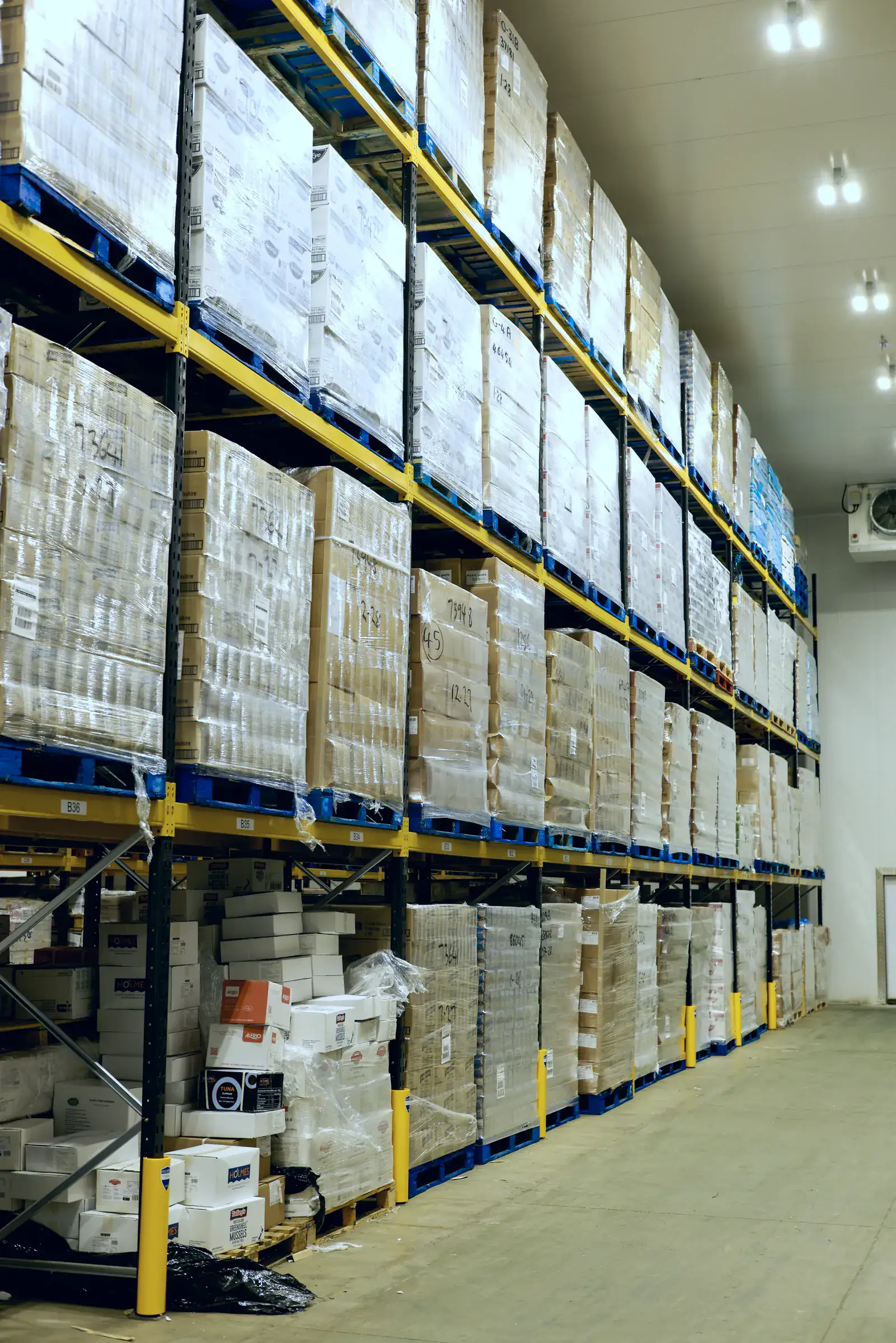
Push back racking. Gravity brings the next pallet forward.
Pallets ride on nested carts or inclined roller beds and are loaded and picked from one face. Each new pallet pushes the row back; take the front one out and the next rolls forward to replace it.
Up to 10 pallets deep, standard forklifts, and the truck never enters the racking.
- Depth, carts
- 4 to 6
- Depth, rollers
- Up to 10
- Rotation
- LIFO
- Trucks
- Standard
- SKUs
- One per level
Load from the front, pick from the front.
Push back is a deep lane system that never asks the truck to leave the aisle. The incline in the lane does the work that driving in does in drive-in racking.
- Step 1
First pallet
Placed on the top cart or the front of the roller bed at the lane face.
- Step 2
Push back
The next pallet is set against it and the truck pushes the row gently up the incline.
- Step 3
Fill the lane
Repeat until the lane is full, 4 to 6 pallets on carts or up to 10 on rollers.
- Step 4
Retrieve
Lift the front pallet out. The rest roll forward under gravity at a controlled rate.
Because loading and retrieval happen at the same face, the lane is last in, first out. Each level of each lane holds its own product, so a block of 8 lanes at 4 levels gives 32 separate SKU positions at the aisle face, all reachable with a standard counterbalance or reach truck.
Carts or rollers.
The two variants look similar from the aisle. They differ in depth, in what pallets they accept, and in how the pallet moves.
Cart systems nest a set of wheeled carts on inclined rails, one cart per pallet position, stacked so each new pallet rides on the next cart down. They suit uniform pallets 4 to 6 deep. Roller systems use full-width inclined roller beds with speed control, so lanes go up to 10 deep and the rollers support whatever pallet size sits on them.
If your stock arrives on a single pallet type, carts are simpler. If you handle UK and Euro pallets in the same lanes, or want more depth, specify rollers.
| Attribute | Cart system | Roller system |
|---|---|---|
| Typical depth | 4 to 6 pallets | Up to 10 pallets |
| Mixed pallet sizes | No | Yes |
| Pallet support | Nested wheeled carts | Full-width roller bed |
| Descent control | Cart incline | Brake rollers on an incline |
| Rotation | LIFO | LIFO |
| Truck | Standard counterbalance or reach | Standard counterbalance or reach |
Push back cart and roller variants compared.
- Typical depth
- 4 to 6 pallets
- Mixed pallet sizes
- No
- Pallet support
- Nested wheeled carts
- Descent control
- Cart incline
- Rotation
- LIFO
- Truck
- Standard counterbalance or reach
Push back racking specification.
Published working figures. Lane depth, incline and structure are designed from your pallets, loads and truck at survey.
| Attribute | Typical |
|---|---|
| Lane depth, carts | 4 to 6 pallets |
| Lane depth, rollers | Up to 10 pallets |
| Rotation | LIFO |
| Loading and picking | Same face |
| SKUs | One per level of each lane |
| Mixed pallet sizes | Rollers yes, carts no |
| Trucks | Standard, no specialist equipment |
| Truck enters racking | No |
Push back racking. Typical figures; final design from the manufacturer's data.
- Lane depth, carts
- 4 to 6 pallets
- Lane depth, rollers
- Up to 10 pallets
- Rotation
- LIFO
- Loading and picking
- Same face
- SKUs
- One per level of each lane
- Mixed pallet sizes
- Rollers yes, carts no
- Trucks
- Standard, no specialist equipment
- Truck enters racking
- No
Load per pallet position and lane incline: From the manufacturer's design data for your lane
When push back is the wrong answer.
Push back is a good compromise between density and convenience. It is still a compromise, and these are the cases where it loses.
Strict FIFO stock
One pallet per SKU
Mixed pallets on carts
Very deep single-product stock
Poor pallet condition
Lowest cost per position
Who it suits.
Operations with a moderate number of SKUs, several pallets of each, and no appetite for trucks driving inside the racking or for specialist forks.
- Food and drink producers with LIFO-tolerant ambient stock
- Chilled stores wanting density without trucks in the lanes
- Manufacturers buffering raw materials beside production
- Distribution sites with mid-volume lines, 4 to 10 pallets each
Against the neighbouring systems.
Push back is usually weighed against drive-in, double deep and pallet live racking. The differences are rotation, depth and where the truck goes.
| Attribute | Push back | Drive-in | Double deep | Pallet live |
|---|---|---|---|---|
| Rotation | LIFO | LIFO, or FIFO drive-through | LIFO | FIFO, automatic |
| Depth | 4 to 6 carts, up to 10 rollers | Sized to SKU | 2 | Sized to throughput |
| Truck enters racking | No | Yes | No | No |
| Specialist truck | No | No | Telescopic forks | No |
| Aisles | One face | One face | Every double run | Separate in and out |
Push back racking against its nearest alternatives.
- Rotation
- LIFO
- Depth
- 4 to 6 carts, up to 10 rollers
- Truck enters racking
- No
- Specialist truck
- No
- Aisles
- One face
Read drive-in racking, double deep racking and pallet live racking, or filter all nine by FIFO and LIFO in the racking system comparison.
Spares and protection for existing racking
Beams, decking and upright protection for the racking around your push back block are available from the racking and shelving department at palletrackingwales.shop. Push back lanes themselves are designed and quoted after a survey.
- Racking & shelving (opens the online store in a new tab)
- Storage (opens the online store in a new tab)
- Safety & premises (opens the online store in a new tab)
- Trucks & trolleys (opens the online store in a new tab)
- Steps & ladders (opens the online store in a new tab)
- Lifting, drum & cylinder (opens the online store in a new tab)
- Workshop & environment (opens the online store in a new tab)
- Office & mailroom (opens the online store in a new tab)
Push back racking questions.
Pallets sit on nested wheeled carts or full-width inclined roller beds, and are loaded and picked from the same face. Each new pallet pushes the row back up the incline. When the front pallet is removed, the rest roll forward under gravity at a controlled rate to the pick face.
Typically 4 to 6 pallets deep on the cart system and up to 10 pallets deep on the roller system. Depth is chosen from your pallets per SKU, because each lane level should hold one product.
LIFO, last in, first out. Pallets are loaded and retrieved from the same face, so the last pallet in is the first one out. If you need first in, first out, pallet live racking does it automatically from a separate loading aisle.
No. Push back works with standard counterbalance and reach trucks. The truck never enters the racking and needs no telescopic forks, which is the main advantage over double deep and drive-in.
The roller variant accommodates mixed pallet sizes, because the full-width rollers support whatever sits on them. The cart variant does not, because each cart is sized for one pallet footprint. If you handle UK and Euro pallets in the same lanes, specify rollers.
One product per level of each lane. A block of 8 lanes at 4 levels gives 32 lane positions, each able to hold a different SKU, which is more flexible than drive-in where the whole lane, floor to top, is normally one product.
Drive-in is denser and can go deeper, but the truck drives into the lane, which brings impact damage. Push back keeps the truck at the face, allows a different SKU per level and cycles faster, at a shallower lane depth of 4 to 10 pallets.
Carts, wheels, rollers and brake or speed control components are checked as part of the regular racking inspection, alongside the structure. Damaged pallets that snag on rollers are the most common operational issue, so pallet condition is part of the specification.
Tell us how many pallets each product runs to.
Between 4 and 10 pallets per line and LIFO-tolerant stock, push back is often the best fit. We will lay it out against drive-in and adjustable racking on the same floor so you can compare positions and price.