
Rack protection. Fitted where the strikes actually happen.
Physical impact protection that separates vehicles from people, racking, building structure and installed equipment. Upright protectors, rack end barriers, traffic and pedestrian barriers, column guards, bollards and charge point protection.
Aisle ends take the most strikes. Protect those first.
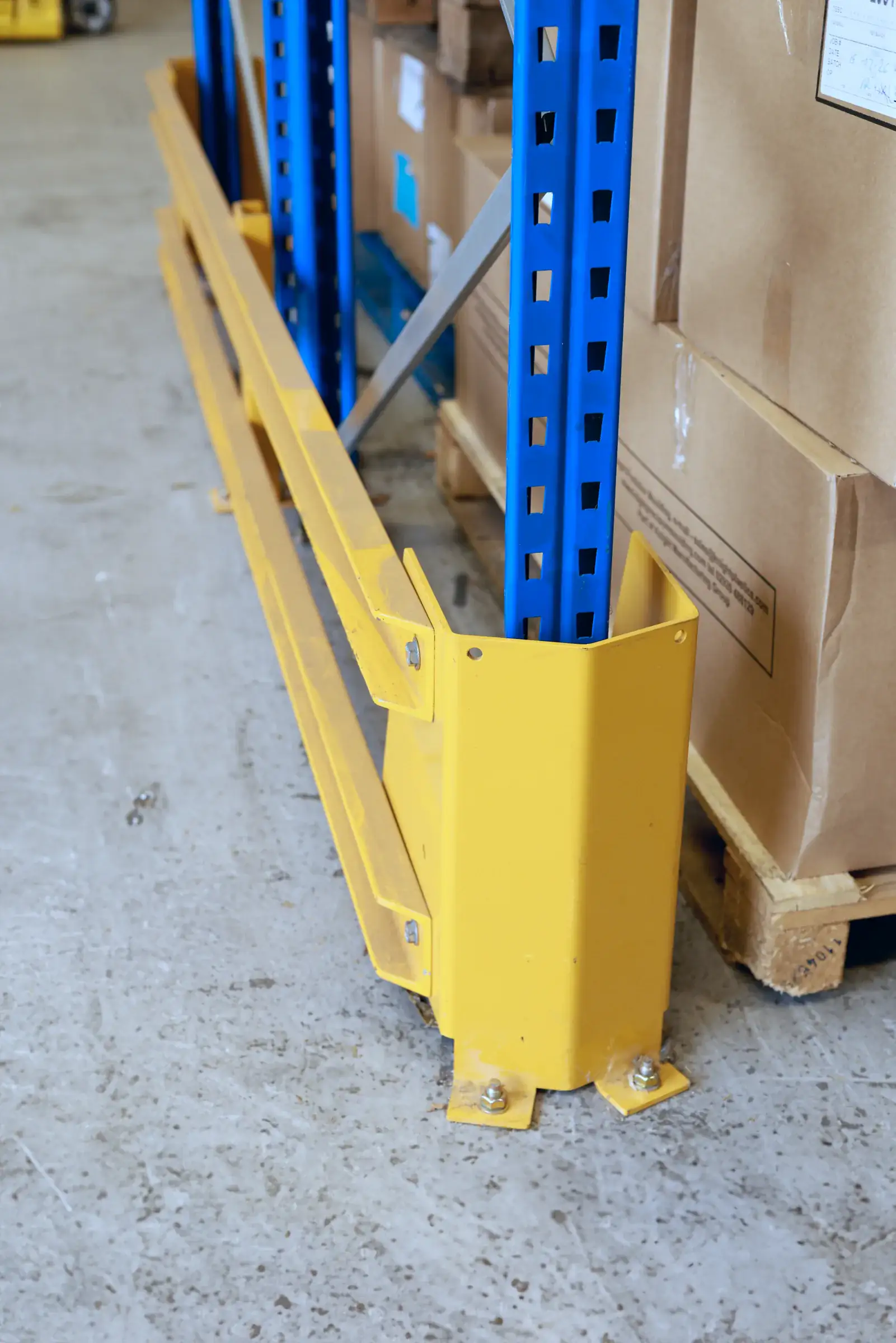
- Highest strike location
- Aisle ends
- Polymer after impact
- Returns to shape
- Steel after impact
- Stays bent
- Fitting
- RetrofitNo major disruption
Where the strikes happen.
Damage is not spread evenly. It concentrates where trucks turn, reverse and queue, and the same positions appear in inspection reports year after year.
Aisle ends
Turning points
Loading areas
Busy aisles
Building columns
Pedestrian crossings
What we fit.
Every product does one of two jobs: keep a vehicle off something, or keep a person away from a vehicle.
Protection is specified by position, not by catalogue. A rack end barrier at a busy turn, a clip-on protector in a narrow aisle and a bollard at a doorway are three different answers to three different strikes. The survey marks each position on your layout.
Upright protectors
Clip-on, strap-on or floor fixed guards around individual uprights, sized to the profile.Rack end barriers
Floor fixed barriers across the exposed end frame at aisle ends, standing clear of the racking so impact never reaches it.Vehicle and traffic barriers
Barrier runs that keep trucks to their routes and off plant, doors and building structure.Pedestrian barriers and walkway segregation
Guarded walkways and crossing points separating people from truck routes.Building column protection
Wraps and guards for portal frame columns inside the building.Bollards
For single assets and doorways where a barrier run would be excessive.EV charge point protection
Kerb barriers and bollards around charging bays and their cabling.
Polymer absorbs. Steel transmits.
The choice is decided by what happens after the strike. Rigid steel deforms permanently and passes the load into its floor fixings and the slab, so one knock becomes a bent protector and a damaged floor. Polymer absorbs the energy and returns to its original shape, which is what you want where low speed contact is a fact of daily life.
| Attribute | Polymer protection | Rigid steel guard |
|---|---|---|
| After an impact | Absorbs energy and returns to its original shape | Deforms permanently |
| Where the load goes | Dissipated within the barrier | Transmitted into floor fixings and slab |
| Repeat strikes | Keeps working after repeated low speed contact | Weakened after the first deformation |
| Floor and slab | Fixings protected from shock load | Anchors loosen, slab can crack |
| After a strike | Usually inspect and carry on | Replace the guard, often repair the fixings |
| Visibility | Coloured through, no paint to chip | Painted, needs repainting after strikes |
| Best suited to | Forklift traffic inside the building | Low cost guarding where strikes are rare |
| Not suited to | Heavy vehicles in the yard | Positions struck weekly |
Polymer protection against rigid steel guards, inside the building.
- After an impact
- Absorbs energy and returns to its original shape
- Where the load goes
- Dissipated within the barrier
- Repeat strikes
- Keeps working after repeated low speed contact
- Floor and slab
- Fixings protected from shock load
- After a strike
- Usually inspect and carry on
- Visibility
- Coloured through, no paint to chip
- Best suited to
- Forklift traffic inside the building
- Not suited to
- Heavy vehicles in the yard
Outside the building the trade reverses. Yard traffic has too much mass for polymer, so gas cages, tanks, sub-stations and charge points in the yard are protected with Armco crash barriers, which stop the vehicle and take the permanent damage doing it.
Upright protectors and barriers, off the shelf
Standard upright protectors, rack end barriers, bollards, column guards and walkway barriers are in the Safety and premises department of the online store, delivered across Wales. Not sure which positions need them? The survey marks every one on your layout.
- Racking & shelving (opens the online store in a new tab)
- Storage (opens the online store in a new tab)
- Safety & premises (opens the online store in a new tab)
- Trucks & trolleys (opens the online store in a new tab)
- Steps & ladders (opens the online store in a new tab)
- Lifting, drum & cylinder (opens the online store in a new tab)
- Workshop & environment (opens the online store in a new tab)
- Office & mailroom (opens the online store in a new tab)
Retrofitted, without stripping anything.
Protection is nearly always added to racking that is already loaded and working. Most positions are fitted in minutes, with the aisle closed only while that position is done.
- Slab checked before anything is anchored to it
- Aisle width measured against the truck in use, so protection does not create the next strike
- Floor fixed barriers set clear of the racking, so impact never reaches the frame
- Positions marked on a layout, so a struck protector can be re-ordered by reference
Drive-in blocks need particular care, because the truck works inside the racking. Entry uprights and guide rails take the most contact and are protected first.

EV charge point protection.
Charge posts are usually installed where vehicles reverse, and almost nobody in storage is protecting them.
Forklift fleets and company cars are moving to battery power, and the charge points are going in beside loading bays, car parks and the outside walls trucks back towards. A strike on a charge post is an electrical hazard as well as a repair bill.
Kerb barriers
Low wheel stops that keep a reversing vehicle off the post and cabling.Bollards
Either side of the post, for car and van bays.Barrier runs
Across the front of banked chargers for forklift and yard vehicles.Yard positions
Heavier vehicle traffic outside is handled with Armco instead.
What changes afterwards.
The return on protection shows up in the next inspection report and the repair budget, not in the catalogue.
Less rack damage
Fewer interruptions
Better traffic flow
When protection is the wrong answer.
Protection treats the strike. Sometimes the strike is telling you something else.
The cause is overloading
The slab will not hold a fixing
Inspect, repair, protect, train, re-inspect.
Each stage produces the next. Repeated damage in the same location is a symptom, and the cause is usually layout, systematic overloading or truck and aisle geometry.
- Step 1InspectAnnual expert inspection, plus the recorded visual checks your appointed person runs.
- Step 2RepairDamaged components replaced like for like across brands, never straightened.
- Step 3Protect (this page)Rack protection inside, Armco barriers in the yard, fitted where the strikes actually happen.
- Step 4TrainAwareness course so the people who see damage first can classify and report it.
- Step 5Re-inspectAnnual date set at handover, so nothing lapses quietly.
Rack protection questions.
Aisle ends. The exposed end frames at the ends of aisles are statistically the highest strike location, because that is where trucks turn. After that: turning points mid-run, loading areas, the busiest aisles, and any upright beside a door or a cross aisle. An inspection report showing repeat damage locations is the best map of where protection is needed.
For repeated low speed forklift contact, yes. Polymer absorbs the impact energy and returns to its original shape. Rigid steel deforms permanently and transmits the load into its floor fixings and the slab, so one strike can become two repairs: the protector and the floor. Steel still has a place outside, where vehicle mass is too high for polymer, which is what Armco crash barriers are for.
Yes. Most upright protectors and rack end barriers are retrofitted without unloading the racking or stopping the aisle for more than a short period. Floor fixed products need a sound slab to anchor into, which is checked first, and anything that narrows the aisle is measured against the truck in use.
Both types exist. Clip-on or strap-on protectors fit around the upright and add little width. Floor fixed protectors and rack end barriers stand free of the racking so an impact is not passed into the frame at all. Which is right depends on aisle width, truck type and how hard the strikes are.
That is the point of it. Protection reduces the number and severity of strikes reaching the racking, which means less rack damage, lower repair spend, fewer bays taken out of use and cleaner inspection results. It does not remove the need for inspection, and a protector that has been struck repeatedly should itself be checked and replaced.
Yes. Charge posts and their cabling are protected with kerb barriers and bollards around the charging bay, sized to the vehicles using it. It is a growing need as forklift fleets and company vehicles electrify, and charge posts are usually sited where vehicles reverse.
There is no single rule that says every upright must be guarded. Racking is work equipment under PUWER 1998, and you must keep it in safe condition, and HSG76 and EN 15635 expect protection where racking is exposed to impact, such as at aisle ends and gangways. In practice an inspector will record unprotected high risk positions as findings.
Yes. Standard upright protectors, barriers, bollards and column guards are available from the online store. A survey is worth it where you are not sure which positions need protection or what width the aisle can lose.
Protection surveyed with the racking, quoted separately
Get the strike points marked on a drawing.
One visit covers the racking, the traffic routes and the yard. You get a layout showing every protection position, the product for each, and a priced quotation. No charge and no obligation.