
Narrow aisle racking. The same racking with half the aisle.
VNA racking is the adjustable pallet racking structure with its aisles compressed to the minimum a guided truck needs. It recovers a large share of the floor currently given to aisles, and every pallet stays accessible.
The racking is the easy part. The truck, the guidance and the floor decide whether it works.
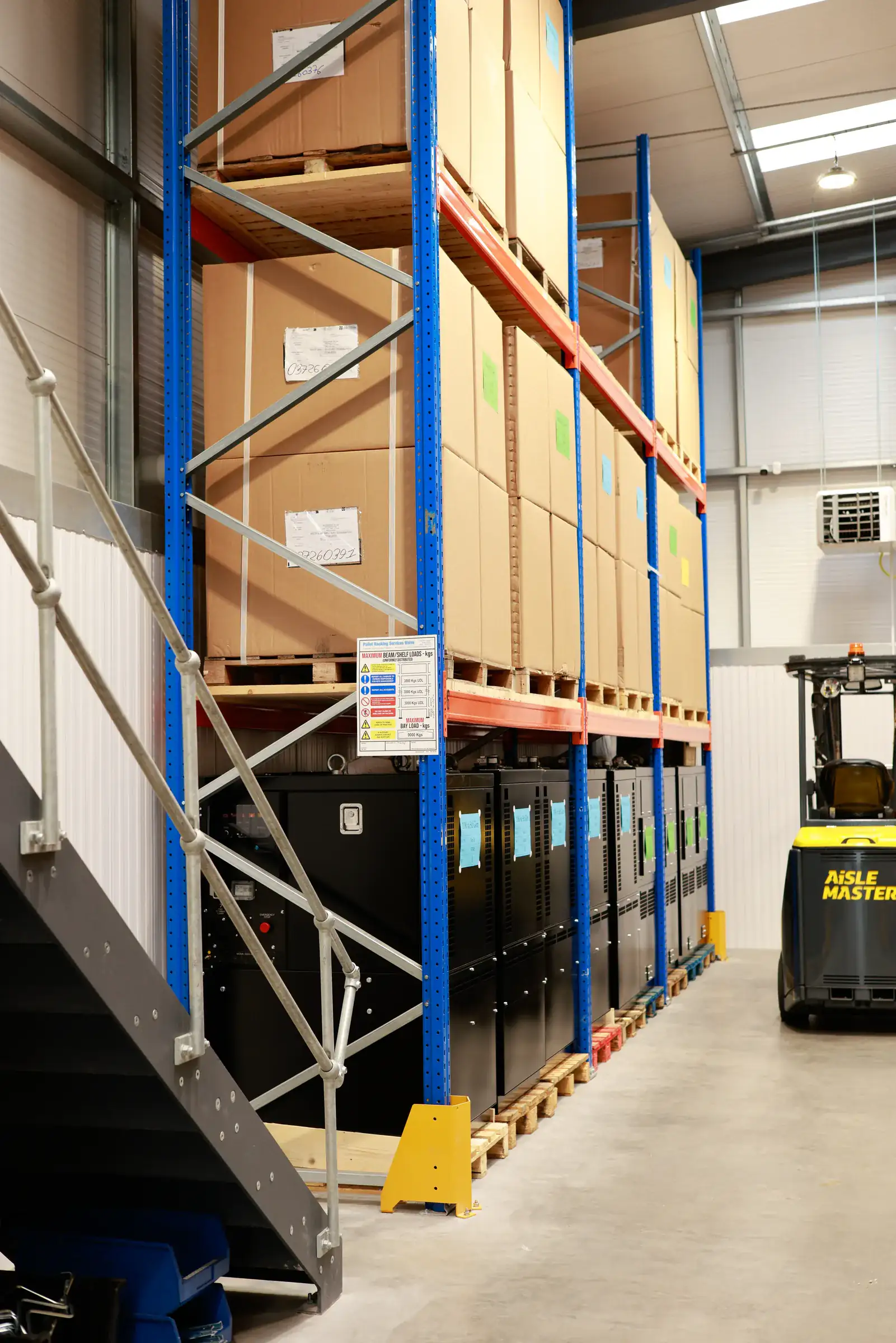
- VNA aisle
- 1.6 to 1.9m
- Counterbalance aisle
- 3.5 to 4.2m
- Reach truck aisle
- 2.7 to 3.2m
- Selectivity
- 100%
- Guidance
- Wire or rail
VNA aisle width, in metres.
A guided very narrow aisle truck works in 1.6 to 1.9m. A counterbalance truck needs 3.5 to 4.2m. That is the whole argument for narrow aisle racking: roughly half the aisle, on every aisle in the building.
In a counterbalance layout the aisles can take as much floor as the racking. Narrow them and the same building takes more runs, with every pallet still reachable from the aisle. Where a site has height to spare as well, guided trucks can usually work taller racking than the existing fleet, so the gain comes in two directions.
These ranges are for layout, not design. The final aisle is taken from the truck manufacturer's data for your pallet size and load overhang.
| Truck class | Aisle width | Note |
|---|---|---|
| Counterbalance | 3.5 to 4.2m | Standard forklift, no guidance, most flexible on mixed duties. |
| Reach truck | 2.7 to 3.2m | The usual choice for adjustable pallet racking at height. |
| Reach, telescopic forks | 2.9 to 3.4m | Needed for double deep. A fleet decision as much as a racking one. |
| Articulated | 1.8 to 2.1m | Works aisle and yard, no guidance required. |
| Guided narrow aisle | 1.6 to 1.9m | Wire or rail guidance and a flat floor survey required. |
Aisle width by truck class, in metres.
- Counterbalance
- 3.5 to 4.2m
- Reach truck
- 2.7 to 3.2m
- Reach, telescopic forks
- 2.9 to 3.4m
- Articulated
- 1.8 to 2.1m
- Guided narrow aisle
- 1.6 to 1.9m
Two truck types, two kinds of operation.
Guided narrow aisle trucks travel inside the aisle and turn the load to either face without turning the truck. Which one you need depends on whether you pick full pallets or cases.
| Attribute | Man-up order picker | Man-down high-lift |
|---|---|---|
| Operator position | Rises with the load in the cab | Stays at floor level |
| Best for | Case picking at every level plus pallet handling | Full pallet put-away and retrieval |
| Aisle | 1.6 to 1.9m, guided | 1.6 to 1.9m, guided |
| Guidance | Wire or rail | Wire or rail |
| Feeds from | Pick and drop positions at the aisle ends | Pick and drop positions at the aisle ends |
| Visibility at height | Direct, operator is at the level | Camera or height selection systems |
Guided narrow aisle trucks compared.
- Operator position
- Rises with the load in the cab
- Best for
- Case picking at every level plus pallet handling
- Aisle
- 1.6 to 1.9m, guided
- Guidance
- Wire or rail
- Feeds from
- Pick and drop positions at the aisle ends
- Visibility at height
- Direct, operator is at the level
Wire guidance
A cable is cut into the floor along the centre of each aisle and the truck follows it electronically. The aisle floor stays clear of steel, which suits sites that clean or reconfigure often. The slab must take the cut, and any future relocation means a new cut.
Rail guidance
Steel guide rails fixed along the foot of each run and the truck runs its guide rollers against them. Mechanical, simple and visible, and the rails also protect the bottom of the upright frames. Rail entry flares at the aisle ends bring the truck in on line.
The floor comes before the quote.
A guided truck lifting a pallet to the top level of a narrow aisle needs a floor flat enough to run safely at height. Small slab variations at floor level become large movements at the top of the mast.
Floor flatness is measured in a floor survey against EN 15620 and the truck manufacturer's requirements, along the wheel tracks the truck will actually use. Some slabs pass as they are. Others need grinding in the wheel tracks, and a few are not suitable without major work. Knowing which before you order trucks is the point.
Required floor flatness for your aisles: Set by the floor survey against EN 15620
- Floor flatness survey along the planned wheel tracks
- Slab suitability for wire cutting or rail fixing
- Transfer space at each aisle end for the truck to enter on line
- Pick and drop positions so the feeder fleet never enters the aisle
- Pedestrian exclusion from guided aisles while trucks operate
- End of aisle protection and clear signage
Narrow aisle racking specification.
The racking itself follows adjustable pallet racking dimensions. What changes is the aisle and everything that runs in it.
| Attribute | Typical range |
|---|---|
| Aisle width, guided | 1.6 to 1.9m |
| Versus counterbalance | Roughly half the aisle |
| Upright frame depth | 900mm or 1100mm |
| Beam length | 1500mm to 5000mm |
| Beam pitch adjustment | 50mm to 75mm increments, by manufacturer |
| Selectivity | 100 percent |
| Stock rotation | FIFO or LIFO, set by your process |
| Trucks | Man-up order pickers or man-down high-lift |
| Guidance | Wire in the slab or rail at the rack foot |
| Floor | Surveyed against EN 15620 and the truck specification |
Narrow aisle racking. Typical ranges; final figures from the truck and racking manufacturers' data.
- Aisle width, guided
- 1.6 to 1.9m
- Versus counterbalance
- Roughly half the aisle
- Upright frame depth
- 900mm or 1100mm
- Beam length
- 1500mm to 5000mm
- Beam pitch adjustment
- 50mm to 75mm increments, by manufacturer
- Selectivity
- 100 percent
- Stock rotation
- FIFO or LIFO, set by your process
- Trucks
- Man-up order pickers or man-down high-lift
- Guidance
- Wire in the slab or rail at the rack foot
- Floor
- Surveyed against EN 15620 and the truck specification
When narrow aisle racking is the wrong answer.
The aisle saving is real, and so are the conditions attached to it. If these apply, a different layout is cheaper overall.
Uneven or untested slab
No route to guided trucks
Low building height
Fast single-SKU pallet flow
Frequent layout changes
Few SKUs, many pallets each
Narrow aisle against the alternatives.
VNA is usually weighed against two options: keep wide aisles and reach trucks, or keep the fleet and go double deep.
- Adjustable pallet racking keeps any standard truck and 100 percent selectivity, at 2.7 to 4.2m per aisle.
- Double deep racking halves the aisle count instead of the aisle width, but drops selectivity to 50 percent and needs telescopic forks.
- Mobile pallet racking opens one aisle at a time, for very high density where throughput is low.
- The warehouse space calculator gives an order of magnitude position count for narrow aisle against wide aisle in your building.
Typical users are high-bay distribution centres, third party logistics sites and manufacturers with large SKU ranges, where the building is tall, the slab is good and every pallet still needs to be reachable.
Spares, beams and protection online
Aisle end barriers, column guards, beams and decking for existing racking are available from the racking and shelving department at palletrackingwales.shop. Narrow aisle layouts themselves start with a survey.
- Racking & shelving (opens the online store in a new tab)
- Storage (opens the online store in a new tab)
- Safety & premises (opens the online store in a new tab)
- Trucks & trolleys (opens the online store in a new tab)
- Steps & ladders (opens the online store in a new tab)
- Lifting, drum & cylinder (opens the online store in a new tab)
- Workshop & environment (opens the online store in a new tab)
- Office & mailroom (opens the online store in a new tab)
Narrow aisle racking questions.
A guided very narrow aisle truck typically works in a 1.6 to 1.9m aisle. That compares with 3.5 to 4.2m for a counterbalance truck and 2.7 to 3.2m for a reach truck, so VNA roughly halves the aisle width of a counterbalance layout. The exact figure depends on the truck model, pallet size and load overhang, and is confirmed at survey.
The racking is the same adjustable pallet racking structure. The terms describe the aisle. Very narrow aisle (VNA) usually means guided trucks in aisles around 1.6 to 1.9m. Narrow aisle is sometimes used for articulated trucks in 1.8 to 2.1m aisles, which need no guidance. We quote both and say which suits your floor and fleet.
Yes, for guided VNA. Dedicated narrow aisle trucks are required: man-up order pickers, where the operator rises with the load and can pick cases at height, or man-down high-lift trucks, where the operator stays at floor level and handles full pallets. Your counterbalance or reach fleet still feeds pallets to the aisle ends.
Wire guidance uses a cable cut into the floor slab that the truck follows electronically. Rail guidance uses steel guide rails fixed along the foot of the racking that the truck's guide rollers run against. Wire keeps the floor clear; rail is mechanical and simple. The truck supplier's requirement and your floor decide which.
Flat enough to run guided trucks safely at height, which is a tighter requirement than conventional racking. Flatness is measured in a floor survey against EN 15620 and the truck manufacturer's specification. We do not quote a tolerance until the survey is done, because the requirement depends on lift height and truck class.
It depends on the building, but halving each aisle lets more runs fit into the same floor. In a layout where aisles take a large share of the floor, narrowing them recovers much of that area as storage while keeping every pallet accessible. A survey gives you a position count for both layouts.
Often, because the structure is the same type. The runs are re-spaced, guidance is added and the floor is surveyed. Frame heights, beam levels and the existing components are checked against the manufacturer's data for the new layout, and the components must all be from one manufacturer.
Either. Like adjustable pallet racking, every pallet is one deep and directly accessible, so selectivity is 100 percent and stock rotation is set by your process rather than the racking.
Measure the floor before you buy the trucks.
The survey covers the building, the slab and your stock. You get a narrow aisle layout and a wide aisle layout drawn over the same floor, each with a position count and a price.