Pallet racking systems. Building height turned into pallet positions.

Upright frames and horizontal beams, supplied new or fully refurbished, from Dexion, Link 51, Apex, Esnova, Sperrin and others. Nine distinct systems, each suited to a different stock profile.

The right system is the one that matches your pallets per SKU and the trucks you already run.

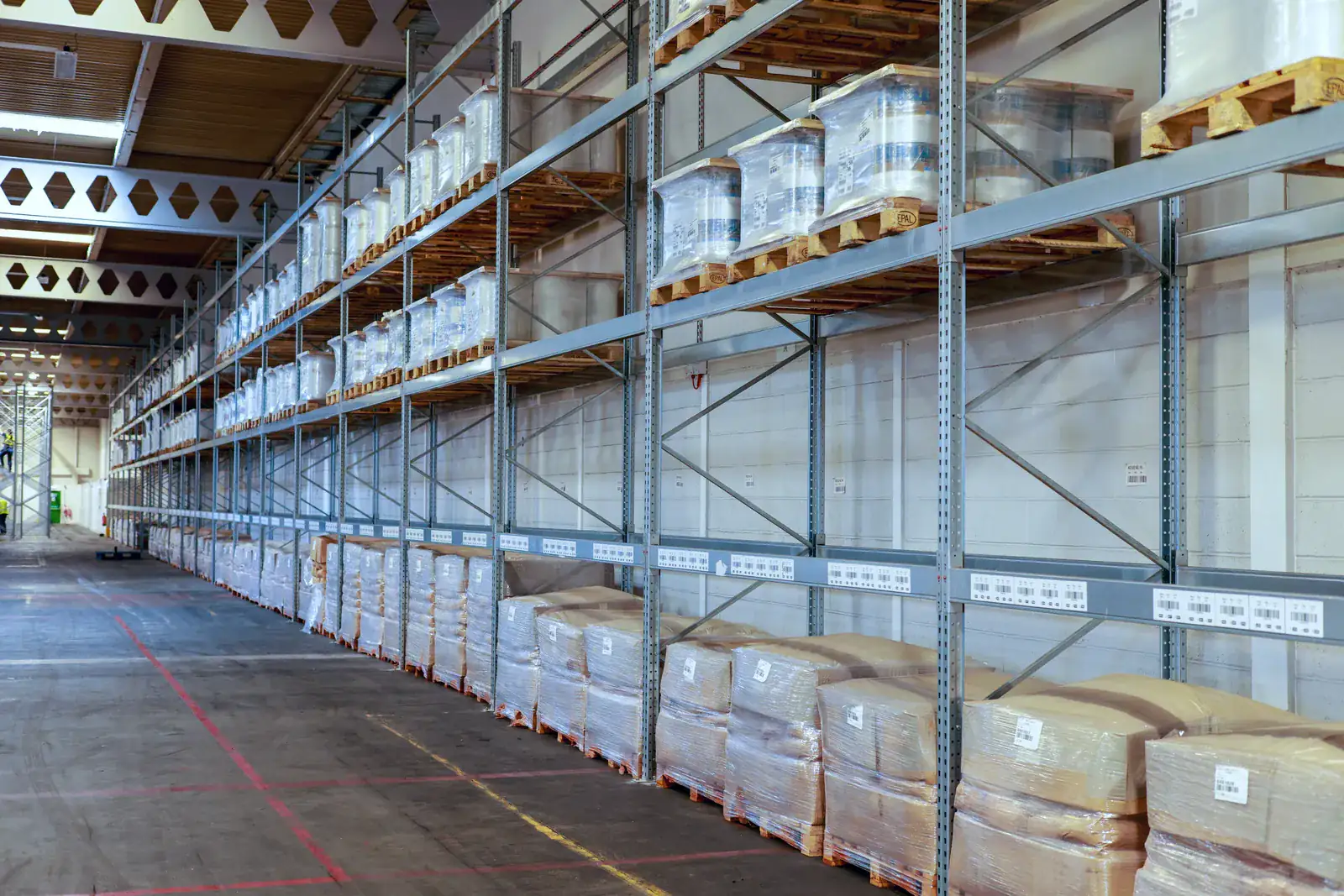
Long run of galvanised pallet racking with bay labels in a distribution warehouse
Frame depth
900 / 1100mm
Beam length
1500 to 5000mm
Beam pitch
50 to 75mmsteps, by manufacturer
Systems supplied
9
Lead time, new
4 to 8 wks

What pallet racking actually is.

Pallet racking is a steel structure of upright frames joined by pairs of horizontal beams. Each pair of beams forms a level, and each level holds pallets side by side. Its job is simple: turn the height of the building into usable storage, so the floor stops doing all the work.

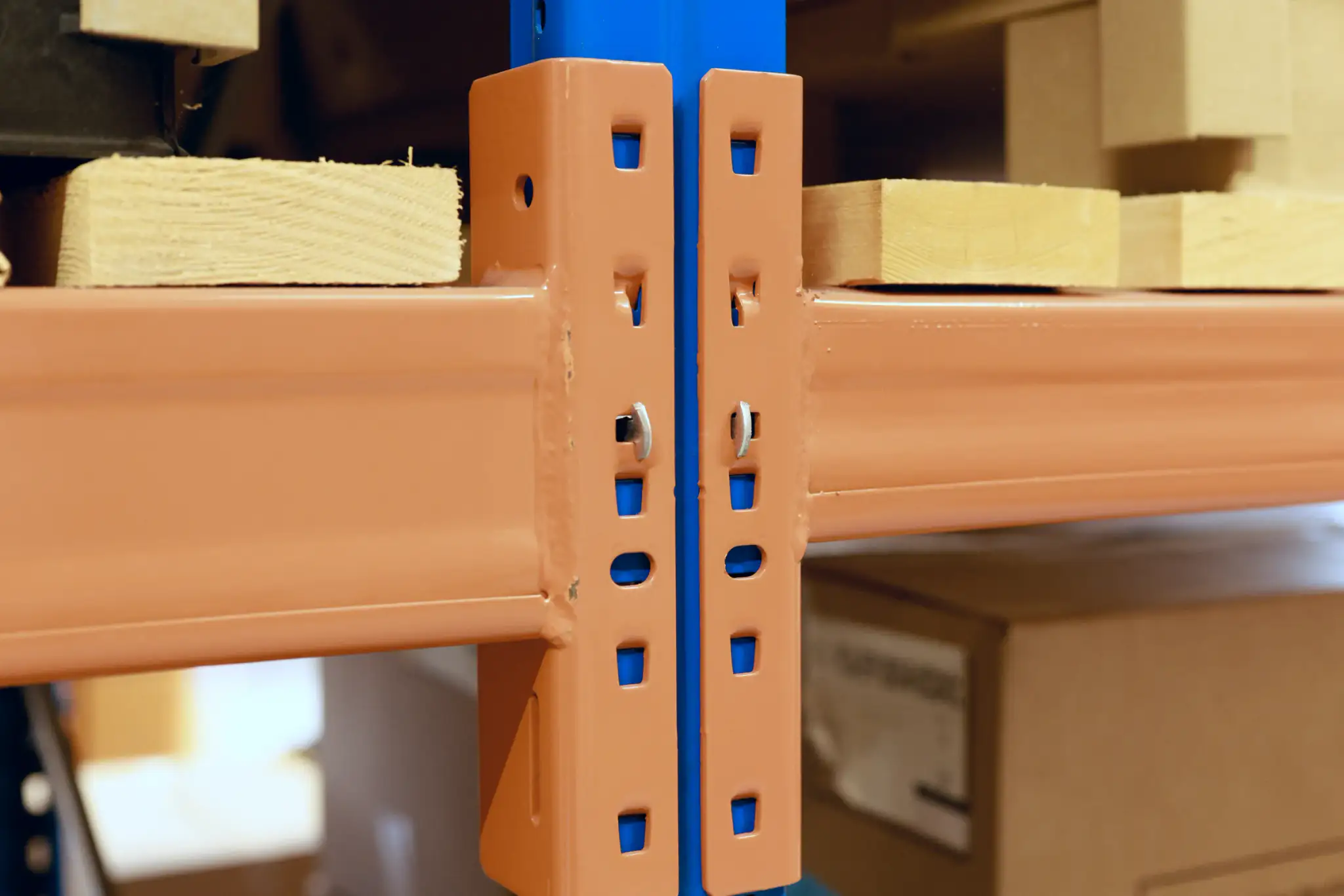
The beams hook into perforations along the upright and are locked by safety pins. Because the perforations run the full height of the frame, beam levels can be moved as stock changes. A level set for tall pallets this year can be re-pitched for shorter loads next year without buying new steel, provided the revised configuration is checked against the manufacturer's load data.

  • Upright frames: typically 900mm or 1100mm deep, with height set by the building and the truck lift.
  • Beams: typically 1500mm to 5000mm long, usually two or three pallets per level.
  • Beam pitch: adjustable in 50mm to 75mm increments depending on the manufacturer.
  • Accessories: timber or steel decking, pallet supports, frame and run end protection, anti-collapse mesh and load notices.
Close up of a pallet racking beam connector with timber decking

Four questions decide the system.

Every racking decision is a trade-off between four things. You cannot maximise all of them at once, so the survey starts by asking which one your operation can least afford to lose.

Storage density

How many pallets fit on the floor you have. Removing or narrowing aisles raises it, at the cost of access.

Pallet selectivity

What share of pallets you can reach without moving another. Adjustable and narrow aisle racking give 100 percent; double deep gives 50 percent.

Stock rotation

First in, first out (FIFO) for date coded stock, or last in, first out (LIFO) where age does not matter. Some systems fix this in their geometry.

Handling equipment

The trucks already on site. Some systems need telescopic forks or guided trucks, which is a budget line in its own right.

A site holding thousands of product lines with one or two pallets each needs selectivity, which points to adjustable or narrow aisle racking. A site holding a few lines in hundreds of pallets needs density, which points to drive-in, push back or a pallet shuttle. Most real warehouses are a mix, and the best layouts often combine two systems in one building.

The nine pallet racking systems we supply.

Each system below has its own page with full specifications, aisle widths and the cases where it is the wrong answer. Start with the stock profile, not the product.

Adjustable pallet racking

Also called wide aisle racking

Frame depth
900 or 1100mm
Beam length
1500 to 5000mm
Selectivity
100%

Every pallet is directly accessible from the aisle, one pallet deep. It is the default system and the most widely installed, because it suits the widest range of stock. Beam levels reposition in 50 to 75mm increments depending on the manufacturer, so the system adapts as the stock changes.

Not for: Operations with very few SKUs and hundreds of pallets each, where the aisles are paying for access nobody uses.

Adjustable pallet racking: specifications and limits

Narrow aisle racking

Same structure, half the aisle

Aisle width
1.6 to 1.9m
Versus counterbalance
Roughly half
Guidance
Wire or rail

The same structure as adjustable pallet racking with the aisles compressed to the minimum a guided truck needs. It recovers a large share of the floor given to aisles while keeping every pallet accessible. It needs wire or rail guidance and a floor flat enough to run guided trucks safely at height.

Not for: Buildings with an uneven or untested floor slab, or fleets with no route to guided trucks.

Narrow aisle racking: specifications and limits

Drive-in and drive-through racking

Aisles removed entirely

Rotation
LIFO or FIFO
Density
Highest static
Damage risk
High, protect ends

The truck drives into the lane and pallets rest on continuous steel rails. Drive-in is loaded and unloaded from one face and runs last in, first out. Drive-through is open at both ends and runs first in, first out. It is strongest in cold stores and freezers, where cubic space is expensive, and for seasonal or bulk single-product stock.

Not for: High SKU counts. One product per lane means the lane count caps your SKU count, and trucks entering lanes cause most of the impact damage we repair.

Drive-in and drive-through racking: specifications and limits

Double deep racking

Two rows back to back

Selectivity
50%
Rotation
LIFO
Truck
Telescopic forks

Two rows are placed back to back so pallets are stored two deep from a single aisle, roughly halving the aisle count. It needs a reach truck with telescopic or pantograph forks to reach the rear position, which is a real budget line that most suppliers fail to mention.

Not for: Sites with a single pallet per SKU, or fleets that cannot be upgraded to telescopic forks.

Double deep racking: specifications and limits

Push back racking

Gravity does the retrieval

Depth, carts
4 to 6 pallets
Depth, rollers
Up to 10
Rotation
LIFO

Pallets sit on nested wheeled carts or full-width inclined roller beds and are loaded and picked from one face. Each new pallet pushes the row back up the incline. Removing the front pallet lets the rest roll forward under gravity at a controlled rate. It works with standard trucks.

Not for: Strict first in, first out stock. It is last in, first out by design, and the cart variant will not accept mixed pallet sizes.

Push back racking: specifications and limits

Pallet live and gravity flow racking

Automatic FIFO, no operator input

Rotation
FIFO, automatic
Aisles
Input and output
Control
Brake rollers

Inclined roller lanes are loaded at the high end from a dedicated input aisle and picked at the low end from a separate output aisle, with brake rollers and speed controllers regulating descent. Rotation is first in, first out with no operator intervention, and goods-in traffic is separated from goods-out.

Not for: Slow moving stock. Lanes tie up capacity per SKU and only pay when the product turns.

Pallet live and gravity flow racking: specifications and limits

Mobile pallet racking

Very high density with full selectivity

Cold store
To minus 30C
Selectivity
100%
Standard
BS EN 15095

Racking is mounted on powered mobile bases running on rails set flush into the floor slab, with only one aisle open at a time. It gives very high density while keeping every pallet accessible, which is the key advantage over drive-in. Compacting the footprint also reduces the volume being lit, heated or refrigerated.

Not for: High throughput operations. Waiting for an aisle to open is a real cost when movements per hour are high.

Mobile pallet racking: specifications and limits

Cantilever racking

For stock that will never fit a pallet

Stock
Timber, bar, tube, sheet
Arms
Height adjustable
Outdoor
Galvanised, roofed

Arms project from a central column with no front upright obstructing the load, so long lengths load sideways along their length. Single-sided against a wall or double-sided and freestanding. Galvanised for outdoor use, with optional roofing and cladding that turns unused yard into covered storage.

Not for: Palletised goods. A pallet on cantilever arms wastes both the arm capacity and the height.

Cantilever racking: specifications and limits

Coil racking and cradle storage

Cylindrical loads that cannot sit on a flat beam

Load type
Coil, reel, cylinder
Support
Shaped cradle
Access
Ram or crane

Heavy duty cradles hold steel coil, reels and cylindrical loads that cannot sit safely on a flat beam. The cradle stops rolling and spreads the point load, and is specified on coil diameter, width and weight.

Not for: Anything that sits stably on a flat beam. A cradle costs more and stores less per bay.

Coil racking and cradle storage: specifications and limits

Holding many pallets of each product and want rotation set in software rather than geometry? A pallet shuttle system runs inside deep lane racking and keeps the forklift at the lane face.

The nine side by side.

Rotation, selectivity, density, aisle and truck class for each system. The full interactive version with filters is in the racking system comparison.

Pallet racking systems compared. Aisle widths are working ranges in metres, confirmed at survey.
SystemRotationSelectivityDensityAisleTruck class
Adjustable pallet rackingEither100%Low2.7 to 4.2mCounterbalance or reach
Narrow aisle rackingEither100%Medium1.6 to 1.9mGuided VNA, man-up or man-down
Drive-in and drive-through rackingLIFO or FIFOPer laneVery highNone within blockCounterbalance or reach into lane
Double deep rackingLIFO50%Medium2.9 to 3.4mReach truck with telescopic forks
Push back rackingLIFOPer laneHigh2.7 to 4.2mStandard, no specialist truck
Pallet live and gravity flow rackingFIFOPer laneHighSeparate in and outStandard at each face
Mobile pallet rackingEither100%Very highOne open aisleCounterbalance or reach
Cantilever rackingEither100%Low3.0 to 4.5mSideloader or counterbalance
Coil racking and cradle storageEither100%Low3.0 to 4.2mCounterbalance with coil ram or crane

Pallet racking systems compared. Aisle widths are working ranges in metres, confirmed at survey.

Adjustable pallet racking
Either
Narrow aisle racking
Either
Drive-in and drive-through racking
LIFO or FIFO
Double deep racking
LIFO
Push back racking
LIFO
Pallet live and gravity flow racking
FIFO
Mobile pallet racking
Either
Cantilever racking
Either
Coil racking and cradle storage
Either

Filter by FIFO or LIFO and sort by density in the racking system comparison, or estimate positions for your building with the warehouse space calculator.

Aisle width by truck class.

Aisles are the biggest single use of floor in most racked warehouses, and their width is set by the truck. Change the truck class and you change how much of the building stores pallets.

These are working ranges for layout, not design figures. Load overhang, mast type and turning method move them, so the final figure is confirmed against your fleet at survey. Moving from counterbalance to guided narrow aisle trucks roughly halves the aisle.

Aisle width by truck class, in metres.
Truck classAisle widthNote
Counterbalance3.5 to 4.2mStandard forklift, no guidance, most flexible on mixed duties.
Reach truck2.7 to 3.2mThe usual choice for adjustable pallet racking at height.
Reach, telescopic forks2.9 to 3.4mNeeded for double deep. A fleet decision as much as a racking one.
Articulated1.8 to 2.1mWorks aisle and yard, no guidance required.
Guided narrow aisle1.6 to 1.9mWire or rail guidance and a flat floor survey required.

Aisle width by truck class, in metres.

Counterbalance
3.5 to 4.2m
Reach truck
2.7 to 3.2m
Reach, telescopic forks
2.9 to 3.4m
Articulated
1.8 to 2.1m
Guided narrow aisle
1.6 to 1.9m

New or fully refurbished used.

Both are supplied, and both carry load ratings. The choice is about budget, lead time and whether a matching system is available, not about safety.

New racking

Specified to the exact frame heights, beam lengths and finish your layout needs, with a full manufacturer warranty and design data. Typical lead time is 4 to 8 weeks from order. It is the right route for large layouts, unusual sizes, galvanised finishes and any project where every component must come from one current series.

  • Any height or beam length in the manufacturer range
  • Current design data and load notices
  • Galvanised and cold store finishes available

Used racking

Recovered from dismantled sites, inspected, sorted by manufacturer and series, and rejected where damaged. It suits smaller budgets, extensions to an existing run of the same make, and fast moves where new steel would take weeks. Every used bay is supplied as a matched set, never as mixed components.

  • Inspected and matched to a single manufacturer
  • Damaged components rejected at the yard
  • Often available from stock

Used pallet racking · Sell us your racking

Dexion, Link 51, Apex and the rest.

We supply and identify racking from Dexion, Link 51, Apex, Esnova and Sperrin, plus other systems found in older Welsh warehouses.

Components are not interchangeable between manufacturers. Upright profiles, perforation patterns, beam connectors and baseplates all differ, and a beam that appears to fit a foreign upright has no load rating in it. That is why identification comes before any extension, repair or spares quotation on an older installation.

If you are not sure what you have, photograph the upright face straight on including the perforations, a beam end connector with the safety pin visible and the baseplate, then measure the upright depth and beam length. The rack identification guide shows what to look for.

Dexion racking

One of the most common systems in UK warehouses, with several generations of upright and beam still in service.

Link 51 racking

Widely installed in distribution and manufacturing sites, identified by its own upright and connector pattern.

Apex racking

Found across older and newer sites. Matching the series matters before any extension.

Esnova and Sperrin

Supplied new and identified on existing installations, with spares sourced to match.

Three questions before you order.

The ones we are asked on almost every survey. The honest answers protect you from the most common expensive mistakes.

What load can my racking take?

Only the manufacturer's design data for your exact configuration can say: frame type, beam section, beam length, number of levels and the pitch between them. The answer is written on the load notice at the end of each run. If there is no notice, the run has no known rating and should be assessed before it is loaded further.

Safe working load per beam level: From the manufacturer's design data for your configuration

Can we extend it later?

Yes, if the extension matches the original manufacturer and series. Extension bays share a frame with the run they join, so mixed makes are not an option. Leave space at the end of runs and in the floor plan for growth, and keep the layout drawing so the next bay can be specified without a fresh survey.

Will it work with our existing forklifts?

Adjustable, drive-in and push back racking all work with standard counterbalance and reach trucks. Double deep needs telescopic or pantograph forks. Narrow aisle racking needs guided trucks. Top beam height is set by your truck's lift height and the clearances in EN 15620, so we survey the fleet before drawing anything.

How much pallet racking costs.

Price follows the system and the number of positions more than anything else. Adjustable racking is the lowest cost per position; deep lane and powered systems cost more per position and save it back in floor area.

Every quotation itemises steel, decking, protection, installation and removal of any old racking, and offers a used alternative where one exists. The bands here are indicative only. A survey turns them into a priced layout.

Indicative cost bands, supplied and installed. The survey quotation prices your building.
SystemIndicative band
Used adjustable pallet rackingLowest, often well below new
New adjustable pallet rackingTens of pounds per position
Narrow aisle rackingSimilar steel, plus guidance and trucks
Double deep rackingSimilar steel, plus telescopic forks
Drive-in and push backHigher per position, fewer aisles
Mobile and pallet liveHighest static, priced per lane or base

Indicative cost bands, supplied and installed. The survey quotation prices your building.

Used adjustable pallet racking
Lowest, often well below new
New adjustable pallet racking
Tens of pounds per position
Narrow aisle racking
Similar steel, plus guidance and trucks
Double deep racking
Similar steel, plus telescopic forks
Drive-in and push back
Higher per position, fewer aisles
Mobile and pallet live
Highest static, priced per lane or base

From survey to first inspection.

The same six stages on every project, whether it is ten bays or a full building. Installation is by SEIRS registered teams working to SEMA codes of practice.

  1. Step 1

    Survey

    We measure the building and learn how the operation runs before mentioning a product.

  2. Step 2

    Design

    Layout, system selection and a capacity figure, drawn in CAD against your trucks and stock.

  3. Step 3

    Quote

    An itemised price covering protection, decking and installation, with alternative routes.

  4. Step 4

    Install

    SEIRS registered teams, phased around a live operation with RAMS issued before attendance.

  5. Step 5

    Sign-off

    Load notices, layout drawings and handover documentation, walked through on site.

  6. Step 6

    Inspect

    Your first annual inspection date is set at handover so nothing lapses quietly.

See how installation is phased around a live operation on racking installation, and how inspection keeps the rating valid on racking inspections.

Pallet racking questions, answered with numbers.

Upright frames are typically 900mm or 1100mm deep, matched to the pallet depth and how it overhangs the beams. Beam lengths typically run from 1500mm to 5000mm, and beam levels adjust on the upright in 50 to 75mm increments depending on the manufacturer. Frame height is set by the building, the truck lift height and the clearances required under EN 15620.

It depends on the manufacturer, the beam section, the beam length, the frame and the spacing between levels. The rating comes from the manufacturer's design data for that exact configuration and is written on the load notice fixed to the end of the run. We do not quote a generic figure, because the same beam carries a different load on a different frame or pitch.

It is set by the truck, not the racking. Working ranges are 3.5 to 4.2m for counterbalance trucks, 2.7 to 3.2m for reach trucks, 2.9 to 3.4m for reach trucks with telescopic forks, 1.8 to 2.1m for articulated trucks and 1.6 to 1.9m for guided narrow aisle trucks. The exact figure is confirmed at survey against your fleet, mast type and pallet size.

No. Dexion, Link 51, Apex, Esnova, Sperrin and other systems use different upright profiles, perforation patterns and beam connectors. A beam from one manufacturer in a frame from another cannot be load rated with confidence. We identify the system you have before quoting any extension, repair or spares.

Used racking is safe when it is inspected, matched to a single manufacturer and supplied with load ratings from that manufacturer's data. It typically costs a fraction of new. Damaged or unidentifiable components should never go back into service, and we reject them at the yard rather than on your floor.

Yes, provided the extension uses the same manufacturer and a compatible component series, and the layout leaves space for it. Extension bays share an upright with the existing run, so the identification of the original system comes first. Planning the end of a run against a future extension at design stage saves a later rebuild.

Usually, if the layout is drawn around them. Adjustable pallet racking, drive-in and push back all work with counterbalance and reach trucks. Double deep needs telescopic or pantograph forks, and narrow aisle racking needs dedicated guided trucks. We list your fleet at survey and say plainly if a system needs a different truck.

Lead time for new pallet racking is typically 4 to 8 weeks from order, depending on manufacturer and finish. Installation of a few hundred positions often takes days rather than weeks, and larger projects are phased around a live operation by SEIRS registered installers. Pallet shuttle systems are longer, at 12 to 16 weeks.

Cost depends on the system, the number of positions, heights, protection and whether the steel is new or used. As an indicative band, new adjustable pallet racking is usually priced in tens of pounds per pallet position supplied, with installation, decking and protection on top, and used racking typically comes in well below that. A free site survey gives you a priced layout rather than a band.

Yes. HSE guidance HSG76 and EN 15635 call for regular recorded visual checks by a Person Responsible for Racking Safety, often weekly, and an expert inspection at least every 12 months. Racking is work equipment under PUWER 1998. We set your first inspection date at handover.

Bring your stock profile and your truck list.

Pallets per SKU and the trucks you run decide the system. We will lay out the right candidates over your building and give you a capacity figure and price for each. No charge, no obligation.