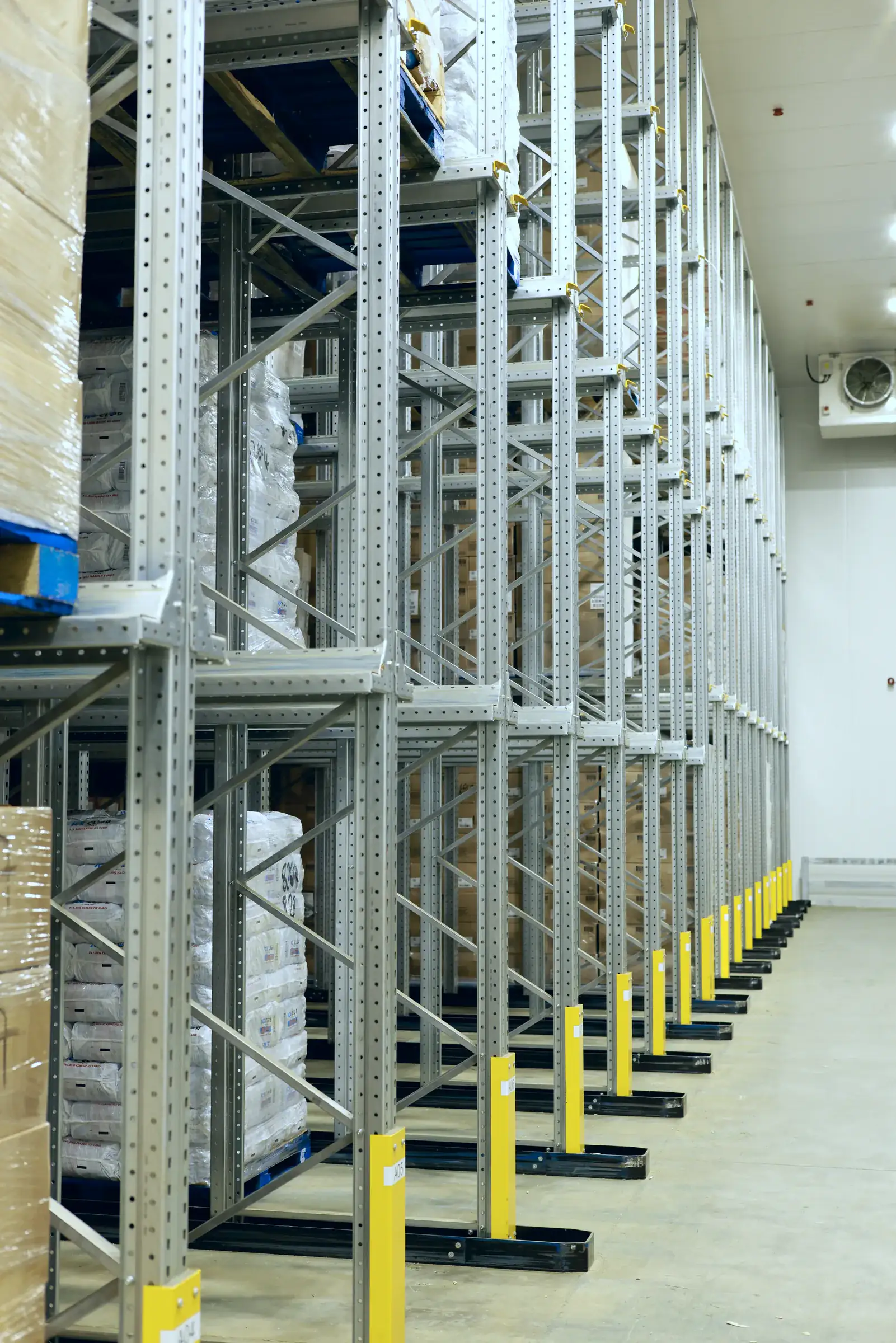
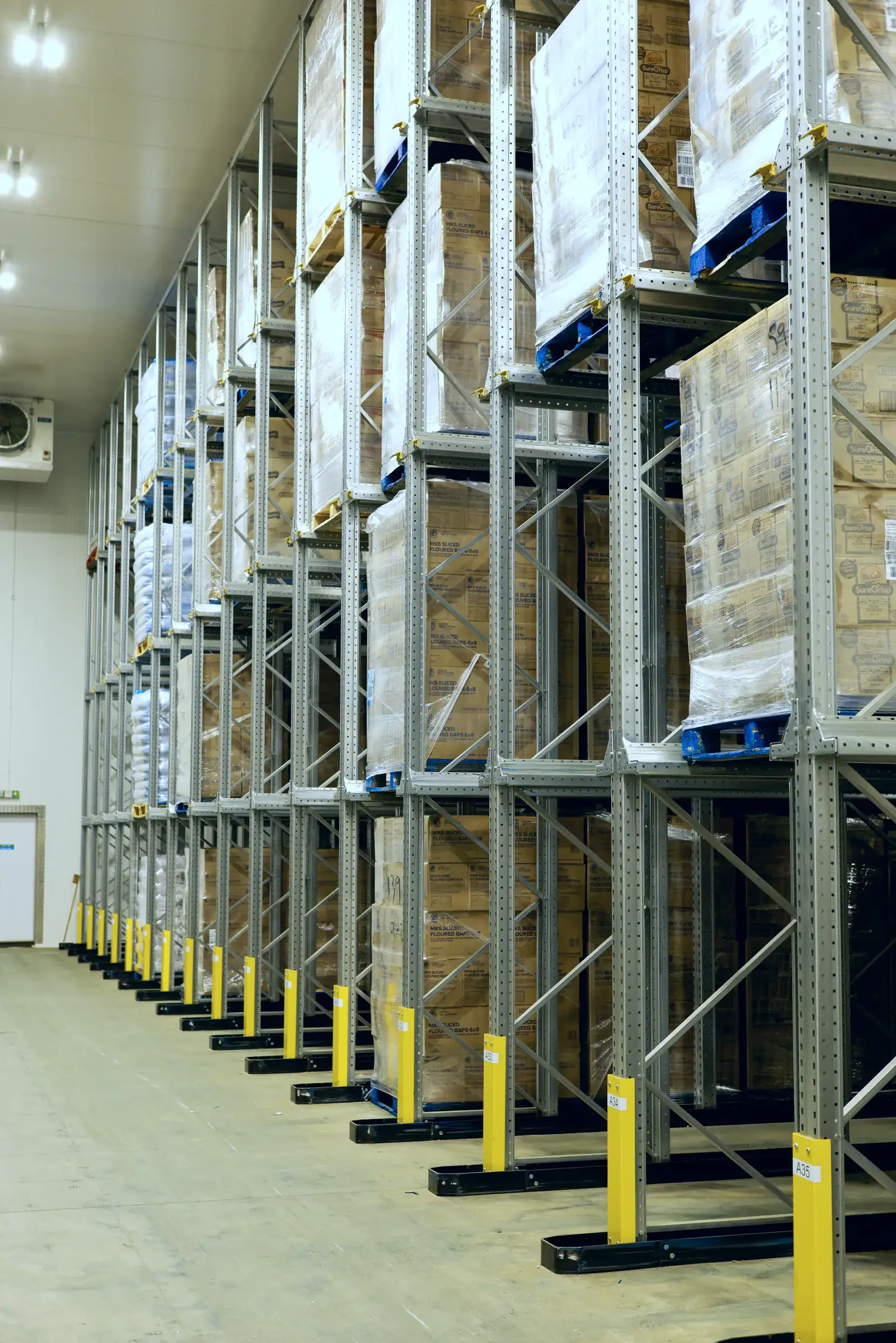
Drive in racking. The aisles become storage.
Drive-in and drive-through racking remove the aisles entirely. The truck drives into the lane and pallets rest on continuous steel rails either side. It is the highest density of any static racking system.
One product per lane. Few SKUs, many pallets each, and the density is hard to beat.
- Density
- Highest static
- Aisles in block
- None
- Drive-in rotation
- LIFO
- Drive-through rotation
- FIFO
- Products per lane
- 1
Drive-in or drive-through: decide by rotation.
The structure is almost identical. What differs is whether the back of the lane is closed, and that single choice fixes how your stock rotates for the life of the racking.
| Attribute | Drive-in | Drive-through |
|---|---|---|
| Access | One face only | Both ends of the lane |
| Stock rotation | LIFO, last in first out | FIFO, first in first out |
| Aisles needed | One, at the loading face | Two, one at each end |
| Density | Highest of any static system | Very high, less the second aisle |
| Typical stock | Bulk, seasonal, non-perishable single product | Date coded stock in quantity |
| Back of block | Against a wall or another block | Open, often a goods-out or staging area |
| Truck | Counterbalance or reach into the lane | Counterbalance or reach into the lane |
Drive-in and drive-through racking compared.
- Access
- One face only
- Stock rotation
- LIFO, last in first out
- Aisles needed
- One, at the loading face
- Density
- Highest of any static system
- Typical stock
- Bulk, seasonal, non-perishable single product
- Back of block
- Against a wall or another block
- Truck
- Counterbalance or reach into the lane
Rails, not beams.
In conventional racking a pallet sits across two beams. In a drive-in lane there is nothing across the front, because the truck has to drive through. Pallets rest instead on continuous steel rails running the depth of the lane, supported at each frame by rail arms.
The truck enters the lane, lifts the pallet above its rail level and sets it down at the back of the lane on its edges. The next pallet goes in front of it. Levels stack above one another with rails at each level, and floor guide rails at the base steer the truck in on line and keep it off the uprights.
Because the pallet bears on its edges, pallet type, condition and orientation all matter. They are recorded at survey so the rail profile suits what you actually use.
- Continuous pallet rails on each level
- Floor guide rails at the lane base
- Top ties and back bracing for stability
- Lane entry protection on the loading face
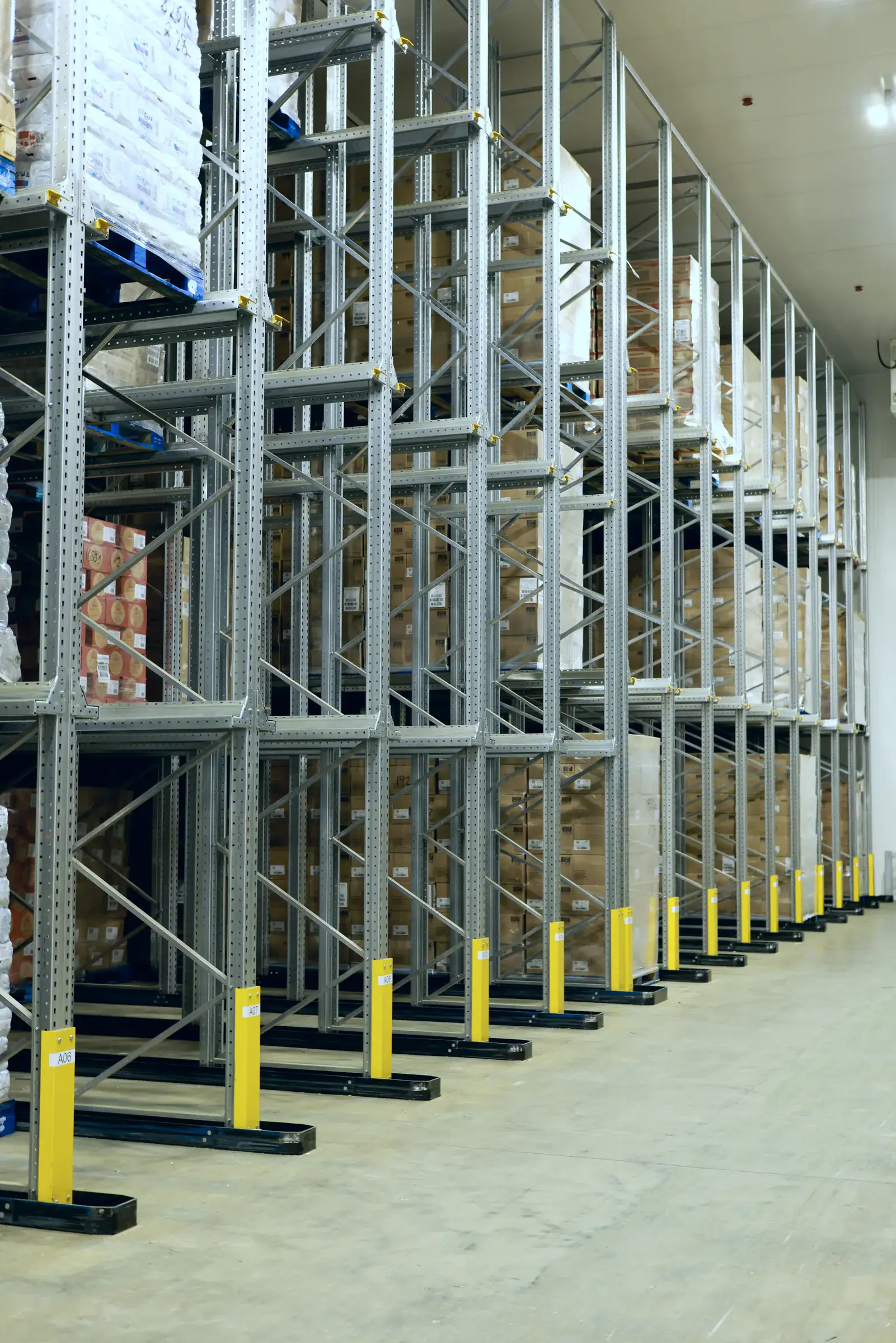
Strongest where space costs most to chill.
In a cold store or freezer every cubic metre is refrigerated whether it holds stock or an aisle. Drive-in takes the aisles out of the volume you pay to chill.
That is why drive-in is common in frozen food, ice cream and chilled distribution, and for seasonal or bulk single-product stock in ambient warehouses. Where cold store lanes need FIFO or the truck should stay out of the cold lane, a pallet shuttle runs inside the same kind of block.
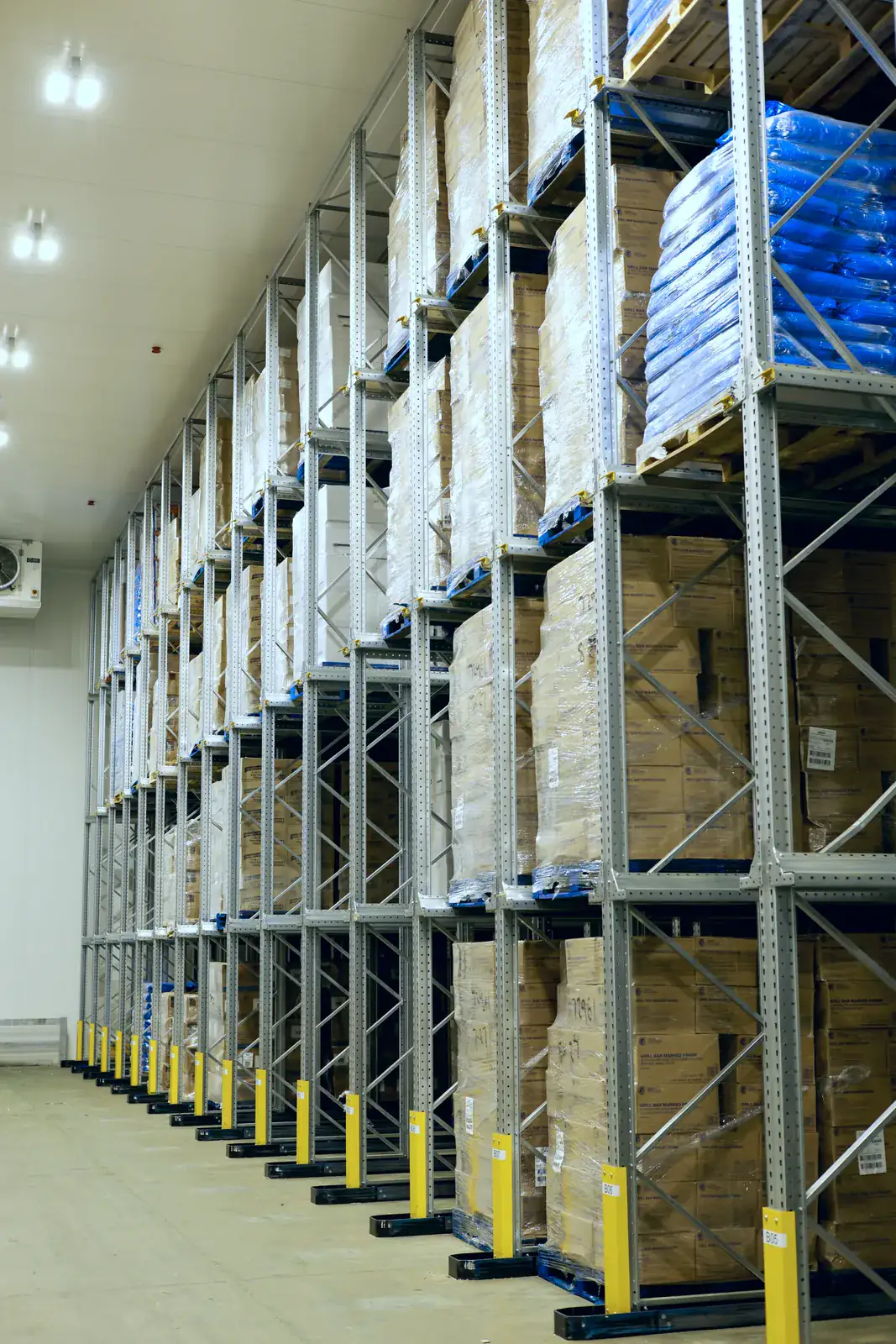
Drive-in racking specification.
Published working figures. Lane widths, depths and rail heights are set from your pallets and truck data at survey.
| Attribute | Typical |
|---|---|
| Aisles within the block | None |
| Rotation | Drive-in LIFO, drive-through FIFO |
| Products per lane | One |
| Selectivity | Per lane, front pallet only |
| Lane depth | Sized to pallets per SKU |
| Pallet support | Continuous steel rails on rail arms |
| Trucks | Counterbalance or reach, must clear lane and lowest rail |
| Protection | Lane entry guards and floor guide rails |
| Lead time, new | 4 to 8 weeks from order |
Drive-in and drive-through racking. Typical figures; final design from the manufacturer's data.
- Aisles within the block
- None
- Rotation
- Drive-in LIFO, drive-through FIFO
- Products per lane
- One
- Selectivity
- Per lane, front pallet only
- Lane depth
- Sized to pallets per SKU
- Pallet support
- Continuous steel rails on rail arms
- Trucks
- Counterbalance or reach, must clear lane and lowest rail
- Protection
- Lane entry guards and floor guide rails
- Lead time, new
- 4 to 8 weeks from order
Load per pallet position: From the manufacturer's design data for your lane
When drive-in is the wrong answer.
Drive-in is dense because it gives up almost everything else. These are the costs that rarely make it into a quotation.
High SKU counts
Part-empty lanes
Impact damage
Strict FIFO from one face
Slow truck cycles
Weak or mixed pallets
Drive-in for the bulk lines, wide aisle for the rest.
A Port Talbot warehouse where a handful of products made up most of the pallets. Drive-in lanes took the bulk lines and adjustable racking kept full selectivity for everything else, on the existing counterbalance fleet.
Distribution and logistics · Port Talbot · Drive-in and adjustable pallet racking
Drive-in racking for the high volume lines
One product per lane with many pallets each. Aisles removed entirely within the block.
Adjustable pallet racking for mixed lines
Every pallet directly accessible from the aisle, the right choice for many SKUs with few pallets each.
Rack protection on drive-in lane entries
Trucks entering lanes cause most of the impact damage we repair.
They asked how many pallets of each product we hold before they drew a single aisle.
- Before
- 1,180 pallet positions
- After
- 1,870 pallet positions
- Floor recovered
- 27%
- Install time
- 8 days
Against the other deep lane systems.
If drive-in is on your list, these three are usually on it too. The difference is where the truck goes and how the stock rotates.
| Attribute | Drive-in | Push back | Pallet live | Pallet shuttle |
|---|---|---|---|---|
| Rotation | LIFO, or FIFO drive-through | LIFO | FIFO, automatic | Software selected |
| Truck enters lane | Yes | No | No | No |
| Lane depth | Sized to SKU | 4 to 6 carts, up to 10 rollers | Sized to throughput | 30 to 50 pallets |
| Products per lane | One | One per level | One | One |
| Damage exposure | High | Low | Low | Low |
Deep lane systems compared.
- Rotation
- LIFO, or FIFO drive-through
- Truck enters lane
- Yes
- Lane depth
- Sized to SKU
- Products per lane
- One
- Damage exposure
- High
Read push back racking, pallet live racking and pallet shuttle systems, protect lane entries with rack protection, or see all nine on pallet racking systems.
Lane entry guards and upright protectors
Upright protectors, barriers and safety signage for drive-in lane entries are stocked in the racking and shelving and safety departments at palletrackingwales.shop.
- Racking & shelving (opens the online store in a new tab)
- Storage (opens the online store in a new tab)
- Safety & premises (opens the online store in a new tab)
- Trucks & trolleys (opens the online store in a new tab)
- Steps & ladders (opens the online store in a new tab)
- Lifting, drum & cylinder (opens the online store in a new tab)
- Workshop & environment (opens the online store in a new tab)
- Office & mailroom (opens the online store in a new tab)
Drive-in racking questions.
Drive-in racking is closed at the back and loaded and unloaded from one face, so it runs last in, first out (LIFO). Drive-through racking is open at both ends: pallets go in at one face and come out at the other, so it runs first in, first out (FIFO). Drive-through needs an aisle at each end of the block.
One product per lane, so your SKU count is capped by your lane count. A block of 10 lanes at 4 levels gives you 40 lane positions, and each should hold a single product. Mixing products in one lane means moving pallets to reach the one behind.
Lane depth is set by your pallets per SKU, the truck and the building, not by a fixed limit. Deep lanes only pay when they fill with the same product. A partly empty lane cannot take another product, so lanes are sized to the quantities you actually hold. Beyond a practical depth, a pallet shuttle keeps the truck out of the lane entirely.
Yes, and it is one of the strongest applications. Removing aisles means less refrigerated volume per pallet, which matters when cubic space is expensive to chill. The structure is specified for the temperature, and trucks and operators must be suited to working inside the lanes in the cold.
A standard counterbalance or reach truck that fits inside the lane. The truck's width, overhead guard height and mast must clear the lane and the lowest rail level, and these are checked against the truck data at survey. No telescopic forks or guided trucks are required.
Because the truck drives inside the structure. Every movement passes between uprights, and lane entries take most of the impacts. Lane entry protection, floor guide rails, trained drivers and regular inspection are part of the specification, not extras. Damage is assessed against the limits set by your inspector.
Both are LIFO and both store pallets several deep. Drive-in is denser and goes deeper, but the truck enters the lane. Push back keeps the truck at the face, with pallets on carts 4 to 6 deep or rollers up to 10 deep, and allows a different product on each level of each lane.
Often, where the rail profile and structure suit a two-way pallet shuttle. Compatibility is verified on site before anything is quoted. A shuttle lets the lane run FIFO or LIFO in software and keeps the forklift out of the racking.
Count your pallets per product first.
Drive-in pays when a few products account for most of your pallets. Send us the stock profile and we will show you how many lanes it fills, and what the rest of the stock needs.