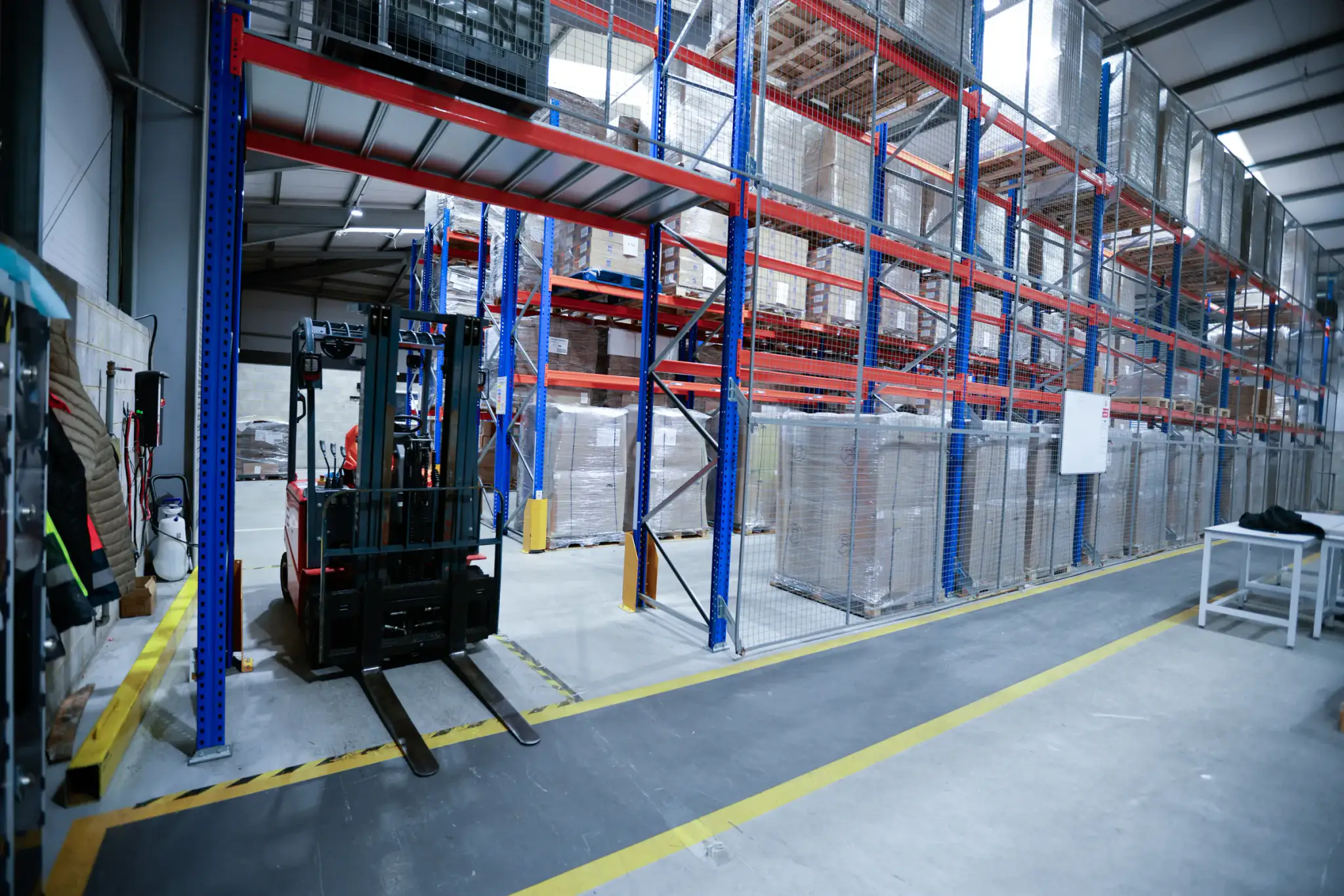
Adjustable pallet racking. Every pallet one move from the aisle.
The default and most widely installed racking system, also called wide aisle racking. Every pallet sits one deep and is directly accessible from the aisle, so you never move one pallet to reach another.
Lowest density of the nine systems. Highest flexibility. Works with the trucks you already own.
- Selectivity
- 100%
- Frame depth
- 900 / 1100mm
- Beam length
- 1500 to 5000mm
- Beam pitch
- 50 to 75mm
- Aisle, reach truck
- 2.7 to 3.2m
Frames, beams and a level you can move.
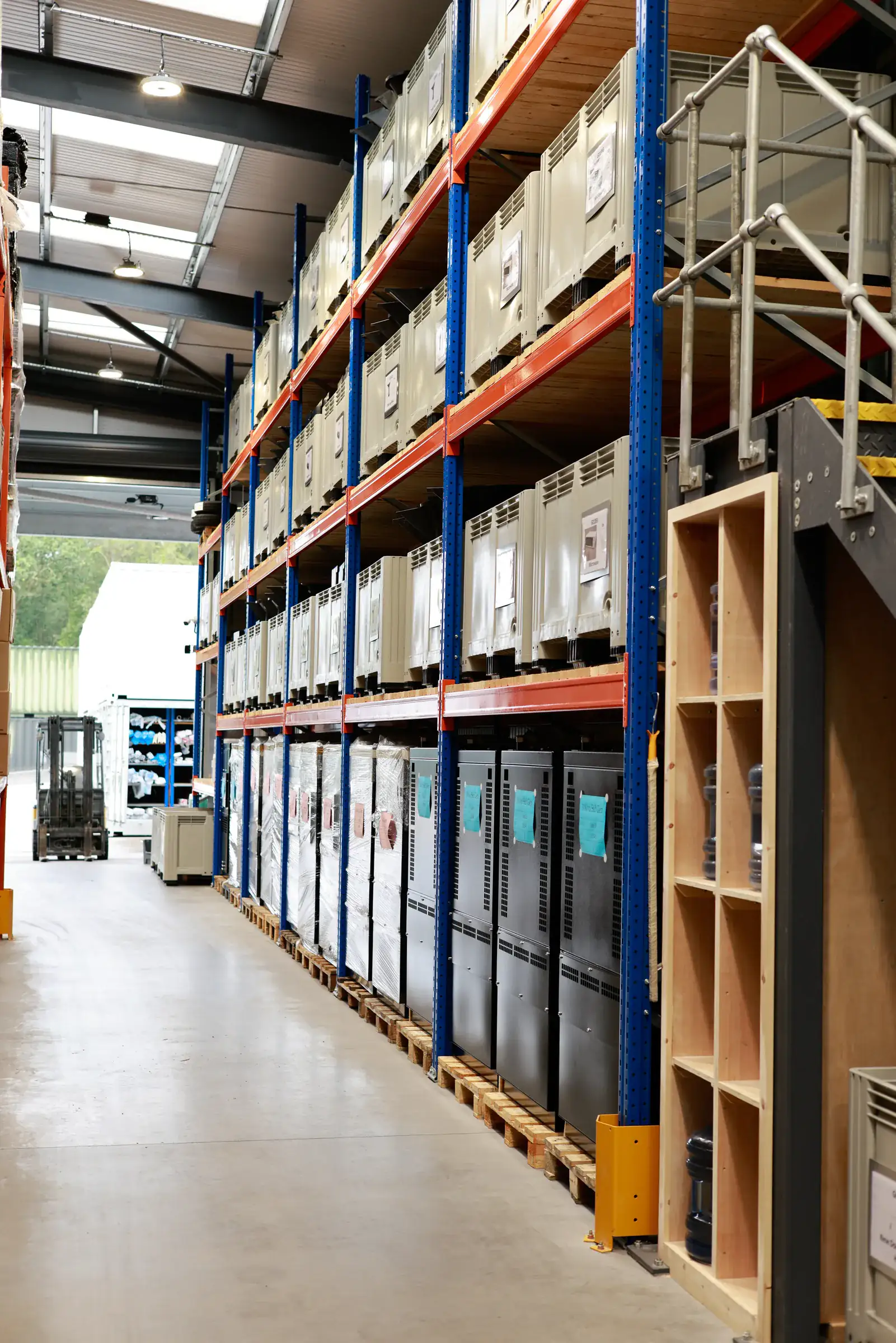
Two upright frames and a pair of beams make a bay. Bays share frames along a run, and runs face each other across an aisle. Each beam pair carries a row of pallets, usually two or three per level.
The adjustable part is the beam. Connectors on each beam end hook into perforations running the full height of the upright and are locked with a safety pin. When your stock changes height, the levels move with it, in 50 to 75mm steps depending on the manufacturer. A layout drawn for tall pallets of bulk goods can be re-pitched for shorter mixed loads without replacing steel.
Where loads do not sit squarely on a pallet, timber or steel decking turns a beam level into a shelf. Stillages, cages and drums go on decking or pallet supports rather than straight onto beams.
- Pallet rack beams in pairs, locked with safety pins
- Timber, steel or mesh decking for non-pallet loads
- Frame and run end protection at aisle ends
- Load notices on every run, from the design data
Adjustable pallet racking specification.
Published working ranges. Final sizes are set against your building height, pallets and trucks at survey.
| Attribute | Typical range |
|---|---|
| Upright frame depth | 900mm or 1100mm |
| Beam length | 1500mm to 5000mm |
| Pallets per level | Usually 2 or 3 |
| Beam pitch adjustment | 50mm to 75mm increments, by manufacturer |
| Selectivity | 100 percent |
| Stock rotation | FIFO or LIFO, set by your process |
| Aisle, counterbalance | 3.5 to 4.2m |
| Aisle, reach truck | 2.7 to 3.2m |
| Aisle, articulated | 1.8 to 2.1m |
| Lead time, new | 4 to 8 weeks from order |
| Manufacturers | Dexion, Link 51, Apex, Esnova, Sperrin and others |
Adjustable pallet racking. Typical ranges; final figures from the manufacturer's design data.
- Upright frame depth
- 900mm or 1100mm
- Beam length
- 1500mm to 5000mm
- Pallets per level
- Usually 2 or 3
- Beam pitch adjustment
- 50mm to 75mm increments, by manufacturer
- Selectivity
- 100 percent
- Stock rotation
- FIFO or LIFO, set by your process
- Aisle, counterbalance
- 3.5 to 4.2m
- Aisle, reach truck
- 2.7 to 3.2m
- Aisle, articulated
- 1.8 to 2.1m
- Lead time, new
- 4 to 8 weeks from order
- Manufacturers
- Dexion, Link 51, Apex, Esnova, Sperrin and others
Load per beam level: From the manufacturer's design data for your bay. It depends on beam section, beam length, frame type and level spacing, and is printed on the load notice at the end of the run.
Moving pallet rack beams, properly.
Adjustability is the point of the system, and it is also where most self-inflicted rating problems start. This is the order we work in.
- Step 1
Check the load notice
Note the current rating and configuration for the bay before anything moves.
- Step 2
Check the new layout
Confirm the revised level positions against the manufacturer's data. Raising the first level can reduce the frame rating.
- Step 3
Unload and move
Unload the levels affected, relocate the beams and refit every safety pin.
- Step 4
Update the notice
Fit a load notice that matches the configuration on the floor, then reload.
If you have inherited racking with no load notices or a run built from more than one manufacturer, start with an inspection. Our rack identification guide explains what to photograph.
When adjustable racking is the wrong answer.
Full selectivity is paid for in floor area. If any of these describe your site, a denser system will store more for the same rent.
Few SKUs, many pallets each
Floor is the constraint
Strict FIFO at volume
Cold stores
Long or round loads
Mixed manufacturer runs
Who it suits.
Operations carrying many SKUs with few pallets per SKU, mixed stock, or uncertain growth. If you cannot predict next year's stock profile, buy the system that adapts to it.
Typical sites are general distribution, builders' and trade merchants, manufacturers holding raw materials and finished goods, and third party logistics warehouses with changing clients. It is also the usual starting point for a first racked warehouse, because it works with a standard counterbalance truck from day one.
- Pallets per SKU
- 1 to a few
- Selectivity
- 100%
- Trucks
- Any standard
- Rotation
- FIFO or LIFO
Against the neighbouring systems.
Adjustable racking is the baseline the other systems are measured against. These are the three it is most often weighed up with.
| Attribute | Adjustable | Narrow aisle | Double deep | Drive-in |
|---|---|---|---|---|
| Selectivity | 100% | 100% | 50% | Per lane |
| Density | Low | Medium | Medium | Very high |
| Rotation | Either | Either | LIFO | LIFO or FIFO |
| Aisle | 2.7 to 4.2m | 1.6 to 1.9m | 2.9 to 3.4m | None within block |
| Truck | Counterbalance or reach | Guided VNA | Telescopic forks | Counterbalance or reach |
Adjustable pallet racking against its nearest alternatives.
- Selectivity
- 100%
- Density
- Low
- Rotation
- Either
- Aisle
- 2.7 to 4.2m
- Truck
- Counterbalance or reach
Read narrow aisle racking, double deep racking and drive-in racking, or see all nine on the pallet racking systems page. Buying on a budget? Used pallet racking is matched and load rated.
Rated positions for heavy castings in Llanelli.
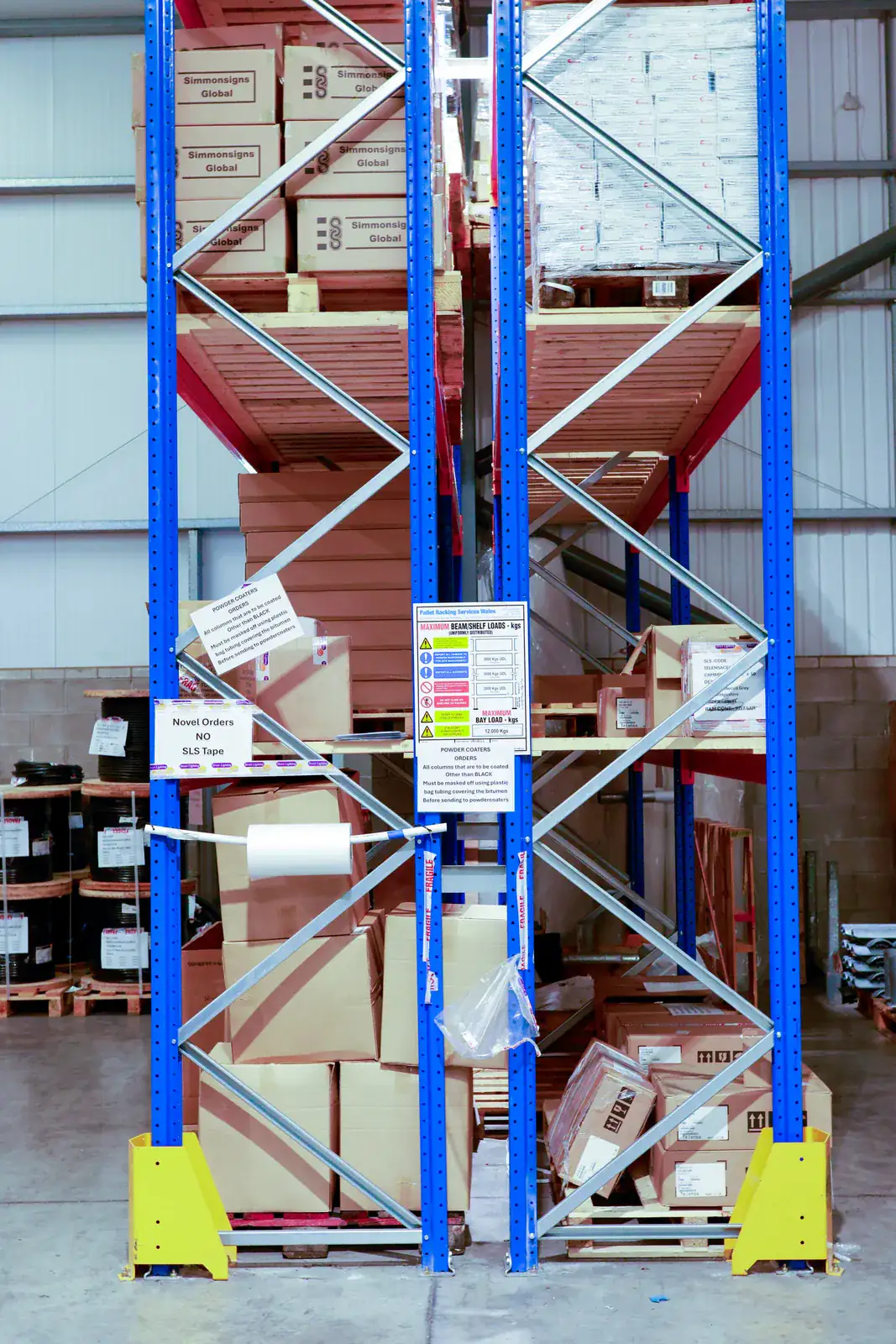
An inherited run built from more than one manufacturer, with no load notices, carrying dense castings. Replaced bay by bay with single-manufacturer adjustable racking, rated and labelled.
Manufacturing and engineering · Llanelli · Adjustable pallet racking
New adjustable pallet racking from a single manufacturer
Components are not interchangeable between manufacturers. A mixed run cannot be load rated with confidence.
Steel decking on the levels carrying irregular castings
Supports loads that do not sit squarely on a pallet.
Load notices on every run
Ratings come from the manufacturer's design data for the configuration as built.
For the first time we know exactly what each level is rated for, and it is written on the end of the run.
- Before
- 320 unrated positions
- After
- 384 rated positions
- Floor recovered
- 22%
- Install time
- 5 days
Need a few bays, not a layout
Standard adjustable pallet racking bays, extension bays, beams and decking are available off the shelf from the racking and shelving department at palletrackingwales.shop, delivered across Wales.
- Racking & shelving (opens the online store in a new tab)
- Storage (opens the online store in a new tab)
- Safety & premises (opens the online store in a new tab)
- Trucks & trolleys (opens the online store in a new tab)
- Steps & ladders (opens the online store in a new tab)
- Lifting, drum & cylinder (opens the online store in a new tab)
- Workshop & environment (opens the online store in a new tab)
- Office & mailroom (opens the online store in a new tab)
Adjustable pallet racking questions.
Yes. Adjustable pallet racking (APR) is the structure, and wide aisle racking describes the layout it is usually installed in: single deep runs served by counterbalance trucks in 3.5 to 4.2m aisles or reach trucks in 2.7 to 3.2m aisles. The same frames and beams in 1.6 to 1.9m aisles become narrow aisle racking.
Beam levels move along the upright in 50mm to 75mm increments, depending on the manufacturer's perforation pitch. Any change to level positions alters the bay's rating, so the revised configuration is checked against the manufacturer's design data and the load notice updated before stock goes back in.
Beam length is set by the number and width of pallets per level. Typical lengths run from 1500mm to 5000mm; a common bay carries two or three pallets per level. Beam section is then selected from the manufacturer's data for the load. We do not publish a generic load per beam pair, because it depends on the section, length and frame.
Frames are typically 900mm or 1100mm deep. A 1200mm deep pallet normally sits on a 1100mm frame with a small overhang front and back, and the exact choice depends on pallet orientation and how it is presented to the truck. It is confirmed at survey against the pallets you actually use.
Standard counterbalance trucks in 3.5 to 4.2m aisles and reach trucks in 2.7 to 3.2m aisles, plus articulated trucks at 1.8 to 2.1m. No guidance, telescopic forks or specialist equipment is needed, which is why it is the most widely installed system.
Either. Every pallet is directly accessible from the aisle, one pallet deep, so stock rotation is decided by your warehouse process, not by the racking. That 100 percent selectivity is the reason to choose it.
Yes, with components from the same manufacturer and series. Extension bays share a frame with the existing run, and parts are not interchangeable between manufacturers. Send photographs of the upright, beam connector and baseplate and we will identify it before quoting.
It is the lowest cost per position of the nine systems. As an indicative band, new adjustable pallet racking is usually priced in tens of pounds per pallet position supplied, with installation, decking and protection on top, and used matched racking comes in well below that. A survey gives you a priced layout.
Typically 4 to 8 weeks from order, depending on the manufacturer and finish. Used racking matched to your requirement is often available from stock and can be installed within days.
Tell us how many pallets you hold per product.
If the answer is one or two, adjustable racking is probably right and we will lay it out to the last position. If it is fifty, we will tell you that too, and show you the denser option.