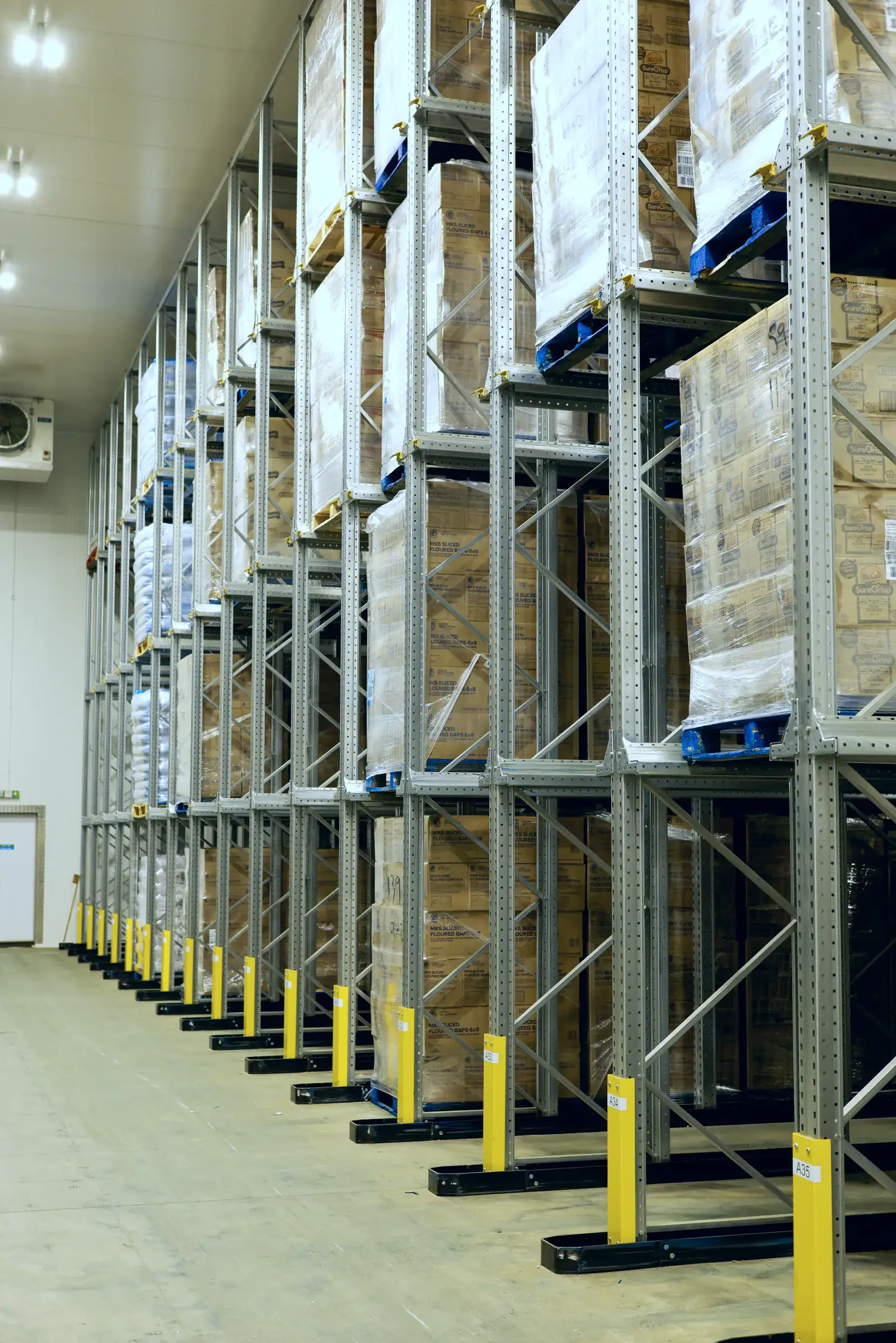
Pallet live racking. Gravity runs the rotation.
Inclined roller lanes, loaded at the high end and picked at the low end. Every pallet leaves in the order it arrived, with nobody deciding which one to take, and goods-in never shares an aisle with goods-out.
For stock where the date on the label is the thing that matters.
- Rotation
- FIFOautomatic
- Working aisles
- 2in and out
- Operator input on rotation
- None
- Lane gradient
- Manufacturer data for your pallet
Load high, pick low.
A pallet live block has no aisles inside it. Each lane is a roller track running from the input face down to the output face, and gravity does the moving. The engineering is in controlling that movement, not starting it.
- Step 1
Load at the input face
A truck in the input aisle places the pallet at the high end of the lane, centred by entry guides.
- Step 2
Controlled descent
The pallet rolls down the shallow incline. Brake rollers and speed controllers spaced along the lane hold it to a safe speed.
- Step 3
Queue at the separator
At the low end a pallet separator holds the queue back, so the front pallet can be lifted without the weight of the lane behind it.
- Step 4
Pick at the output face
A truck in the output aisle takes the front pallet. The separator releases and the next pallet advances.
Goods-in and goods-out never meet.
The less obvious gain is traffic. In a selective layout, replenishment trucks and picking trucks share the same aisles and wait for each other. A pallet live block puts them on opposite sides of the racking.
The input aisle can face goods-in or production, and the output aisle can face dispatch. That removes aisle conflict at the busiest point of the shift and makes the flow of the building readable at a glance: stock enters on one side and leaves from the other.
It also removes a decision. On static racking, first in, first out relies on a driver choosing the oldest pallet. In a live lane there is only ever one pallet to pick, and it is the oldest.
Brake rollers and speed controllers
Regulate descent along the lane so a full pallet arrives at the pick face at walking pace, not at speed.
Pallet separator
Holds the queue at the output end so the front pallet can be lifted clear without line pressure behind it.
Entry guides
Centre the pallet on the rollers as it is placed, so it tracks straight down the lane.
End stops
Positive stops at the output face. The lane is designed so a pallet can never run off the end.
Roller track
Full width roller beds sized to the pallet type, carried on a standard pallet racking structure.
Specification, and who sets each figure.
Some figures are fixed by your pallets and some by the building. The safety critical ones come from the manufacturer's design data for your load and are never quoted before your pallets have been weighed and measured.
| Attribute | Typical figure | Set by |
|---|---|---|
| Rotation | First in, first out, automatic | Lane geometry |
| Working faces | Two: input aisle and output aisle | Layout |
| Aisles inside the block | None | Layout |
| Truck at each face | Standard counterbalance or reach | Your fleet |
| Aisle width at each face | 2.7 to 3.2m reach, 3.5 to 4.2m counterbalance | Truck class |
| Pallet types | UK 1200 x 1000mm or Euro 1200 x 800mm, one type per lane | Your stock |
| Pallet presentation | Bottom boards across the rollers, in good condition | Your stock |
| Lane gradient | Shallow incline, manufacturer data | Manufacturer, for pallet type and weight |
| Maximum pallet weight per lane | Manufacturer data | Manufacturer, confirmed at design |
| Lane depth | Sized to pallets per SKU and building length | Survey and design |
| Descent control | Brake rollers and speed controllers along the lane | Manufacturer |
| Temperature | Ambient, chilled or cold store with rated components | Specification |
| Standards | BS EN 15512 structure, EN 15635 use and inspection | Design and operation |
| Lead time | Longer than the 4 to 8 weeks typical for static racking, confirmed at quotation | Manufacturer |
Pallet live racking specification. Figures marked as manufacturer data are confirmed at design for your pallet type and weight.
- Rotation
- First in, first out, automatic
- Working faces
- Two: input aisle and output aisle
- Aisles inside the block
- None
- Truck at each face
- Standard counterbalance or reach
- Aisle width at each face
- 2.7 to 3.2m reach, 3.5 to 4.2m counterbalance
- Pallet types
- UK 1200 x 1000mm or Euro 1200 x 800mm, one type per lane
- Pallet presentation
- Bottom boards across the rollers, in good condition
- Lane gradient
- Shallow incline, manufacturer data
- Maximum pallet weight per lane
- Manufacturer data
- Lane depth
- Sized to pallets per SKU and building length
- Descent control
- Brake rollers and speed controllers along the lane
- Temperature
- Ambient, chilled or cold store with rated components
- Standards
- BS EN 15512 structure, EN 15635 use and inspection
- Lead time
- Longer than the 4 to 8 weeks typical for static racking, confirmed at quotation
Gradient: Set by manufacturer data for your pallet type and weight. Maximum pallet weight per lane: Set by manufacturer data, confirmed at design.
Who it suits.
Few products, many pallets of each, moving fast, where the oldest pallet must always go first. That is the whole brief.
Drinks and beverages
Perishable ingredients
Pharmaceutical and batch controlled stock
When pallet live racking is the wrong answer.
Gravity flow is one of the most expensive positions per pallet in static storage. It only pays when the stock turns.
Slow moving stock
High SKU counts
Poor or mixed pallets
One face available
Last in, first out stock
Uncertain stock profile
Neighbouring systems.
The same density argument, solved in different ways. The racking system comparison sets all ten side by side.
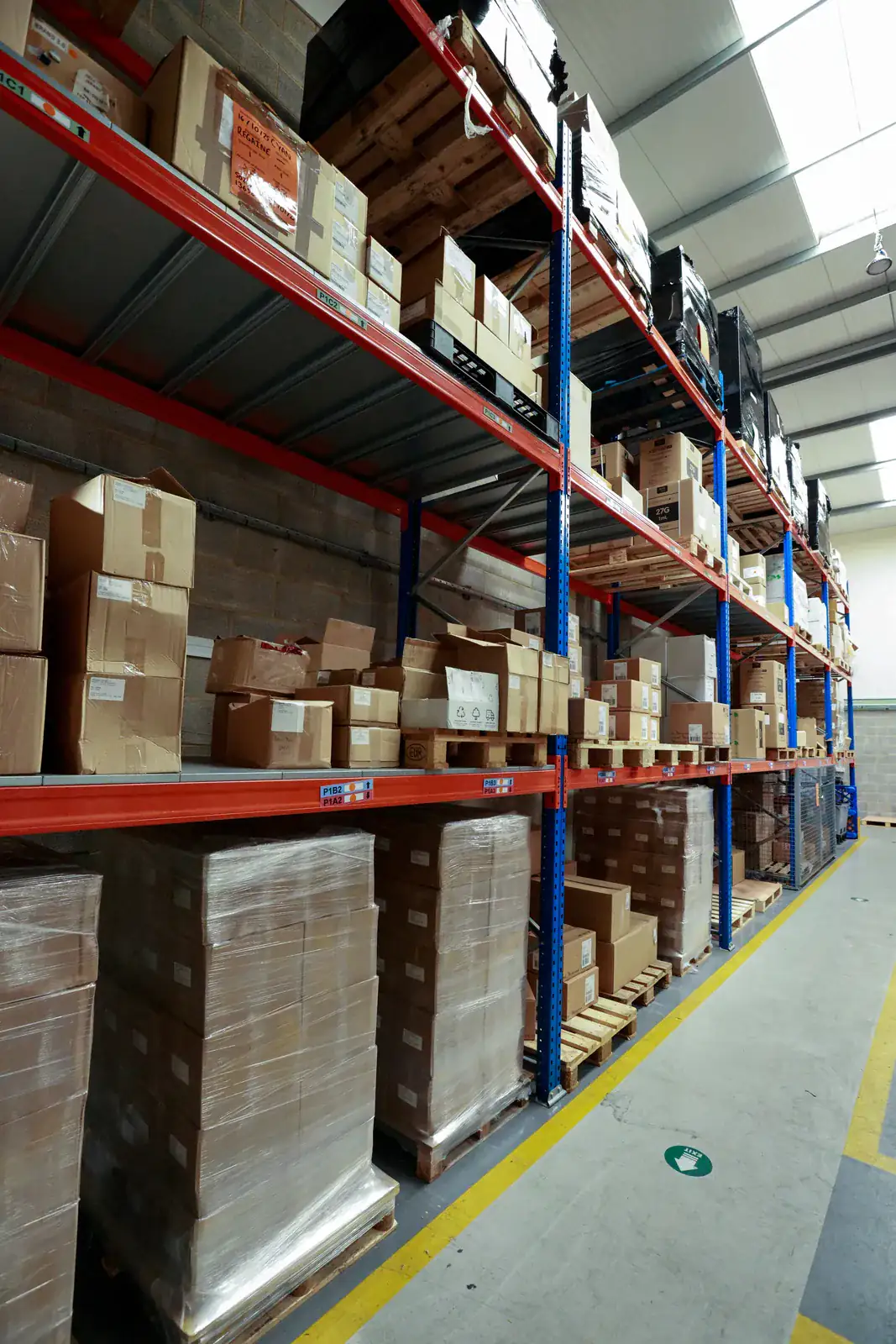
Picking cartons, not pallets.
If the constraint is case picking rather than full pallet movement, the same idea works at a smaller scale. Carton live storage uses inclined roller tracks to present cartons at the pick face and keeps replenishment behind it.
Many food and drink sites run both: pallet live lanes for full pallet dispatch and a carton live pick face for mixed orders. See how a Cardiff distribution site did it in the carton live case study.
Spare beams, decking and safety kit online
Components for the static racking around a pallet live block, plus barriers, signage and pallet handling equipment, are on the online store. The live lanes themselves are designed to your pallets and come through the survey.
- Racking & shelving (opens the online store in a new tab)
- Storage (opens the online store in a new tab)
- Safety & premises (opens the online store in a new tab)
- Trucks & trolleys (opens the online store in a new tab)
- Steps & ladders (opens the online store in a new tab)
- Lifting, drum & cylinder (opens the online store in a new tab)
- Workshop & environment (opens the online store in a new tab)
- Office & mailroom (opens the online store in a new tab)
Pallet live questions, answered.
Pallet live racking, also called gravity flow racking or pallet flow racks, is a block of inclined roller lanes. Pallets are loaded at the high end from an input aisle and roll under gravity to the low end, where they are picked from a separate output aisle. Rotation is first in, first out, automatically, in every lane.
A shallow incline set by the manufacturer for the pallet type, the pallet weight and the lane length. We do not quote a gradient before the pallets have been weighed and measured, because a lane that is too steep runs pallets too fast and one that is too shallow stalls them. The figure comes from the manufacturer's design data for your load.
Lane depth is set by the length of the building available, the volume you hold per SKU and how fast that SKU turns. A lane that is longer than the stock it holds simply ties up positions, so we size lanes against your pallets per SKU, typically confirmed at survey and design.
Two working faces: one input aisle at the high end and one output aisle at the low end. Inside the block there are no aisles at all, which is where the density comes from. Each face is worked by a standard counterbalance or reach truck.
Yes, with components specified for the temperature. Cold store applications are among the strongest uses, because automatic FIFO matters most with date coded chilled and frozen food. Roller and brake components are selected for the operating temperature at design stage.
No. Pallets must be in good condition and presented the right way round, with the bottom boards running across the rollers. Broken boards, overhanging loads and mixed pallet sizes in one lane are the usual causes of stalls. Lanes are designed around one pallet type, commonly the UK 1200 x 1000mm or the Euro 1200 x 800mm.
First in, first out, always. The first pallet loaded at the high end is the first to reach the pick face. If you need last in, first out from a single face, push back racking is the related system that does that.
More per pallet position than adjustable pallet racking, because every position carries rollers, brake rollers and separators. It pays where it removes labour, double handling or stock write-offs from missed rotation. The free site survey gives a priced layout for your stock rather than a rate per position.
Tell us your pallets per SKU and how fast they turn.
Those two numbers decide whether gravity flow pays. If it does not, we will say so and draw the layout that does.