
Armco crash barriers for the yard.
Galvanised corrugated steel beam on bolt-down or cast-in posts, put between vehicles and the things a vehicle must never reach. Gas cages, bulk tanks, sub-stations, charge points, sprinkler valve sets, building corners and pedestrian routes.
Also searched as Amcor barrier. Same product, same corrugated profile.
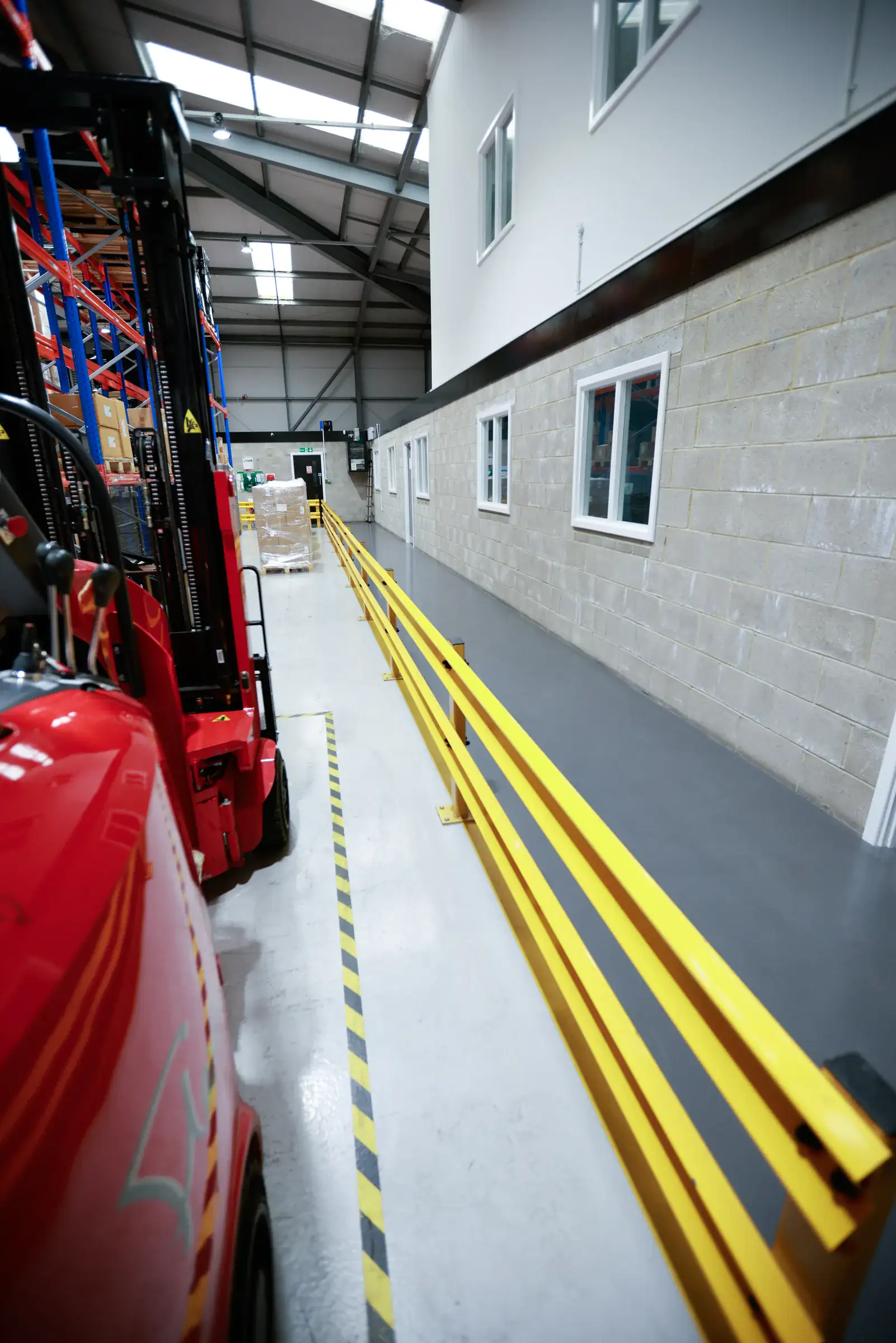
- Heights
- 560 to 1100mm
- Post centres
- 3.2m1.6m high risk
- Steel
- 3mm S275
- Finish
- GalvanisedBS EN ISO 1461
What ends up needing protecting.
Almost every yard has two or three assets that cost far more to repair than a barrier costs to install, and they are usually the ones sitting closest to a turning circle.
Gas cages and cylinder stores
Bulk tanks and fuel points
Electrical sub-stations
Sprinkler valve sets
EV charge bays
Building corners and columns
Pedestrian routes and doors
Loading bays and dock levellers
Racking against an outside wall
Height is set by the vehicle.
Measured from finished ground level to the top of the beam, so the beam meets the vehicle near its centre of gravity instead of riding under the chassis or over the bumper.
| Height | Traffic | Typical position |
|---|---|---|
| 560mm | Forklift and counterbalance truck areas | Inside buildings, yard aisles, plant protection |
| 610mm | Cars, vans and light goods vehicles | Car parks, visitor areas, site perimeters |
| 760mm | HGV traffic, single beam | Service yards, delivery routes, industrial premises |
| 1100mm | HGV traffic, double beam | Loading bays and the heaviest traffic positions |
Post height above ground, by traffic type.
- 560mm
- Forklift and counterbalance truck areas
- 610mm
- Cars, vans and light goods vehicles
- 760mm
- HGV traffic, single beam
- 1100mm
- HGV traffic, double beam
- Beam length
- 3.5mGiving 3.2m of effective coverage once lapped and bolted. 1.9m sections for short runs.
- Post spacing
- 3.2m centresHalved to 1.6m centres where impact risk is high, which doubles the strength of the run.
- Steel gauge
- 3mmS275 mild steel, corrugated profile. 2.7mm available on lighter duty runs.
- Finish
- Hot dip galvanisedTo BS EN ISO 1461. Powder coating to a RAL colour where the yard needs high visibility.
- Post types
- Z-section or RSJBolt-down onto a sound slab, or cast-in where the surface will not hold an anchor.
- Ends
- Three optionsFishtail, bullnose or pedestrian-safe, so no run terminates in an open beam end.
- Corners
- 90° int and extPlus fabricated angles, and curved beams for a radius under 50m.
- Fixings
- M16 throughoutLap bolts, post bolts and anchors, with buffer strips where vibration is a concern.
Built from a kit, so it fits the yard you have.
Runs are made up from standard beams, posts, corners and end sections, which is why an awkward corner, a doorway or a fuel point in the wrong place is a specification question rather than a fabrication job.
Ends matter more than people expect. An unfinished beam end at head height in a walkway is a hazard in its own right, so runs terminate in a fishtail, a bullnose or a pedestrian-safe end.
Corrugated beam
Posts
Base plates and anchors
Cast-in posts
Fishtail ends
Pedestrian-safe ends
Corners and radius beams
Bollards and hoop guards
Steel outside, polymer inside.
The two do different jobs and the choice is usually decided by what happens after the strike. Galvanised steel stops a heavy vehicle and stays bent. Polymer absorbs a forklift knock and returns to shape, which is what you want beside racking where repeated low speed contact is a fact of life.
Galvanised steel Armco
Bollards and kerb barriers
Read the case for polymer on the rack protection page.
Where Armco is the wrong answer.
Worth stating plainly, because getting this wrong is expensive and nobody publishes it.
Not for the public highway
It needs something to fix into
It deforms permanently
It is not a security barrier
It does not fix the cause
Installed around the traffic, not instead of it.
A yard cannot close while a barrier goes in. Work is sectioned so one area is segregated at a time and deliveries keep moving, with risk assessments and method statements issued before anyone attends.
- Step 1
Yard walk and marked layout
Traffic routes, turning circles and exposed assets identified, then post positions and heights marked on a drawing.
- Step 2
Slab and fixing check
Establishes bolt-down or cast-in, which is the single biggest cost variable.
- Step 3
Sectioned installation
One area segregated at a time so deliveries keep running, with RAMS issued before attendance.
- Step 4
Handover
Layout drawing showing what was installed where, so a struck section can be re-ordered by reference later.
Struck sections are replaced the same way: one bay at a time, beam and post swapped, no need to strip the run. Prefer to fit it yourselves? Barriers are supplied with beams, posts, ends and M16 fixings to the marked layout.
Protection is one stage of a loop.
Each stage produces the next. Repeated damage in the same location is a symptom, and the cause is usually layout, systematic overloading or truck and aisle geometry.
- Step 1InspectAnnual expert inspection, plus the recorded visual checks your appointed person runs.
- Step 2RepairDamaged components replaced like for like across brands, never straightened.
- Step 3Protect (this page)Rack protection inside, Armco barriers in the yard, fitted where the strikes actually happen.
- Step 4TrainAwareness course so the people who see damage first can classify and report it.
- Step 5Re-inspectAnnual date set at handover, so nothing lapses quietly.
Barrier questions.
Armco is the correct name. It comes from the American Rolling Mill Company, which developed the corrugated beam profile, and Amcor is a common misspelling of it. Both refer to the same product: a galvanised corrugated steel beam bolted to steel posts, used off the public highway to stop vehicles reaching whatever is behind it.
Height is set by the vehicle you are protecting against, measured from finished ground level to the top of the beam. 560mm for forklift areas, 610mm for cars and light goods vehicles, 760mm for HGV traffic on a single beam, and 1100mm for a double beam in the heaviest traffic. The aim is for the beam to strike the vehicle near its centre of gravity rather than ride under or over it.
Standard spacing is 3.2m centres, which is one post per beam lap. In high impact positions, spacing halves to 1.6m centres and doubles the strength of the run. Every run needs one extra post to finish the final beam.
Yes, where the slab is sound. Bolt-down posts on a base plate suit concrete in reasonable condition, and cast-in posts are used in new slabs or where the surface will not hold an anchor. The survey establishes which the yard will take, because the slab is what the barrier ultimately relies on.
No. These systems are not tested to BS EN 1317 and are not for the public highway. They are specified for private yards, service roads, car parks, loading areas and inside buildings, which is where almost all industrial impact protection is needed.
Galvanised steel absorbs the impact by deforming, and it stays deformed. A struck beam or post is replaced rather than straightened, in the same way as a damaged racking component, because the steel no longer performs as designed. Individual beams and posts can be swapped without taking down the run.
Yes, and it is one of the most common reasons for asking. Gas cages, bulk tanks, fuel and AdBlue points, electrical sub-stations, sprinkler valve sets and EV charge bays all sit in traffic routes and all cause far more trouble when struck than the barrier costs. Protection is usually specified as a three-sided or full enclosure rather than a single run.
Either. As Armco barrier suppliers we can deliver beams, posts, ends and fixings for your own team to install, or survey, specify and install the run ourselves. Installation is planned around yard traffic, with the affected area segregated one section at a time so deliveries keep running.
Surveyed with the racking, quoted separately
Get the yard walked.
One visit covers the racking, the yard and the traffic routes. You get a marked-up layout showing post positions and heights, and a priced quotation. No charge, no obligation.