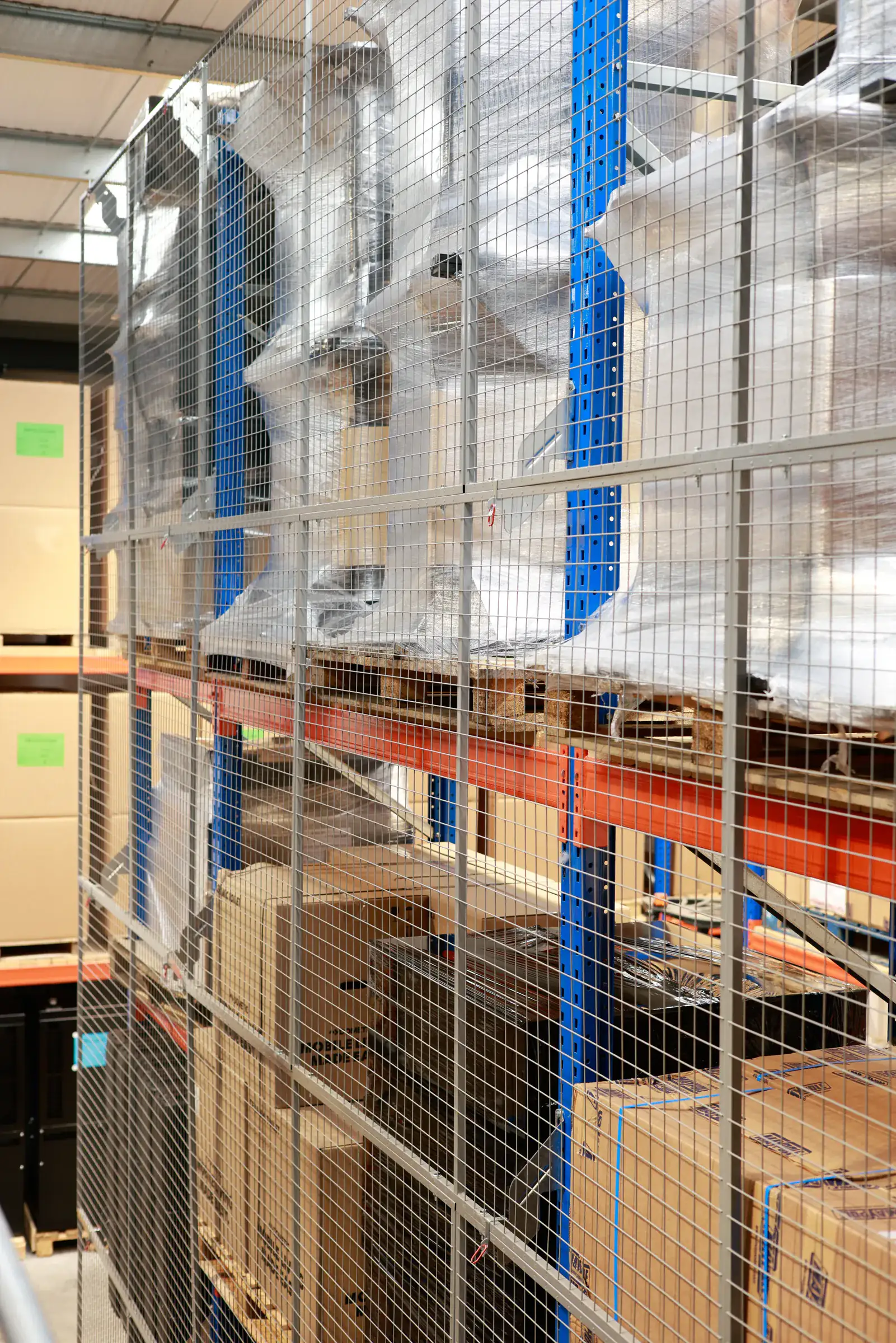
Anti collapse mesh. For every run that backs onto a walkway.
Fitted to the rear of racking runs to stop stock being pushed through into the next aisle or onto a walkway. A pallet placed slightly too far from the front is enough to do it.
Netting is the lighter, faster alternative to steel mesh, and it is graded up to full pallet load.
- Netting install speed
- ≈2×Against steel mesh
- Grades
- Light to full pallet
- Maintenance
- NoneOnce installed
- Colours
- SeveralFor zone segregation
Where it is essential.
The test is simple: if a load pushed out of the back of a bay could land where a person can be, the run needs rear protection.
Runs backing onto walkways
Back-to-back flues
Tunnel bays and walkways through racking
Steel mesh against netting.
Both stop stock leaving the back of the bay. They differ in how they go in, how they live with change and what they cost to keep.
| Attribute | Pallet rack netting | Steel anti collapse mesh |
|---|---|---|
| Construction | Low tension wire net, minimal deflection | Welded steel mesh panels on frames |
| Install speed | Roughly twice as fast as steel mesh | Baseline |
| Confined spaces | Workable where access behind the racking is tight | Needs room to lift and fix panels |
| Adjust or relocate | Easy, run by run | Panels unbolted and refitted |
| Maintenance | None once installed | Check fixings and panels after impact |
| Colours | Several, for zone segregation | Usually one finish |
| Containment grades | Light duty to full pallet load | Light duty to full pallet load |
| Containment rating per grade | Set by manufacturer test data, confirmed at survey | Set by manufacturer test data, confirmed at survey |
| Visibility through | High | High |
| Typical choice | Retrofits, changing layouts, tight spaces | Where a rigid panel is specified |
Rear containment options compared. Containment ratings are set by manufacturer test data for each grade.
- Construction
- Low tension wire net, minimal deflection
- Install speed
- Roughly twice as fast as steel mesh
- Confined spaces
- Workable where access behind the racking is tight
- Adjust or relocate
- Easy, run by run
- Maintenance
- None once installed
- Colours
- Several, for zone segregation
- Containment grades
- Light duty to full pallet load
- Containment rating per grade
- Set by manufacturer test data, confirmed at survey
- Visibility through
- High
- Typical choice
- Retrofits, changing layouts, tight spaces
Graded by what it has to hold.
The grade is chosen against the heaviest unit load that could be pushed through and the height it would fall from, not against the size of the bay.
Under-specifying is the common mistake. Light duty netting behind a run of full pallets looks right and holds cartons. The survey records the loads on each run and specifies the grade to match.
Light duty
Cartons, loose items and small parts falling from hand loaded levels.
Containment rating: From manufacturer test data
Medium duty
Mixed cases and part pallets on forklift loaded levels.
Containment rating: From manufacturer test data
Full pallet load
Complete palletised loads pushed through from the front.
Containment rating: From manufacturer test data
Rear, in-flue and handrail.
The same containment principle applied to three different gaps. Most sites need more than one.
- Rear mesh and netting: fitted to the back face of single-sided runs beside walkways
- In-flue netting: between back-to-back runs, where the flue itself is the risk
- Mezzanine handrail netting: falling object protection along the edges of a mezzanine floor
- Zone colours: different netting colours for pedestrian routes, quarantine or returns
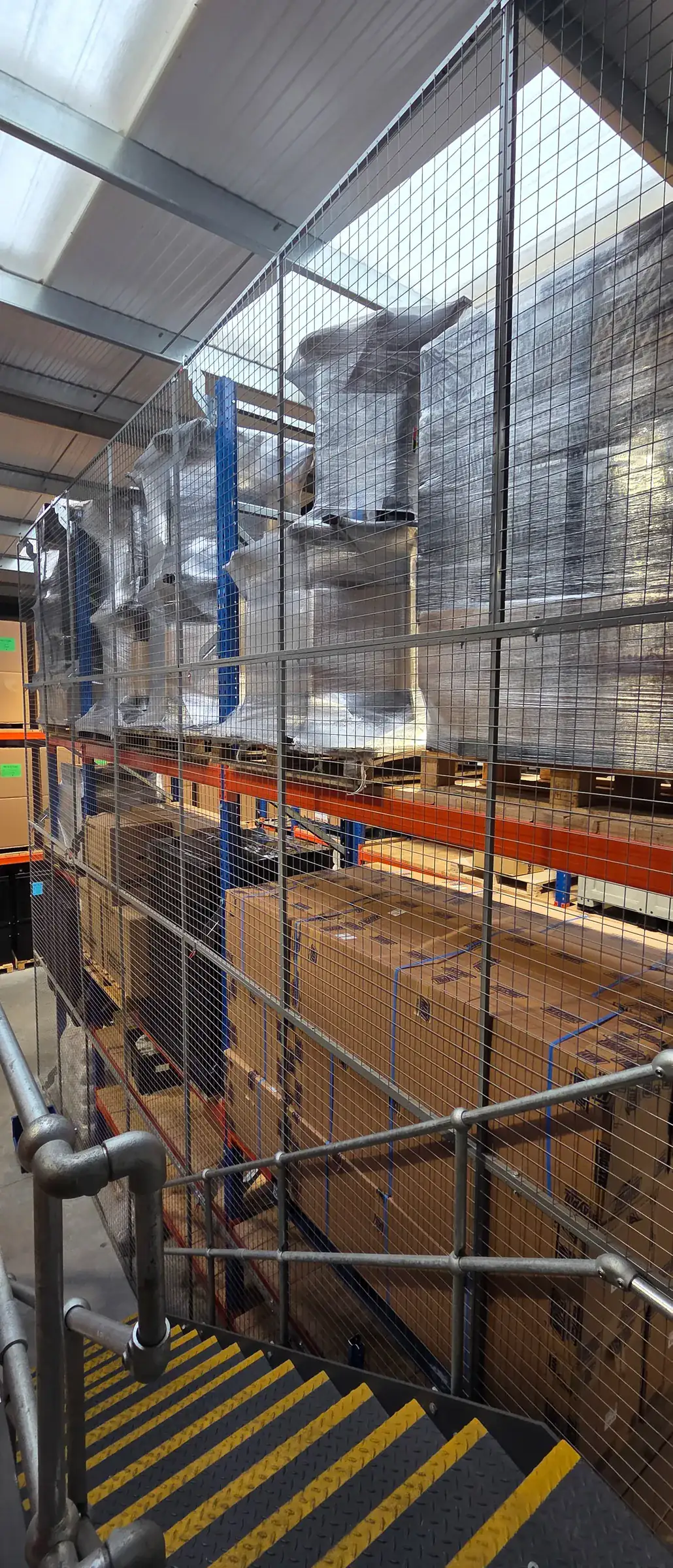
Installed run by run, with the racking in use.
Rear containment is almost always a retrofit. The aisle is only closed for the run being fitted.
- Step 1
Survey the runs
Every run backing onto a route recorded, with the heaviest load on each and the access behind it.
- Step 2
Specify the grade
Netting or mesh, and the containment grade for each run, marked on the layout.
- Step 3
Fit run by run
Fixed to the racking structure, one run at a time, with the area behind it segregated.
- Step 4
Record and hand over
Grades and positions recorded, ready for the next inspection.
When mesh or netting is the wrong answer.
Rear containment stops loads leaving the back of a bay. It does not do everything.
It does not replace a walkway
Wrong grade is no grade
Inspect, repair, protect, train, re-inspect.
Each stage produces the next. Repeated damage in the same location is a symptom, and the cause is usually layout, systematic overloading or truck and aisle geometry.
- Step 1InspectAnnual expert inspection, plus the recorded visual checks your appointed person runs.
- Step 2RepairDamaged components replaced like for like across brands, never straightened.
- Step 3Protect (this page)Rack protection inside, Armco barriers in the yard, fitted where the strikes actually happen.
- Step 4TrainAwareness course so the people who see damage first can classify and report it.
- Step 5Re-inspectAnnual date set at handover, so nothing lapses quietly.
Mesh and netting questions.
On every racking run whose rear face backs onto a pedestrian route, a walkway, a work area or another aisle where people could be below. It stops stock being pushed through the back of the bay when a pallet is placed from the front. It is also used between back-to-back runs, over tunnel bays and walkways through racking, and on mezzanine edges.
Anti collapse mesh is a fixed welded steel mesh panel system. Rack netting is a low tension wire net fixed to the racking. Netting is lighter, installs roughly twice as fast, works in confined spaces, is easy to adjust or relocate, and needs no maintenance once installed. Steel mesh is the more rigid option where a solid looking barrier is preferred or the specification calls for it.
Netting and mesh are graded by containment capacity, from light duty for cartons and loose items up to full pallet load. The containment rating for each grade is set by the manufacturer's test data, and the grade is chosen at survey against the heaviest unit load and the height it could fall from. We do not quote a general figure, because the right grade depends on your loads and your racking.
Yes. Both netting and mesh are retrofitted to racking that is in use. Netting is usually the easier retrofit, because it installs from fewer fixing points, works where access behind the racking is tight, and can go in run by run with minimal disruption to the aisle.
Netting fitted in the flue space between back-to-back runs. It stops a pallet pushed too far on one side from entering the opposite bay or falling into the flue. It is used where the flue itself is the risk rather than a walkway behind a single run.
There is no single rule that names it, but the duty to protect people from falling objects is clear under the Workplace (Health, Safety and Welfare) Regulations 1992, and HSG76 expects measures to stop loads falling where people work or walk. Where a run backs onto a pedestrian route, an inspector or auditor will expect to see rear protection.
Yes. Netting is available in several colours, which is useful for zone segregation and wayfinding: one colour for pedestrian routes, another for quarantine or returns, for example.
Surveyed with rack protection and inspections
Find every run that backs onto a walkway.
The survey records every run with a pedestrian route behind it, the heaviest load on each, and the containment grade it needs, marked on your layout with a priced quotation. No charge and no obligation.