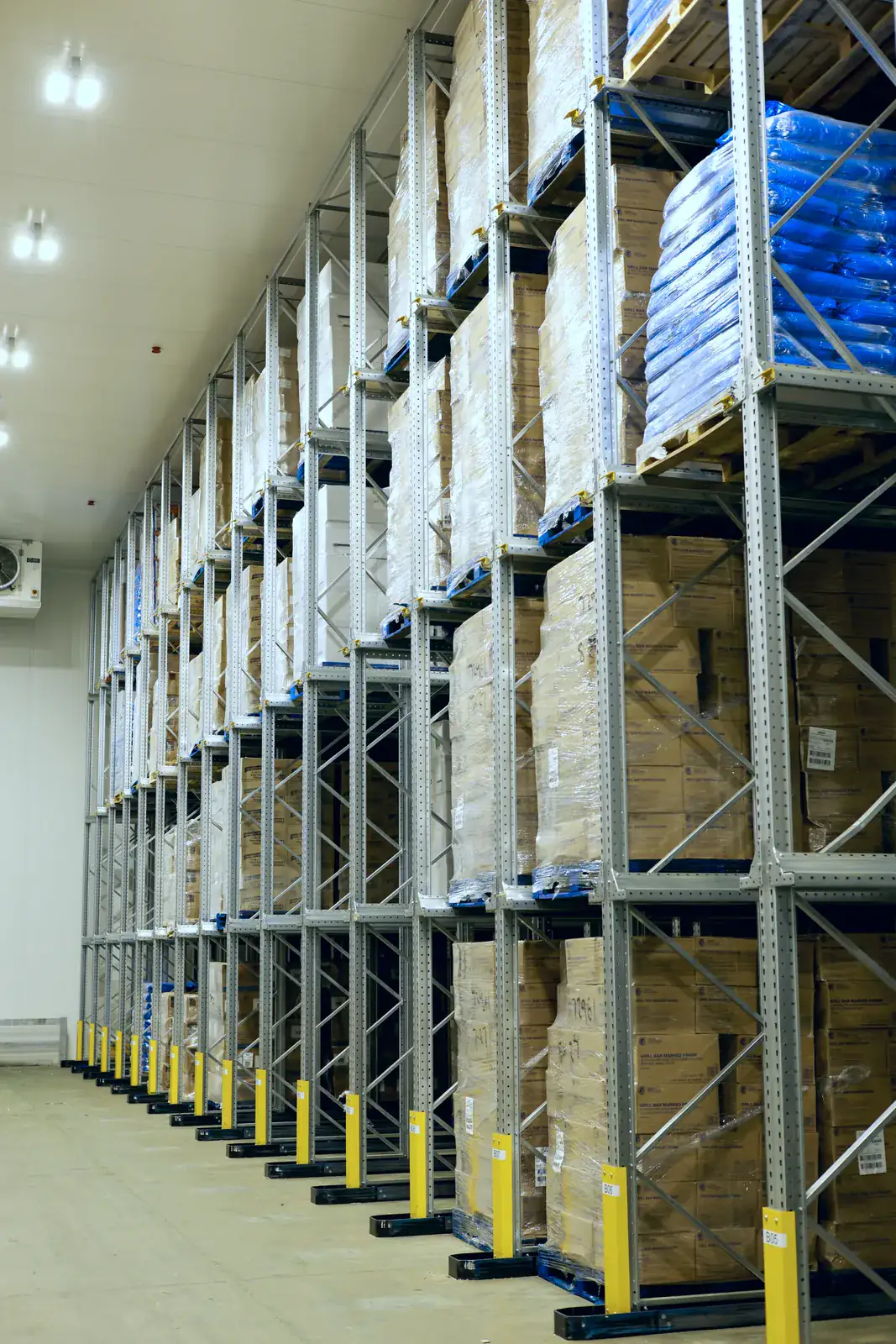
Pallet shuttle systems. The forklift stays at the lane face.
We are the Wales distributor for Spacemaker Systems semi-automated pallet shuttle technology. High density storage removes aisles and stores pallets many deep, which creates an access problem. The shuttle solves the access problem.
Density is a racking decision. Flow is a shuttle decision.
- Density gain
- ≈60%
- Forklift traffic
- −50%
- Uptime across sites
- ≈99%
- Freezer rating, two-way
- −40°C
- Lead time
- 12 to 16 wks
One cycle, five moves.
The shuttle is a battery powered robot that runs on rails inside a deep storage lane and moves pallets in and out of the lane itself.
- Step 1
Place and deposit
The truck places the shuttle at the lane entrance and deposits a pallet onto it.
- Step 2
Lift clear
The shuttle lifts the pallet clear of the rails on its servo driven electro-mechanical platform.
- Step 3
Travel the lane
It travels down the lane at 1.1 m/s under load, guided by flanged wheels.
- Step 4
Lower and return
It lowers the pallet into the first free position and returns to the face.
- Step 5
Retrieve
Retrieval reverses the cycle. The truck never enters the racking.
Commands come from a handheld RF controller, an app, or directly from the warehouse management system over the RF gateway mesh.
Two-way against four-way.
Lead with the two-way. It is the mainstream product, it retrofits most easily, it carries a lower capital cost and it needs no warehouse execution system. Four-way earns its place where a whole block must run without a forklift inside it.
| Attribute | Two-way, semi-automated | Four-way, fully automated |
|---|---|---|
| Travel axes | Single axis within one lane | X and Y axes plus vertical via end of block lift |
| Lane change | Forklift relocates the shuttle | Shuttle relocates itself, no truck inside the block |
| Max pallet load | 1500kg standard, 2000kg custom | 1500kg |
| Pallet standards | CHEP, EUR and GMA | CHEP, EUR and GMA |
| Typical lane depth | 30 to 50 pallets | Around 50 pallets |
| Speed, empty | 1.25 m/s | 2 m/s on both axes |
| Speed, loaded | 1.1 m/s | 0.8 m/s on both axes |
| Duty cycle | 40 percent | 40 percent, fleet balanced |
| Battery | LiFePO4 60Ah, 8hr+ runtime, 3hr charge | LiFePO4 with in-rack opportunity charging |
| Charging | External charger | In-rack automatic docking, low battery fail-safe routing |
| Operating temperature | Minus 40C to plus 50C | Minus 25C to plus 45C |
| Throughput per shuttle | Approximately 30 pallets per hour | Approximately 30 pallets per hour, multiple units share lanes |
| Braking and lift | Servo electro-mechanical lift, no hydraulics | Regenerative AC servo braking, electro-mechanical lift |
| Control | Handheld RF controller, app or WMS | Warehouse execution system required |
| Retrofit into existing racking | Yes, where rail profile is compatible | Generally not, structure must be designed for it |
| Labour | Truck and driver still needed at the face | Lights-out operation possible |
| Lead time | 12 to 16 weeks from order | 12 to 16 weeks, longer for multi-level |
Specification comparison. Figures are manufacturer data for the standard units.
- Travel axes
- Single axis within one lane
- Lane change
- Forklift relocates the shuttle
- Max pallet load
- 1500kg standard, 2000kg custom
- Pallet standards
- CHEP, EUR and GMA
- Typical lane depth
- 30 to 50 pallets
- Speed, empty
- 1.25 m/s
- Speed, loaded
- 1.1 m/s
- Duty cycle
- 40 percent
- Battery
- LiFePO4 60Ah, 8hr+ runtime, 3hr charge
- Charging
- External charger
- Operating temperature
- Minus 40C to plus 50C
- Throughput per shuttle
- Approximately 30 pallets per hour
- Braking and lift
- Servo electro-mechanical lift, no hydraulics
- Control
- Handheld RF controller, app or WMS
- Retrofit into existing racking
- Yes, where rail profile is compatible
- Labour
- Truck and driver still needed at the face
- Lead time
- 12 to 16 weeks from order
Minus 40 against minus 25.
The two-way heavy duty unit is freezer rated to minus 40C with sealed components and holds full speed at temperature extremes. The four-way is rated only to minus 25C. Blast freezer applications must therefore use the two-way unit, and any quotation that ignores that distinction should be questioned.
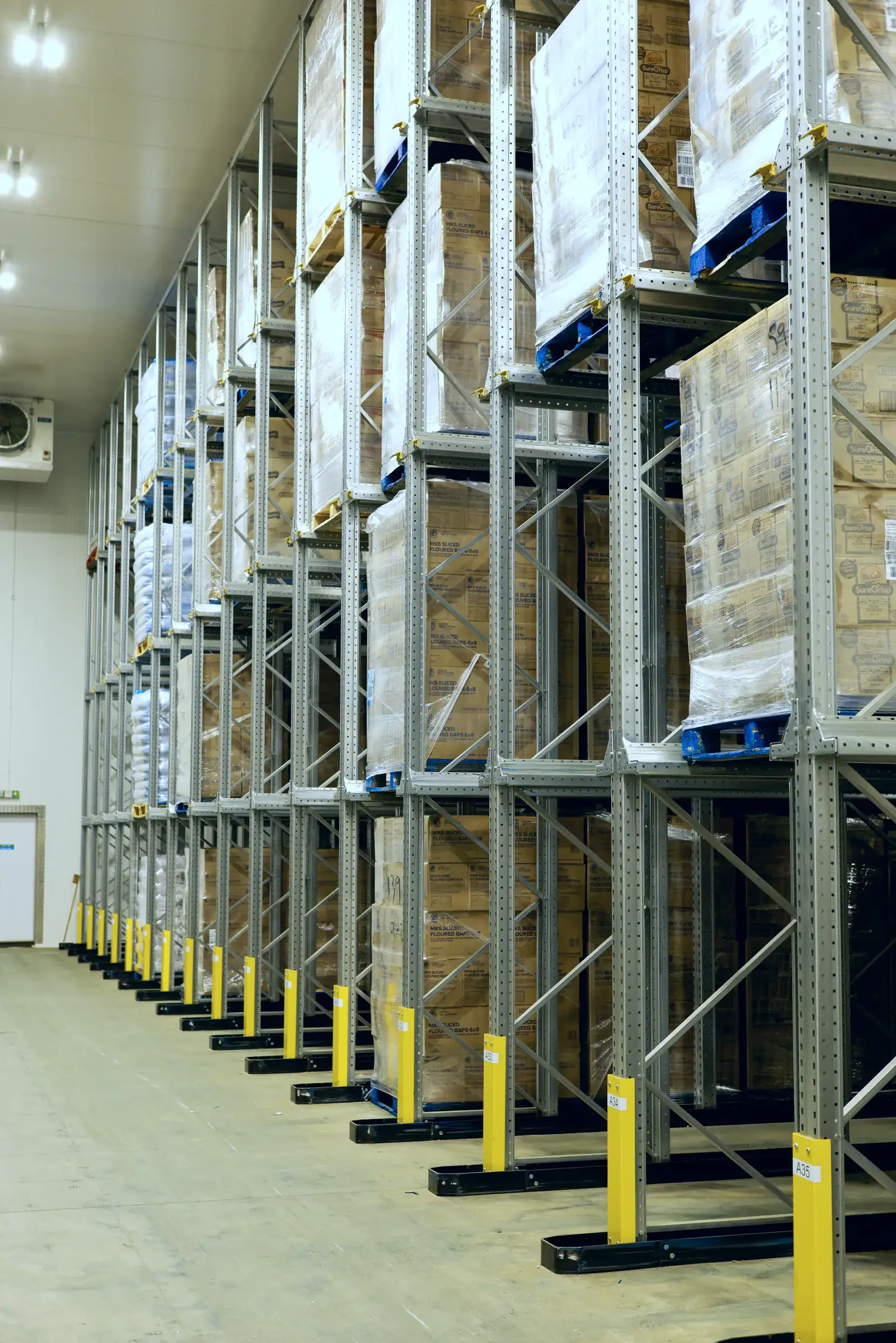
Cold storage is the strongest single market for this product. Fewer, deeper lanes mean less volume to refrigerate, and trucks kept out of the lanes cut travel, door disturbance and energy loss with it. In cold storage the gain is up to 40 percent additional capacity within the existing footprint.
- Two-way heavy duty
- −40°C to +50°C
- Four-way
- −25°C to +45°C
- Blast freezer
- Two-way only
- Extra capacity in cold store
- Up to 40%
- Speed at temperature
- Unchanged
- Components
- Sealed
Rotation is a software setting, not a geometry.
This is the decisive advantage over drive-in racking. A drive-in lane is last in, first out because of how it is built. A shuttle lane runs whichever mode the operation needs that week.
LIFO
FIFO
Pallet shuffle
Stock count
Auto retrieve and deposit
Continuous auto deposit
Single deposit and retrieve
Recovery
Manual operator-directed input is always available. Compare this with fixed-rotation systems in the racking system comparison.
What arrives on site.
Shuttle unit
Chassis, four wheel drive with flange wheel guidance, servo driven electro-mechanical lifting platform, separate drive and lift motors.
Guide rails
Mounted inside the racking beams.
Lifts and cross travel
End of block lifts and cross travel lanes on four-way systems.
Batteries
Lithium iron phosphate. External chargers on two-way, in-rack opportunity charging with automatic docking on four-way.
Controls
Handheld RF controller and an RF gateway mesh network.
Software layer
Fleet management, warehouse management, warehouse control across mixed robot fleets, live 3D warehouse modelling and ERP integration.
What changes afterwards.
- Storage density
- ≈60% gain
- Forklift traffic
- ≈50% less
- Cold store capacity
- Up to +40%
- Uptime, live sites
- ≈99%
- Operators per fleet
- One, remote
- Scaling
- Add shuttles
Racking impact damage drops markedly because trucks stay out of the lanes, which feeds straight back into fewer failed inspections and lower repair spend. Regenerative braking recovers energy, and the flat lifting platform handles weak or damaged pallets without breaking them further.
Retrofit shuttle replacement, without touching the racking.
If you already run shuttles and are being quoted for full replacement, ask whether the rails are the problem. Where rail profiles are compatible, worn or obsolete units can be swapped for current ones with no infrastructure replacement. It is the cheapest route to modern control software.
- Rail profile compatibility verified on site before any quotation
- Minimal downtime, no infrastructure replacement
- Current control software and fleet management on the existing structure
- Existing lanes, depths and load ratings reassessed as part of the check
When a pallet shuttle is the wrong answer.
Read this section before the specification. If any of these describe your operation, say so on the first call and we will quote something else.
Low pallets per SKU
Duty cycle is a real ceiling
Modest throughput per unit
Two-way still needs a driver
Lane depth is bounded
Four-way below minus 25C
Four-way retrofits rarely work
Rails must be compatible
Lead time and infrastructure
Unused building height
Case picking is the bottleneck
Who it suits.
High volume per SKU, full pallet in and full pallet out, predictable repetitive movement, and any operation where each square metre of storage is expensive.
Food and drink
Pharmaceutical and healthcare
Third party logistics
E-commerce and retail fulfilment
Agricultural and dairy processing
Four studies before a price.
The storage study, throughput analysis, system specification and rack layout are all completed before quoting. Then survey, design, install, commission and support.
- Step 1
Storage study
Stock profile, pallets per SKU and rotation rules.
- Step 2
Throughput analysis
Peak and average movements per hour against duty cycle.
- Step 3
System specification
Shuttle count, lane depths and the control layer.
- Step 4
Rack layout
Block geometry, rail profile and protection.
- Step 5
Quotation
Priced against the modelled configuration.
- Step 6
Survey
Floor, structure and truck access confirmed.
- Step 7
Install
Phased around the live operation.
- Step 8
Commission
Modes configured and operators trained.
- Step 9
Support
Fleet monitoring and spares.
Shuttle questions, answered numerically.
A two-way shuttle travels a single axis inside one lane, and a forklift moves it between lanes. A four-way shuttle travels both X and Y axes and moves vertically through an end of block lift, so one shuttle covers a whole storage block with no forklift inside it. That is a design decision for the racking, not an upgrade you add later: cross travel lanes, the lift and in-rack charging are structural.
The two-way heavy duty unit is rated from minus 40C to plus 50C, with sealed components, and holds full speed at temperature. The four-way is rated from minus 25C to plus 45C. Blast freezer applications must therefore use the two-way unit, and any quotation that proposes a four-way below minus 25C should be questioned.
It depends on pallets per SKU, not floor area. A small building holding a few products in quantity can justify a two-way shuttle on a handful of lanes. A large building holding thousands of SKUs one or two pallets deep usually cannot, because deep lanes only pay when they fill with the same product.
Approximately 30 pallets per hour per shuttle, at a 40 percent duty cycle. A single shuttle is not a continuous run machine, so high throughput sites need several units, which changes the economics. Capacity scales by adding shuttles without reconfiguring the racking.
A two-way shuttle can be retrofitted where the rail profile is compatible and the structure is rated for the loads. Both are verified on site before anything is quoted. Four-way systems generally cannot be retrofitted, because they need cross travel lanes, an end of block lift and in-rack charging designed into the structure.
Typically 12 to 16 weeks from order, and longer for multi-level systems. The storage study, throughput analysis, system specification and rack layout are completed before quoting, so the lead time runs from a design you have already seen.
A two-way system does not. It is commanded from a handheld RF controller, an app, or directly from your warehouse management system. A four-way system requires a warehouse execution system to coordinate the fleet, the lift and charging. Both need an RF gateway network across the storage area.
Then a pallet shuttle is the wrong product. It moves full pallets in and out of deep lanes. Case or item picking is better served by carton live storage, pallet live racking or a mezzanine pick floor, and we will say so on the first call.
Price depends on the number of shuttles, lane depth, levels, temperature and whether the racking is new or existing. As an indicative band, a single two-way shuttle retrofitted into compatible racking sits in the low tens of thousands of pounds, and a new deep lane block with several shuttles runs well into six figures. A feasibility survey gives you a priced configuration rather than a band.
Send us your pallets per SKU and your throughput target.
Those two numbers decide the answer faster than a site visit does. If a shuttle does not pay, we will tell you on the call and quote the racking that does.