
Cold store racking. Rated to minus 40, at full speed.
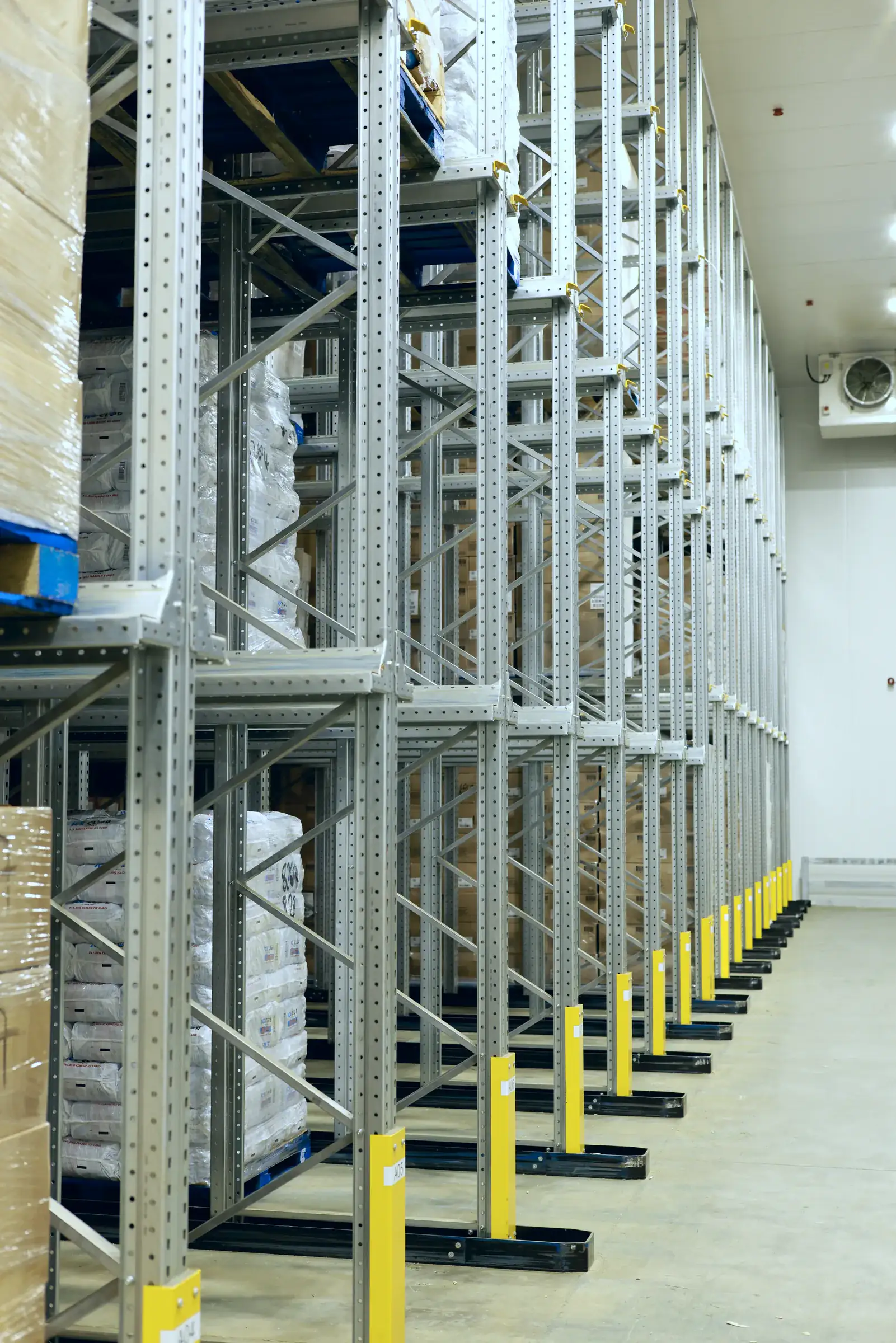
Cold storage is where deep lane storage pays hardest, because every cubic metre is expensive to hold at temperature. The two-way heavy duty shuttle is sealed and freezer rated to −40°C. The four-way stops at −25°C, and that single figure decides blast freezer projects.
Tell us your operating temperature first. It rules systems in and out before anything else does.
- Two-way shuttle
- −40°C
- Four-way shuttle
- −25°C
- Mobile racking
- −30°C
- Cold store capacity gain
- Up to 40%
Capacity and energy are the same decision.
Compacting the same stock into fewer, deeper lanes reduces the volume being refrigerated. Keeping trucks out of those lanes cuts travel, door disturbance and the heat load that comes with both. Mobile racking does the same thing differently, closing every aisle but one.
In an ambient warehouse an aisle costs floor. In a cold store it costs floor, plus the energy to hold that empty air at temperature for every hour the building runs. That is why the density case for cold storage racking is stronger than anywhere else, and why the cold warehouse storage question is usually answered with depth rather than height alone.
The door matters as much as the lane. Thermal and polar grade PVC strip curtains cut warm air exchange at every opening, which is when most of the heat load enters.
- Two-way rating
- −40°C to +50°C
- Four-way rating
- −25°C to +45°C
- Mobile racking
- To −30°C
- Cold store capacity gain
- Up to 40%
- Density gain
- ≈60%
- Forklift traffic
- ≈50% less
Curtains, protection and handling kit in stock
Thermal and strip curtains, rack protection and handling equipment for temperature controlled sites, priced on the online store.
- Racking & shelving (opens the online store in a new tab)
- Storage (opens the online store in a new tab)
- Safety & premises (opens the online store in a new tab)
- Trucks & trolleys (opens the online store in a new tab)
- Steps & ladders (opens the online store in a new tab)
- Lifting, drum & cylinder (opens the online store in a new tab)
- Workshop & environment (opens the online store in a new tab)
- Office & mailroom (opens the online store in a new tab)
Four systems earn their place at temperature.
Rotation discipline usually decides between them before density does. Date coded stock narrows the field to two.
| System | Lowest rated temperature | Rotation | Selectivity | Best for |
|---|---|---|---|---|
| Two-way pallet shuttle | −40°C | FIFO or LIFO, set in software | By lane | Blast freezers, high pallets per SKU |
| Four-way pallet shuttle | −25°C | FIFO or LIFO, set in software | By lane, whole block | Chilled and standard frozen, lights-out blocks |
| Mobile pallet racking | −30°C | Any | 100 percent | Wide ranges in a frozen store |
| Drive-in racking | Specified per project | LIFO, FIFO if drive-through | By lane | Few SKUs in quantity |
| Pallet live | Specified per project | FIFO by gravity | By lane | Date coded, perishable stock |
Cold store systems compared. Temperature ratings are manufacturer data for the standard units.
- Two-way pallet shuttle
- −40°C
- Four-way pallet shuttle
- −25°C
- Mobile pallet racking
- −30°C
- Drive-in racking
- Specified per project
- Pallet live
- Specified per project
Static systems such as drive-in and pallet live are specified for the operating temperature at design, including the speed controllers on gravity lanes. Compare all nine systems on rotation and selectivity in the racking system comparison.
Minus 25 is where the four-way stops.
Blast freezers and deep freeze stores run below the four-way shuttle's rating, so they must use the two-way unit or a static system. A quotation that ignores the distinction should be questioned before it is signed.
- Two-way heavy duty: −40°C to +50°C, sealed components, full speed at temperature
- Four-way: −25°C to +45°C, needs cross travel lanes, a lift and in-rack charging
- Mobile racking: cold store capable to −30°C, 100 percent selectivity
- Batteries, controls and RF network all checked against the operating temperature
Where this lands hardest in Wales.
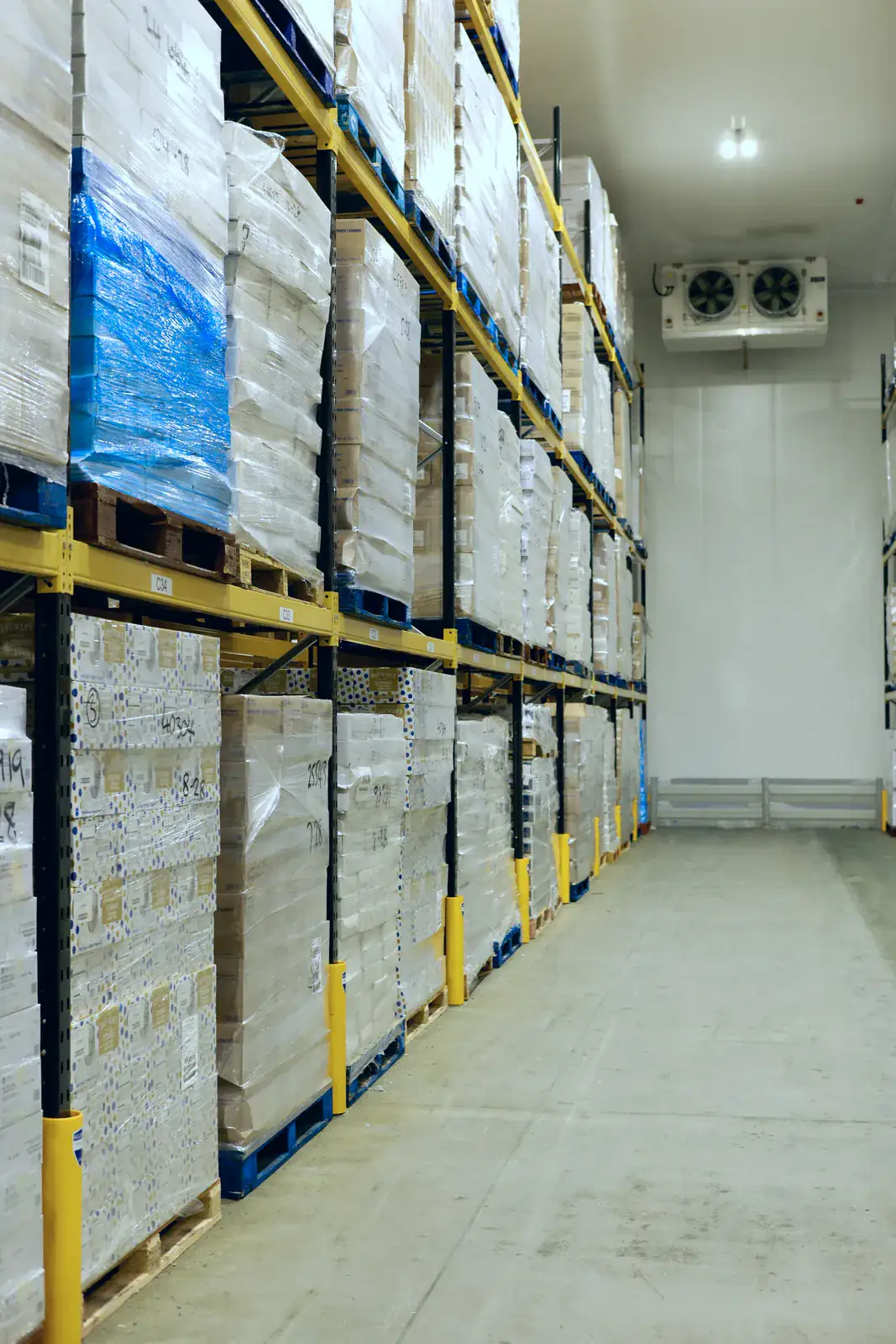
Wales has a large food and drink base, much of it agricultural and much of it chilled or frozen somewhere in the chain. These are the operations where cold store racking decisions carry the most weight.
Cold storage and freezer
Food and drink manufacturing
Agricultural and dairy processing
Cold chain distribution
Pharmaceutical and healthcare
Retail fulfilment
Installing inside a working cold store.
Most cold store projects cannot empty the building. Work is phased bay by bay, planned around defrost cycles and door management, and the method statement sets out how temperature is held while the work runs. Stock is decanted into completed sections before the next is started.
Installers working inside a freezer work limited exposure periods with warm-up breaks, which affects programme length and is priced in rather than discovered. Floor fixings into an insulated slab are checked against the slab construction before anything is drilled.
Once running, impact protection matters more than usual: a damaged upright in a freezer is harder to replace without disrupting temperature. See rack protection and the annual racking inspections that follow.
- Phasing planned around defrost cycles and door schedules
- Method statement covers temperature control during works
- Slab construction checked before any fixing is drilled
- Exposure periods and warm-up breaks priced into the programme
- Polar grade curtains and rack protection fitted at handover
- First annual inspection date set before we leave site
Not a cold store?.
The same depth and rotation logic applies at ambient temperature, with different constraints.
Cold chain questions.
The two-way heavy duty unit is rated from minus 40C to plus 50C with sealed components and holds full speed at temperature extremes. The four-way is rated from minus 25C to plus 45C. Blast freezer applications must use the two-way unit, and any quotation that proposes a four-way below minus 25C should be questioned.
Up to 40 percent additional capacity within an existing footprint is achievable in cold storage using shuttle lanes, with around 60 percent storage density gain against conventional selective racking. The figure for your building comes from the storage study, not from a brochure.
Compacting the same stock into fewer lanes reduces the volume being refrigerated. Keeping trucks out of the lanes cuts travel, door disturbance and the heat load that comes with both, and shuttle forklift traffic runs around 50 percent lower. Mobile racking achieves the same effect by closing every aisle but one.
Yes, mobile pallet racking is cold store capable to minus 30C and keeps 100 percent pallet selectivity, which is its main advantage over drive-in in a temperature controlled space. Below minus 30C the two-way shuttle or drive-in are the remaining dense options.
Pallet live lanes give automatic FIFO, first in, first out, by gravity with no operator intervention. Shuttle lanes give FIFO as a software mode on a lane open at both ends, alongside LIFO, pallet shuffle and stock count on the same structure. Drive-in is LIFO, last in, first out, unless it is built as drive-through.
Yes, phased and out of hours where required. Cold store work is planned around defrost cycles and door management, and the method statement sets out how temperature is maintained while the work runs. Installers working inside the freezer work to limited exposure periods with warm-up breaks.
They reduce the warm air exchange each time a door is open, which is when most of the heat load enters. Polar grade strip is specified for freezer doors so the strips stay flexible at temperature. They complement a fast-action door rather than replacing one.
Racking typically runs 4 to 8 weeks from order and pallet shuttle systems 12 to 16 weeks, longer for multi-level. The storage study, throughput analysis and rack layout are completed before quoting, so the lead time runs from a design you have already seen.
Tell us your operating temperature first.
It rules systems in and out before anything else does. Below minus 25C the four-way shuttle is out, and the conversation changes shape immediately.