
Racking inspection training. An awareness course, not a qualification.
A short course on your own premises that teaches the people who work beside racking to spot damage, classify it by risk level and report it correctly. They are the ones who see it first, usually minutes after it happens.
It also produces a record your insurer, auditor and inspector will recognise.
- Where
- Your siteClassroom plus your racking
- Length
- Half dayIndicative
- Group size
- Up to 10Per session, indicative
- Qualifies as
- AwarenessNot an expert inspector
What this course is, and what it is not.
Courses in this area are sold with loose wording. This is the precise version, so nobody leaves thinking they can sign off racking.
It is
- An awareness course for the people who load, drive past and supervise around racking
- Training in damage recognition, risk classification and correct reporting
- Support for the recorded visual checks your appointed person runs
- Demonstrable due diligence, with an attendance record per person
It is not
- A qualification to carry out expert inspections
- A replacement for the annual inspection by a SEMA Approved Rack Inspector
- The SARI qualification, which is a separate and much longer route administered by SEMA
- A source of general millimetre damage limits that may not fit your system
What the course covers.
Five modules, taught in a room first and then on your own racking, so attendees practise on the frames they walk past every day.
Risk classification follows the red, amber and green categories used in HSG76 and EN 15635 and in every expert inspection report: red means offload and isolate now, amber means remedy within the stated period, green means monitor. The limits behind each grade come from your inspector, not from the course.
Damage limits for your system
Taken from your inspector's report and the manufacturer's data
Damage recognition
What a reportable dent, bow or twist looks like against a cosmetic scuff. Uprights, beams, bracing, baseplates, connectors and locking pins.Risk classification
How findings are graded red, amber and green, and what each grade requires you to do before the next shift.Safe loading and unloading
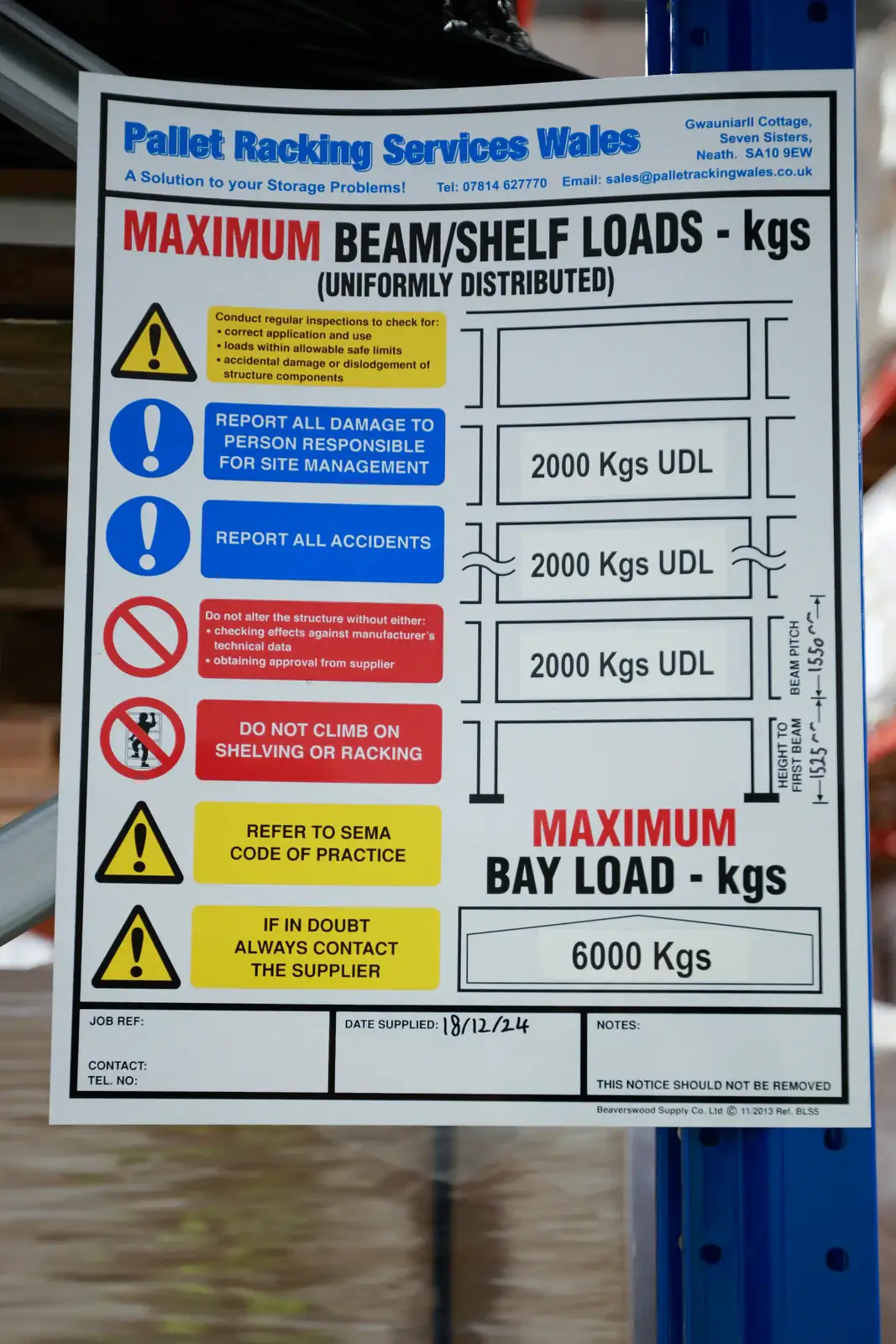
Load notices, pallet condition, overhang, placing rather than dropping, and why beam levels are never moved without a new notice.Housekeeping and aisle discipline
Obstructions, debris, stock left in the aisle, and how aisle width against the truck causes most strikes.Reporting and escalation
Who to tell, what to record, and when to isolate or offload a location without waiting to be told.
Who should attend.
Everyone who works close enough to racking to damage it or notice damage. Mixed groups work well, because the driver and the supervisor leave with the same definitions.
Warehouse operatives and forklift drivers
Supervisors and team leaders
Health and safety officers
Facilities and maintenance staff
The appointed person, and why they need a team.
HSG76 expects every operator to appoint a person responsible for racking safety. Far fewer operators know that than know about the annual inspection, and it is the gap insurers find.
The appointed person runs the regular recorded visual checks between expert inspections, often weekly, and acts on damage reports. They cannot see every strike. The course turns the people on the floor into reliable reporters, so the appointed person's log reflects what actually happened rather than what was noticed on check day.
- Appointed person: owns the recorded visual checks and the damage log
- Trained staff: report immediately, using the same risk language
- Expert inspector: annual racking inspection with a graded written report
A cost, or a record.
The strongest reason to run the course is not the knowledge, useful as it is. It is the evidence that you took reasonable steps, written down, dated and signed.
After an incident, the questions are always the same: were staff trained to recognise damage, did they know how to report it, and can you prove it. An attendance register, the course content and a certificate per person answer all three. Filed with your inspection reports and the in-house check log, they show a system rather than a hope.
- Attendance register
- Per session
- Certificate
- Per person
- Course content
- On file
- Refresher
- 1 to 3 yrsTypical practice
How it runs on your site.
Delivered on your premises, structured so the warehouse keeps running. Many sites book it on the same day as the annual inspection.
Classroom session
Walk of your racking
Split sessions
Indicative length
Indicative price
When training is the wrong answer.
Training reduces damage and improves reporting. It does not fix everything, and it is not a substitute for the stages either side of it.
Inspect, repair, protect, train, re-inspect.
Each stage produces the next. Repeated damage in the same location is a symptom, and the cause is usually layout, systematic overloading or truck and aisle geometry.
- Step 1InspectAnnual expert inspection, plus the recorded visual checks your appointed person runs.
- Step 2RepairDamaged components replaced like for like across brands, never straightened.
- Step 3ProtectRack protection inside, Armco barriers in the yard, fitted where the strikes actually happen.
- Step 4Train (this page)Awareness course so the people who see damage first can classify and report it.
- Step 5Re-inspectAnnual date set at handover, so nothing lapses quietly.
Training questions, answered plainly.
No. It is an awareness course. It teaches staff to recognise damage, classify it by risk level and report it correctly, which is what in-house checks and immediate reporting need. It does not qualify anyone as an expert inspector, and it does not replace the annual expert inspection by a SEMA Approved Rack Inspector.
Typically half a day on your premises, with a classroom session followed by a walk of your own racking. Larger groups are split across sessions so the warehouse keeps running. The exact length is agreed against the number of attendees and the size of the site.
It is priced per session rather than per head, because it runs on your site. As an indicative band, a half day session for up to ten attendees sits in the mid hundreds of pounds, and it is often cheaper when booked on the same day as the annual inspection. A fixed price is confirmed in writing before booking.
Anyone who drives, loads, supervises or maintains around racking: warehouse operatives and forklift drivers, supervisors and team leaders, health and safety officers, and facilities and maintenance staff. Drivers matter most, because they cause and see most damage first.
HSE guidance HSG76 expects operators to appoint a person responsible for racking safety, who runs the regular recorded visual checks between expert inspections and acts on damage reports. The awareness course gives that person and their team a shared vocabulary for damage and risk. The appointed person usually also needs deeper knowledge of your specific system and its load notices, which we cover with them separately during the session.
An attendance register with names, date and course content, and a certificate of attendance for each person. Those records are the due diligence evidence insurers, auditors and inspectors ask for, alongside your inspection reports and the log of in-house checks.
There is no fixed legal interval. Most operators refresh the course every one to three years, and run it for new starters, after a change of system or layout, and after any significant incident. A refresher booked alongside the annual inspection keeps the dates aligned.
It teaches how damage is graded and what each grade requires. The millimetre limits that put damage in a grade are set by your inspector against the manufacturer's data for your system, and the course shows staff where to find them and how to apply them, rather than giving general figures that may not fit your racking.
Delivered on your premises across Wales
Train the team on inspection day.
Book the course alongside your annual inspection and your staff learn on the findings in that day's report. Tell us how many people and how many shifts, and we will send a fixed price.