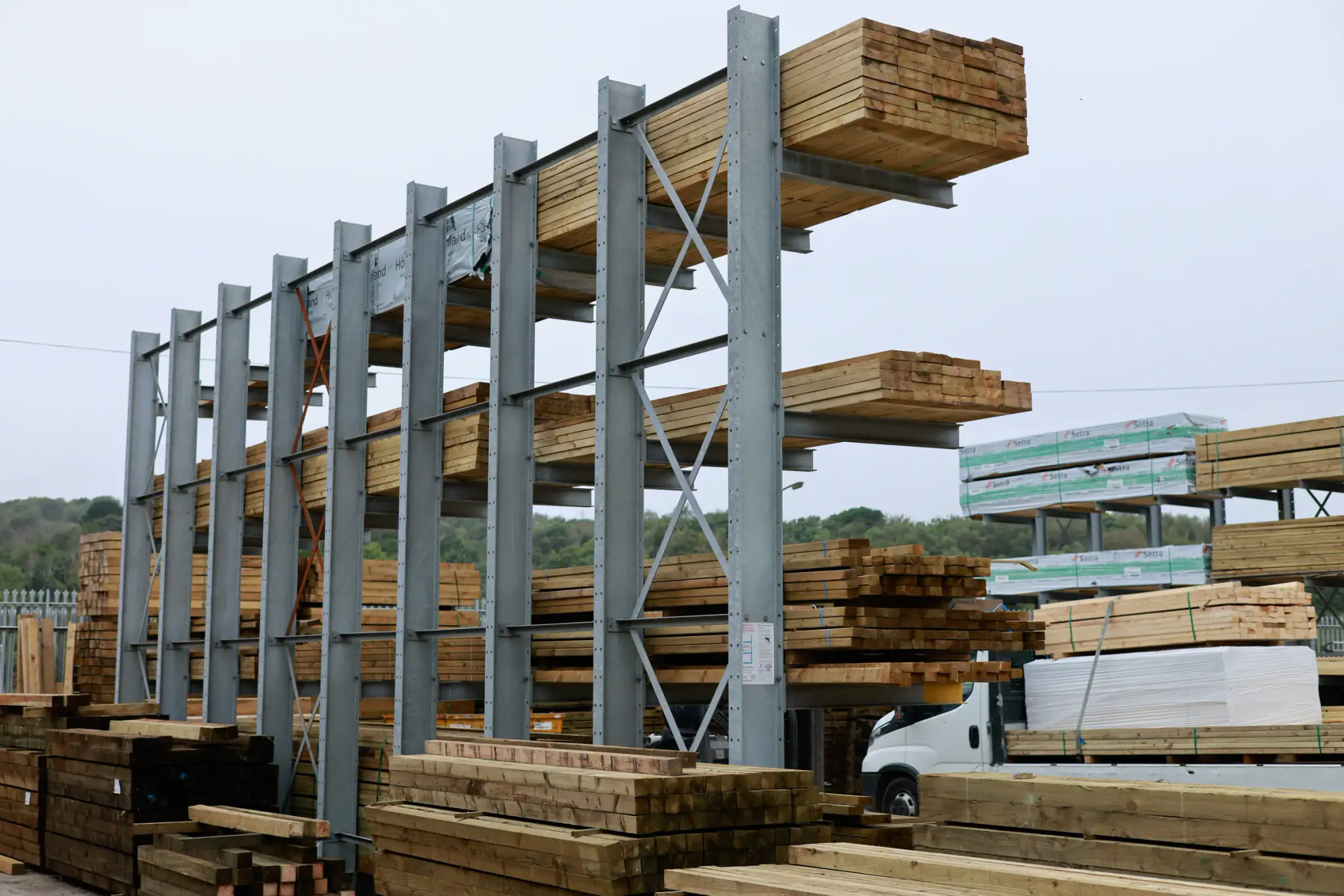
Cantilever racking. For stock that will never fit a pallet.
Timber, bar, tube, sheet, extrusions and tooling. Arms project from a central column with nothing in front of them, so a six metre length goes on sideways along its length and comes off the same way, without threading it between uprights.
Long stock stored flat, supported along its length, and reachable one length at a time.
- Front uprights
- 0
- Configurations
- 1 or 2sided
- Working aisle
- 3.0 to 4.5m
- Outdoor finish
- Galvanised
No front upright, nothing in the way.
Pallet racking has an upright at each end of every beam, and that upright limits what goes in to the length of the bay. Cantilever racking removes the front of the structure altogether.
A row of columns stands on bases, braced together along the back. Arms project forward from each column, and the stock rests across the arms of several columns at once. The front face is open along the whole length of the run, so the only limit on the length you store is the length of the run itself.
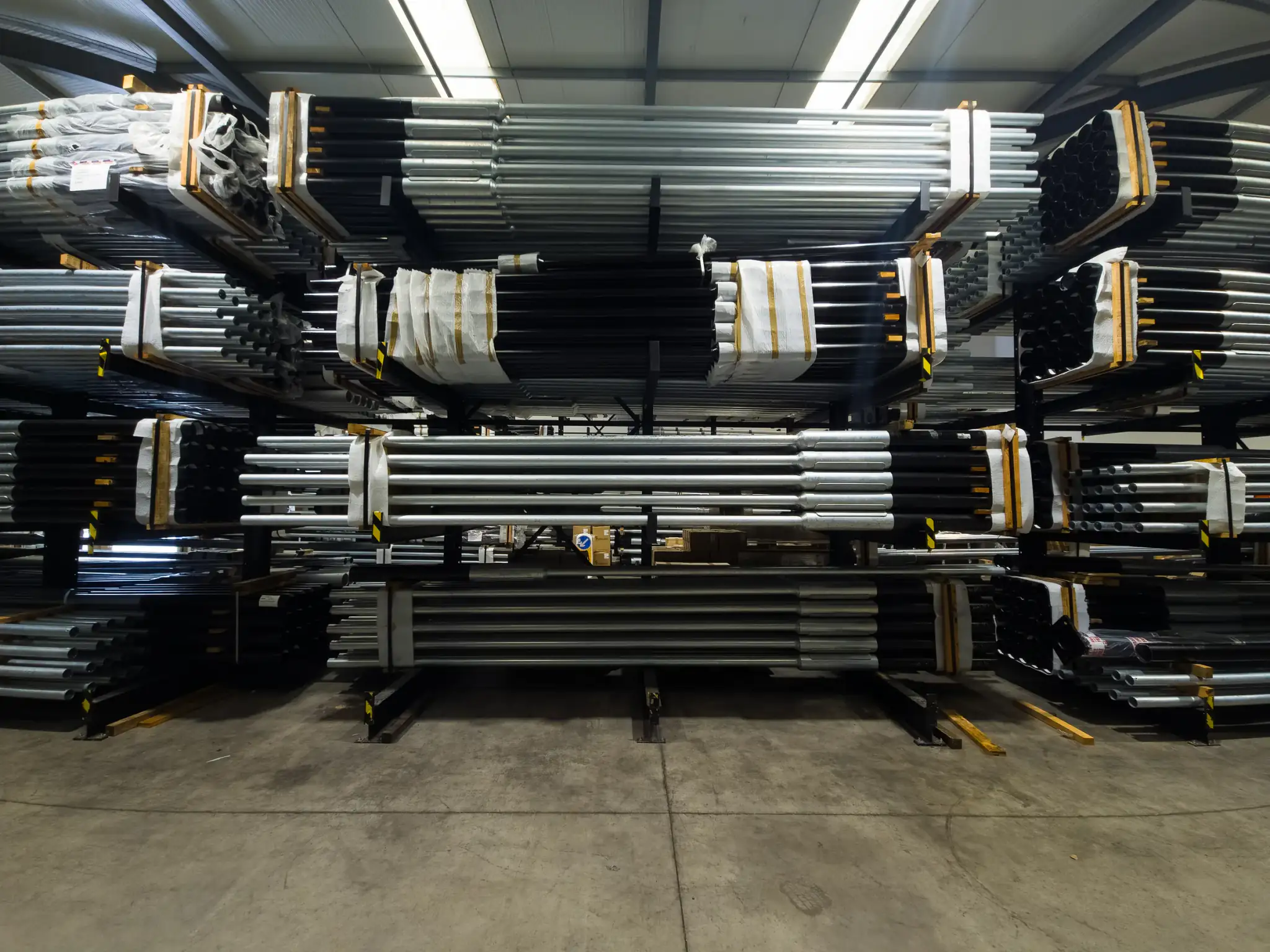
Arms adjust in height on the column, so levels can be reset as the stock changes. A merchant that moves from short boards to long joists in the spring changes the arm levels, not the racking.
Columns
The spine of the run. Height and section set by the load and the number of arm levels.
Bases
Extend forward under the bottom arms to resist overturning, and carry the bottom level of stock where needed.
Arms
Straight or inclined, height adjustable, with end stops or lips to stop round stock rolling off.
Bracing
Ties the columns together along the back of the run into a single stable structure.
What it stores, and what floor storage was doing to it.
Most cantilever enquiries start with stock that is being damaged on the floor. The racking is specified against what goes wrong with each material when it is not supported properly.
Timber and lumber
Metal profiles and sections
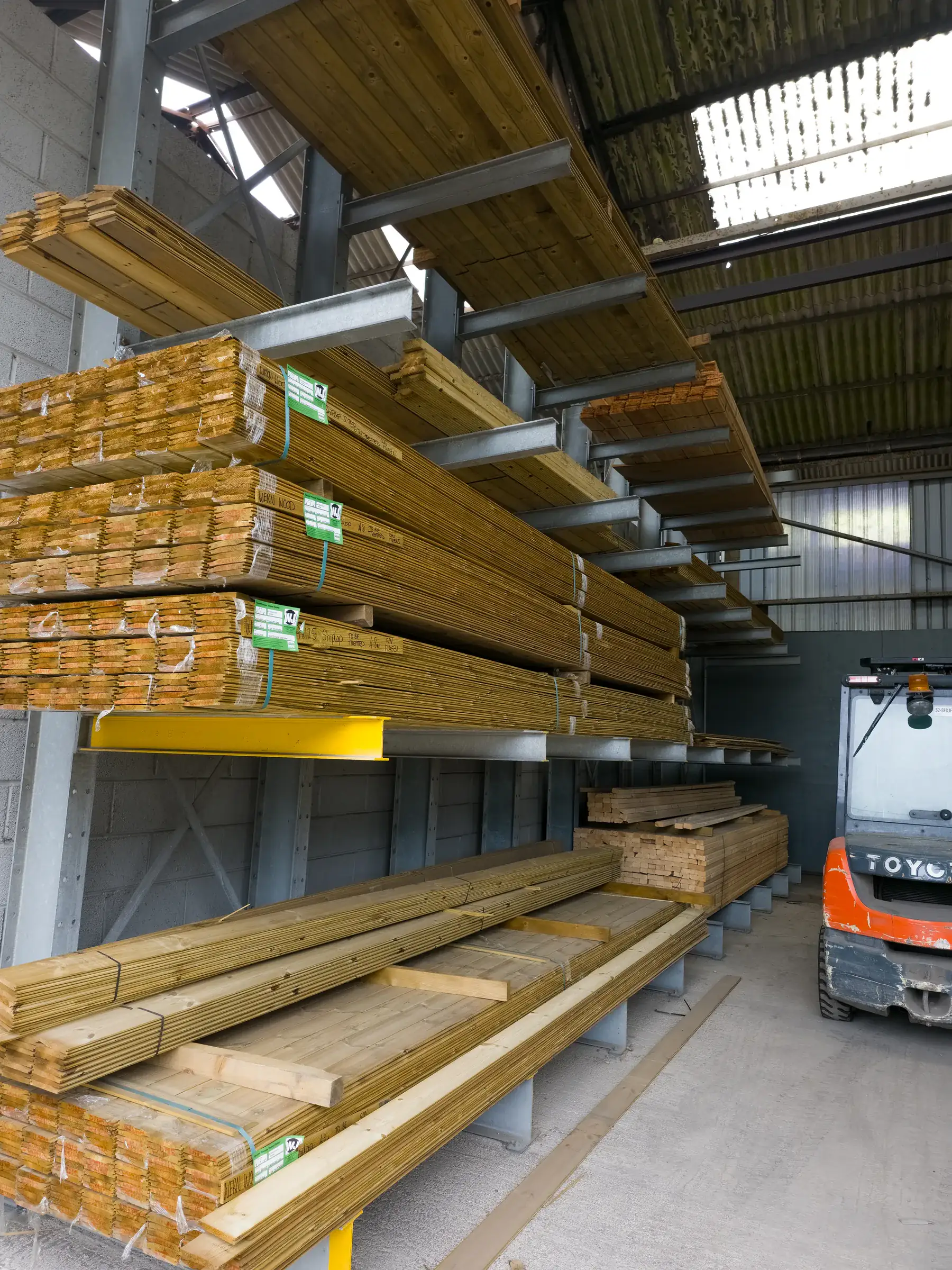
Bar, tube and pipe
Sheet materials and boards
Extrusions
Tooling and jigs
Arm spacing is set so the stock is supported along its length, with the shortest item still resting on at least two arms. Arm length is set by the deepest bundle, and arm levels by the bundle heights measured at survey, leaving pitch adjustment for whatever comes next.
Single sided, double sided or outdoor.
The same components arranged three ways. The building, the yard and the truck usually make the decision.
| Attribute | Single sided | Double sided | Galvanised outdoor |
|---|---|---|---|
| Arms | One face of the column | Both faces of the column | One or both faces |
| Position | Against a wall | Freestanding, mid floor or yard | Yard, open or roofed |
| Aisles served | One | Two, one each side | One or two |
| Arm positions per column line | One face | Roughly twice single sided | As configured |
| Finish | Powder coated or painted | Powder coated or painted | Hot dip galvanised |
| Roof and cladding | Not usually needed indoors | Not usually needed indoors | Optional roof and side cladding |
| Typical use | Extrusions, profiles, wall height | Merchant stock, steel stockholding | Timber yards, builders merchants |
| Truck | Sideloader, counterbalance or crane | Sideloader or multi-directional | Sideloader or counterbalance |
Cantilever racking configurations compared.
- Arms
- One face of the column
- Position
- Against a wall
- Aisles served
- One
- Arm positions per column line
- One face
- Finish
- Powder coated or painted
- Roof and cladding
- Not usually needed indoors
- Typical use
- Extrusions, profiles, wall height
- Truck
- Sideloader, counterbalance or crane
Covered storage without a building.
Galvanised cantilever racking with a roof and side cladding turns unused yard into covered storage. No foundations for a portal frame, no new building envelope, and the stock stays dry and off the ground.
The roof is carried by the cantilever columns themselves, extended above the top arm level, and can overhang the loading face to keep rain off stock as it is lifted. Side cladding closes the exposed end or the back of a single sided run against the prevailing weather, which on a Welsh coastal yard is not a detail.
Galvanising is specified because painted steel outdoors chips at every arm contact point and rusts from there. Wind and snow loads on a roofed structure are part of the design, which is one reason outdoor cantilever always comes through the survey rather than off the shelf.
Heavy duty specification.
Light duty cantilever for workshop stock and heavy duty cantilever for steel stockholding are the same idea at very different sections. Every capacity figure comes from the manufacturer's data for the exact combination of column, arm and base.
| Attribute | Figure | Set by |
|---|---|---|
| Arm capacity | Manufacturer data, on the load notice | Arm section, length and column |
| Column capacity | Manufacturer data, on the load notice | Column section, height and arm levels |
| Arm adjustment | Height adjustable on the column | Manufacturer pitch |
| Arm type | Straight, inclined, with end stops or lips | Stock type |
| Arm spacing | Shortest item rests on at least two arms | Design, against stock lengths |
| Arm length | Set by the deepest bundle or item | Survey measurements |
| Working aisle | 3.0 to 4.5m | Truck and longest load |
| Truck | Sideloader, multi-directional, counterbalance or crane | Your fleet and stock |
| Finish, indoor | Powder coated or painted | Specification |
| Finish, outdoor | Hot dip galvanised, optional roof and cladding | Specification |
| Standards | Designed to manufacturer data, used and inspected under EN 15635 | Design and operation |
| Lead time | Typically 4 to 8 weeks, longer for roofed outdoor runs | Manufacturer |
Cantilever racking specification. Capacities are manufacturer data for the configuration as built and are printed on the load notice.
- Arm capacity
- Manufacturer data, on the load notice
- Column capacity
- Manufacturer data, on the load notice
- Arm adjustment
- Height adjustable on the column
- Arm type
- Straight, inclined, with end stops or lips
- Arm spacing
- Shortest item rests on at least two arms
- Arm length
- Set by the deepest bundle or item
- Working aisle
- 3.0 to 4.5m
- Truck
- Sideloader, multi-directional, counterbalance or crane
- Finish, indoor
- Powder coated or painted
- Finish, outdoor
- Hot dip galvanised, optional roof and cladding
- Standards
- Designed to manufacturer data, used and inspected under EN 15635
- Lead time
- Typically 4 to 8 weeks, longer for roofed outdoor runs
Arm capacity: Set by manufacturer data for the arm and column. Column capacity: Set by manufacturer data, confirmed at design.
Who uses cantilever racking.
Anyone whose stock is measured in metres rather than pallets.
Timber merchants
Builders merchants
Steel stockholders
Plumbing and electrical wholesale
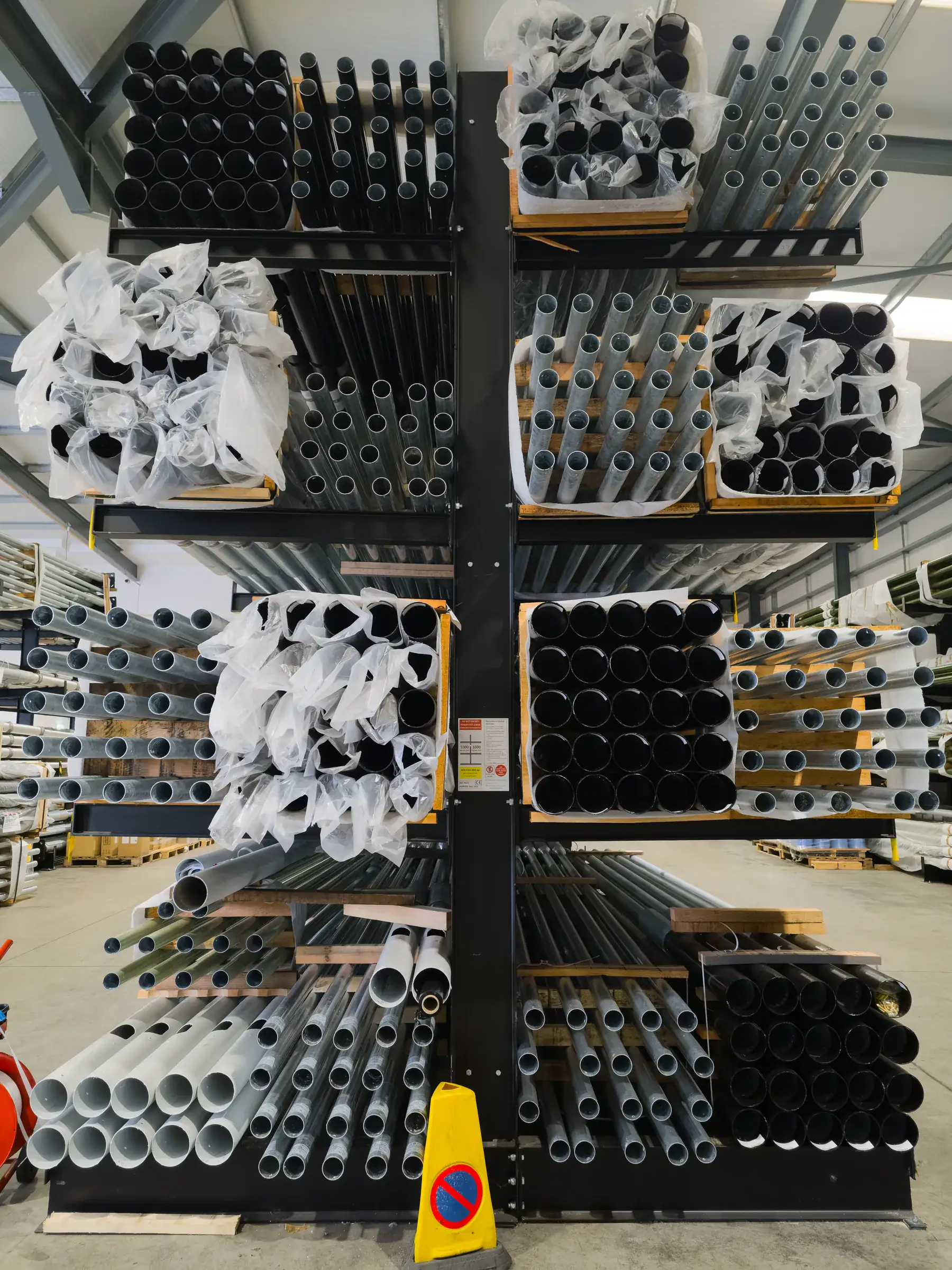
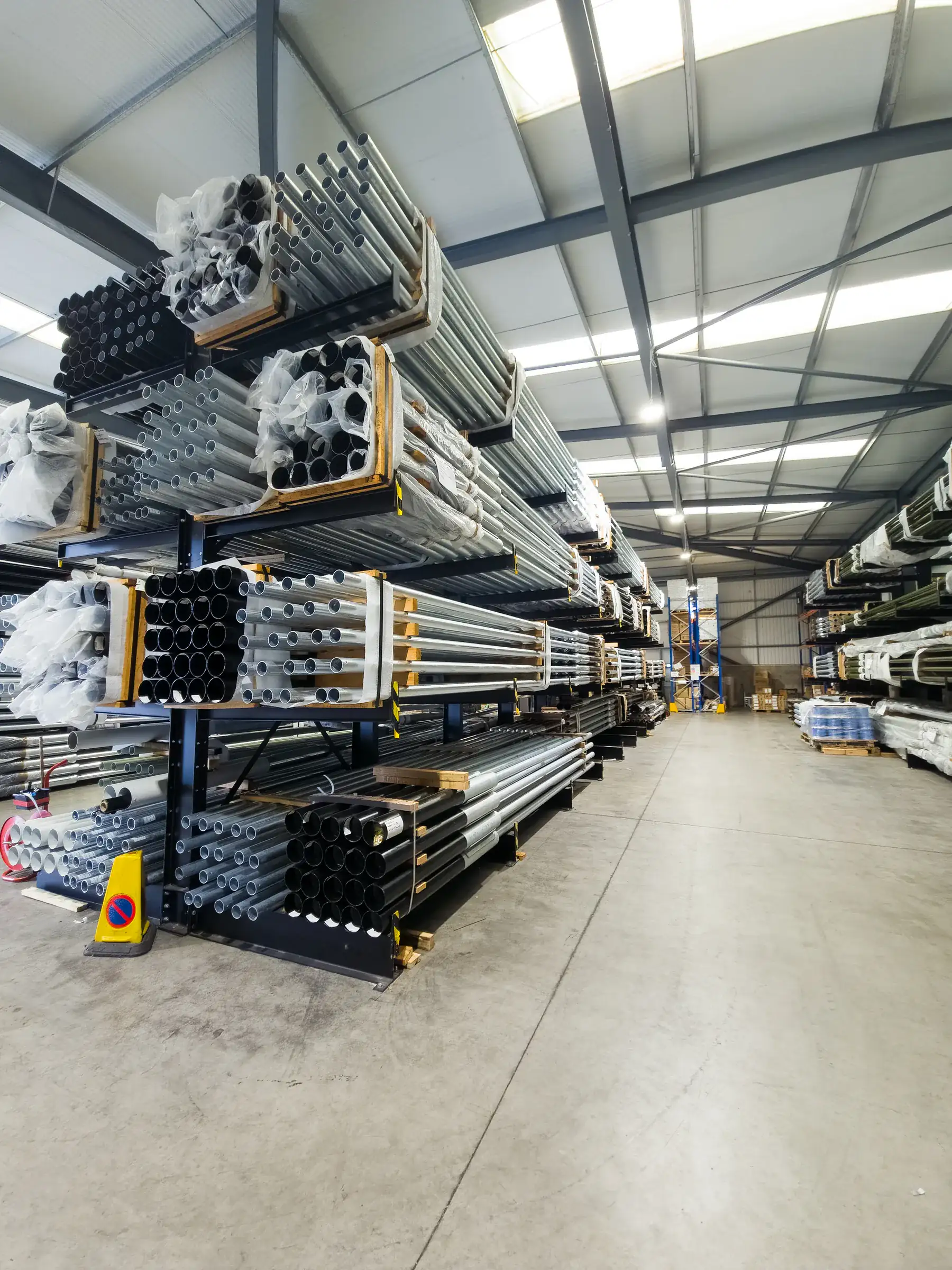
Two cantilever runs in South Wales.
Both started with stock on the floor. Both now give every item its own arm position.
When cantilever is the wrong answer.
It is a specialist structure for specialist stock. Used for anything else, it costs more and holds less.
Palletised goods
Short items and boxed stock
Coil and cylinders
No room for the aisle
Unknown loads
Mixed second hand arms
Used cantilever racking.
Second hand cantilever is a sensible route to capacity, on the same conditions as used pallet racking: identified, inspected, matched and rated.
Columns are checked for straightness and base damage, arms for bending at the root and at the connection, and every component is matched to one manufacturer and one series. The configuration is then load rated from manufacturer data, and the load notice goes on the run. If we cannot identify a component, we do not sell it.
Read how we check, match and rate second hand components on the used pallet racking page, or sell us a redundant cantilever run.
Neighbouring systems.
Cantilever accessories and yard safety online
Barriers, bollards, column protection, signage and handling equipment for the yard and workshop are on the online store. A cantilever run is designed to your stock lengths and weights, so the racking itself comes through the survey.
- Racking & shelving (opens the online store in a new tab)
- Storage (opens the online store in a new tab)
- Safety & premises (opens the online store in a new tab)
- Trucks & trolleys (opens the online store in a new tab)
- Steps & ladders (opens the online store in a new tab)
- Lifting, drum & cylinder (opens the online store in a new tab)
- Workshop & environment (opens the online store in a new tab)
- Office & mailroom (opens the online store in a new tab)
Cantilever questions, answered.
Long, bulky or awkwardly shaped stock that will never fit on a pallet: timber and lumber, metal profiles, bar, tube and pipe, sheet materials and boards, aluminium extrusions, and tool and jig storage. Arms project from a central column with no front upright, so long lengths load sideways along their length.
Single sided cantilever has arms on one face only and usually stands against a wall, using height that is otherwise empty. Double sided has arms on both faces of the column and stands freestanding in the middle of a building or yard, worked from two aisles. Double sided gives roughly twice the arm positions on one line of columns.
Arm capacity is set by the manufacturer's data for the arm section, arm length and column, and it is printed on the load notice for the configuration as built. We do not quote arm or column capacities before the stock has been weighed and measured, because the rating depends on the whole combination, not the arm alone.
Yes. Hot dip galvanised cantilever racking is built for outdoor use, and it can be fitted with a roof and side cladding. That turns unused yard into covered storage without erecting a building, which is why builders merchants and timber yards use it so widely.
Close enough that the stock is supported along its length and does not sag between arms. As a working rule, the shortest item you store must still sit on at least two arms. Arm spacing is set at design against your longest and shortest lengths and the stiffness of the material.
Yes. Arms are height adjustable on the column, so levels can be reset as the stock changes. Any change to the arm configuration should be checked against the load notice, because moving arms changes what the column carries.
Sideloaders and multi-directional trucks are the natural choice for long loads, because they carry lengths parallel to the aisle. Counterbalance trucks with long forks and overhead cranes also work. Typical working aisles are 3.0 to 4.5m, set by the truck and the longest load.
Where we can identify the manufacturer and confirm every column, arm and base is sound and matched, yes. Columns and arms are not interchangeable between manufacturers, and a used configuration still needs a load rating from manufacturer data. See our used pallet racking page for how we check and rate second hand components.
No. A pallet on cantilever arms wastes both the arm capacity and the height. Palletised goods belong in adjustable pallet racking, which can sit alongside a cantilever run in the same building.
Yes. It is racking and work equipment under PUWER 1998, so it falls under the same regime as pallet racking: regular recorded visual checks by your Person Responsible for Racking Safety and an expert inspection at least every 12 months, as set out in HSG76 and EN 15635.
Send us your longest length and your heaviest bundle.
Those two figures set the arm length, the arm spacing and the column. We will measure the rest at the survey and come back with a layout and a price.