
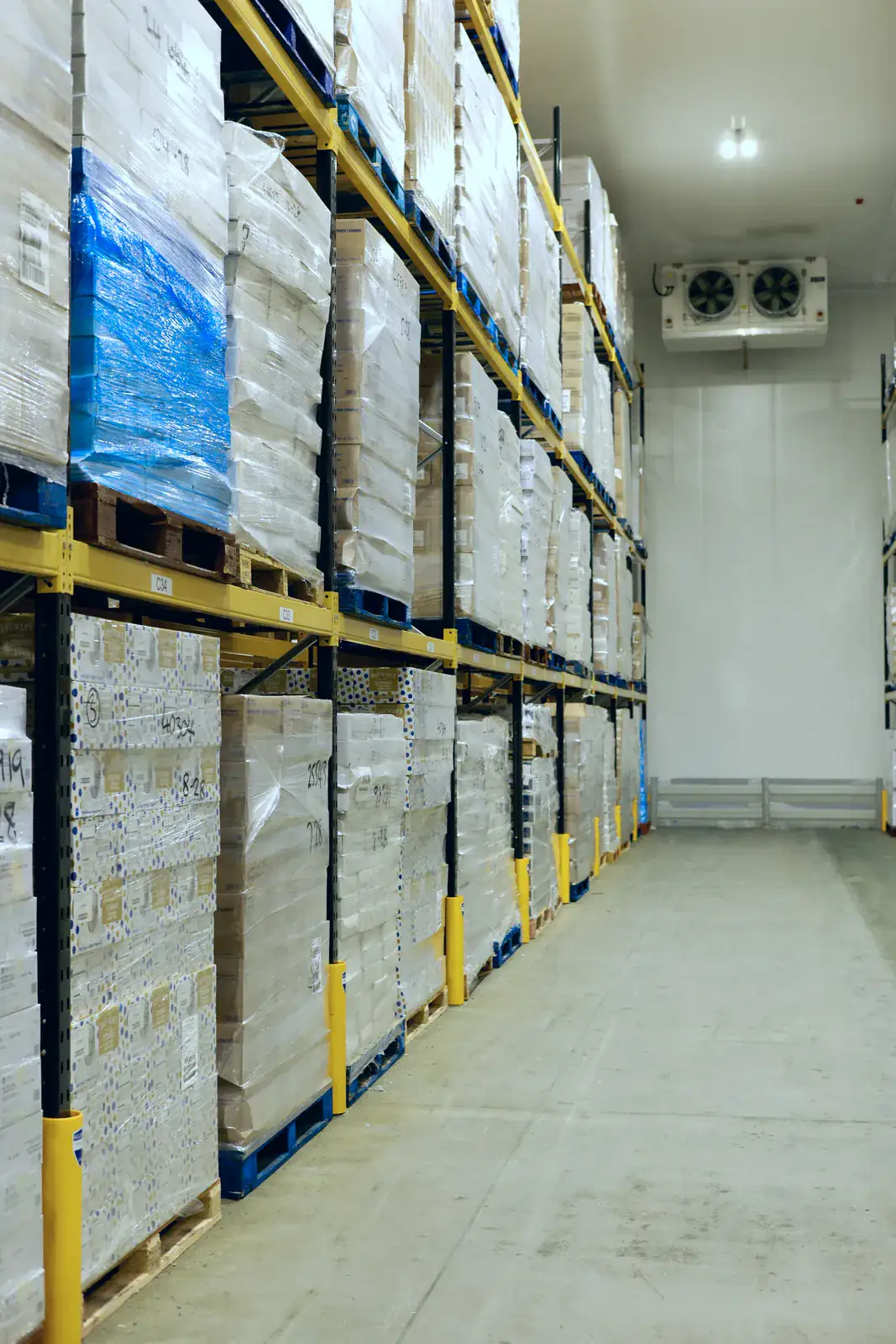
Mobile racking. Every pallet reachable, one aisle.
Adjustable pallet racking on powered bases that run on rails set flush into the floor. The bases close together and open one aisle on demand, so you get density close to drive-in without giving up access to a single pallet.
Density usually costs selectivity. Mobile racking pays for it in time instead.
- Selectivity
- 100%
- Open aisles
- 1at a time
- Cold store rating
- −30°C
- Standard
- BS EN 15095
The arithmetic of one aisle.
Static racking needs an aisle for every pair of runs. Mobile racking needs one aisle for the whole block, and moves it to wherever the truck needs to be.
Take a block of eight rows of racking: a single run against each wall and three double runs between them. Laid out as static adjustable pallet racking for a reach truck, it needs four working aisles. Mounted on mobile bases, it needs one.
At reach truck aisle widths of 2.7 to 3.2m, the three aisles removed return between 8.1 and 9.6 metres of building width to storage, along the full length of the block. In a counterbalance layout, at 3.5 to 4.2m per aisle, the figure is 10.5 to 12.6 metres.
The racking on the bases is ordinary adjustable pallet racking, with the same frame depths, beam lengths and beam pitch. Nothing about the pallet positions changes. Only the aisles do.
Aisle widths per truck class are working ranges from our racking system comparison, confirmed at survey.
- Aisles, static layout
- 4
- Aisles, mobile layout
- 1
- Width recovered, reach
- 8.1 to 9.6m
- Width recovered, counterbalance
- 10.5 to 12.6m
- Selectivity, both layouts
- 100%
- Pallet positions per bay
- Unchanged
How an aisle opens.
The bases are machinery, so the sequence is controlled and interlocked. Nobody pushes anything by hand.
- Step 1
Select the aisle
The operator selects an aisle at the control panel or remote. The system checks the block is clear.
- Step 2
Bases travel
Drive motors move the bases along the floor rails, closing the old aisle and opening the new one.
- Step 3
Aisle locks open
Presence detection protects the open aisle. Movement stops if anyone or anything enters a closing aisle.
- Step 4
Truck works the aisle
A standard counterbalance or reach truck works the open aisle exactly as it would a static one.
Floor rails
Set flush into the slab, so trucks and pedestrians cross them without a step. Cast into new slabs or grouted into a cut channel in an existing one.
Mobile bases
Steel chassis carrying the racking, with drive motors, wheels running on the rails and anti-tip guidance.
Racking
Standard adjustable pallet racking: 900 or 1100mm frame depths, beam lengths of 1500 to 5000mm.
Safety devices
Presence detection, emergency stops and interlocks specified under BS EN 15095 for power-operated mobile storage.
Controls
Panel on each base or a central controller, with options for remote selection and aisle lighting that follows the open aisle.
Power
Supply routed to the bases as part of the design, with the electrical work included in the scope.
Less volume to light, heat and freeze.
Compacting the footprint does more than add positions. A block that occupies less floor occupies less refrigerated, heated or lit volume, so mobile racking cuts running cost as well as adding capacity.
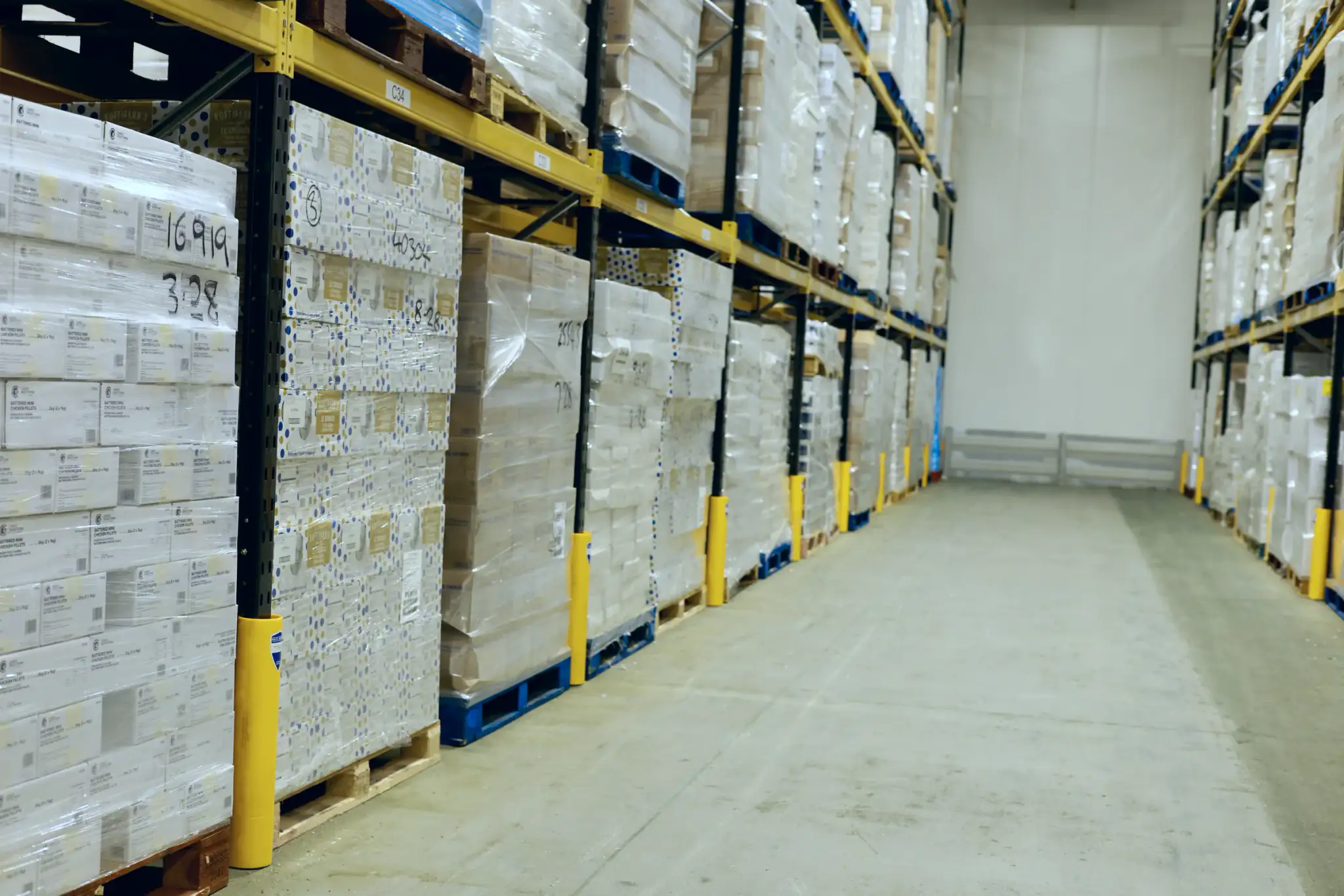
That is why cold stores are its strongest market. Mobile racking is cold store capable to minus 30C, and every cubic metre of freezer that holds pallets rather than air is a cubic metre you are not paying to chill for nothing. Aisle lighting can follow the open aisle, so the rest of the block sits dark.
Specification.
Figures we can publish, and the ones that only come from the design for your floor and your loads.
| Attribute | Figure | Notes |
|---|---|---|
| Selectivity | 100% | Every pallet accessible when its aisle is open |
| Open aisles | One at a time | The whole block shares one working aisle |
| Operating temperature | Ambient to minus 30C | Cold store components specified for the temperature |
| Racking on the bases | Adjustable pallet racking | 900 or 1100mm frames, 1500 to 5000mm beams |
| Truck | Counterbalance or reach | No specialist truck needed |
| Aisle width | 2.7 to 3.2m reach, 3.5 to 4.2m counterbalance | Set by truck class, confirmed at survey |
| Floor | Rails set flush into the slab | Floor survey for level and condition required |
| Run length | Set by the design and the floor rails | Manufacturer data for your configuration |
| Rotation | Either, operator controlled | Selective racking, so FIFO or LIFO by procedure |
| Governing standards | BS EN 15095, Machinery Directive | Plus BS EN 15512 design and EN 15635 inspection |
Mobile pallet racking specification. Run length and loads are confirmed by the manufacturer's design for your configuration.
- Selectivity
- 100%
- Open aisles
- One at a time
- Operating temperature
- Ambient to minus 30C
- Racking on the bases
- Adjustable pallet racking
- Truck
- Counterbalance or reach
- Aisle width
- 2.7 to 3.2m reach, 3.5 to 4.2m counterbalance
- Floor
- Rails set flush into the slab
- Run length
- Set by the design and the floor rails
- Rotation
- Either, operator controlled
- Governing standards
- BS EN 15095, Machinery Directive
Maximum run length: Set by the design and the floor rails. Load per base: Manufacturer design data.
Mobile against drive-in and static racking.
The three ways to fill a block with pallets, set against the things that usually decide it.
| Attribute | Mobile racking | Drive-in racking | Adjustable pallet racking |
|---|---|---|---|
| Selectivity | 100% | Per lane | 100% |
| Density | Very high | Very high | Low |
| Working aisles in the block | One | None, trucks enter lanes | One per pair of runs |
| Products per lane or bay | Any mix | One per lane | Any mix |
| Rotation | Either | LIFO, or FIFO if drive-through | Either |
| Truck inside the racking | No, works an open aisle | Yes, drives into the lane | No |
| Access time | Wait for the aisle to open | Immediate at the lane face | Immediate |
| Floor works | Rails in the slab | None beyond fixings | None beyond fixings |
| Capital cost | Highest of the three | Middle | Lowest |
Comparison of mobile, drive-in and static adjustable pallet racking.
- Selectivity
- 100%
- Density
- Very high
- Working aisles in the block
- One
- Products per lane or bay
- Any mix
- Rotation
- Either
- Truck inside the racking
- No, works an open aisle
- Access time
- Wait for the aisle to open
- Floor works
- Rails in the slab
- Capital cost
- Highest of the three
When mobile racking is the wrong answer.
The trade is time. If your operation cannot afford to wait for an aisle, the density is not worth it.
High throughput
Several trucks at once
Floor you cannot cut
Few SKUs, many pallets each
Short tenancy
Height to spare
Neighbouring systems.
Other ways to put more pallets into the same floor.
Static racking components and safety kit online
Beams, frames, decking, barriers and signage for the rest of the building are on the online store. Mobile racking is machinery on a designed floor, so it always comes through the survey.
- Racking & shelving (opens the online store in a new tab)
- Storage (opens the online store in a new tab)
- Safety & premises (opens the online store in a new tab)
- Trucks & trolleys (opens the online store in a new tab)
- Steps & ladders (opens the online store in a new tab)
- Lifting, drum & cylinder (opens the online store in a new tab)
- Workshop & environment (opens the online store in a new tab)
- Office & mailroom (opens the online store in a new tab)
Mobile racking questions, answered.
Mobile racking is adjustable pallet racking mounted on powered mobile bases that run on rails set flush into the floor slab. The bases close up against each other and only one aisle is open at a time. You open the aisle you need, the bases move, and every pallet in that aisle is accessible. Selectivity stays at 100 percent.
It depends on how many aisles it removes. A block that needs four or five working aisles as static racking needs one as mobile racking. With reach truck aisles of 2.7 to 3.2m, each aisle removed returns that width of floor to storage. Your survey layout gives the actual pallet count for both options side by side.
Yes. Mobile racking is cold store capable to minus 30C with components specified for the temperature. It is one of its strongest applications, because compacting the block reduces the volume that has to be refrigerated as well as adding positions.
BS EN 15095 covers power-operated mobile storage equipment, and the bases are machinery, so the Machinery Directive requirements apply alongside the racking design standard BS EN 15512. Like any racking it also needs regular inspection under EN 15635 and HSG76.
Run length is set by the design, the drive arrangement and the floor rails. We do not quote a maximum before the floor and the load have been surveyed. The figure comes from the manufacturer's design for your configuration.
The rails must be set flush into the slab, so either the slab is cut and the rails grouted in, or they are cast into a new slab or topping. The floor must be surveyed for level and condition first. This civil work is part of the project and is included in the survey and quotation.
Yes, per movement. Opening an aisle takes time, and only one truck can work the block at a time when only one aisle is open. That is acceptable for slower moving stock, archive and cold store reserve, and a real cost for high throughput operations.
Safety devices are part of the system design under BS EN 15095, including presence detection and controls that stop movement when an aisle is occupied. Operators are trained on the controls at handover, and the system is inspected with the rest of the racking.
Send us the floor plan and the temperature.
We will lay out the block as static racking and as mobile racking, and give you the pallet count for both. Then you decide whether the aisle you remove is worth the wait.