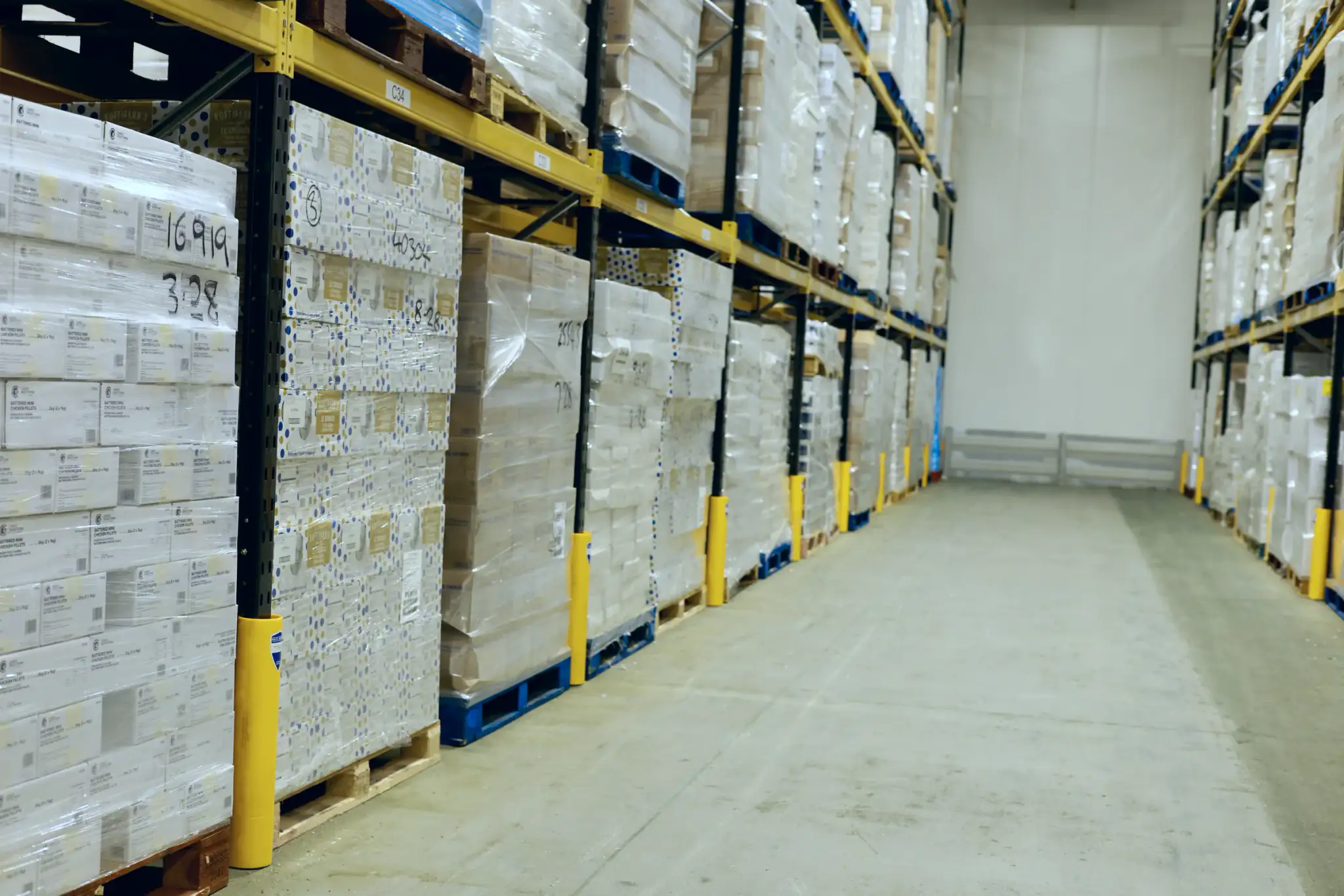
Double deep racking. Half the aisles, if the truck can reach.
Two rows of racking back to back, pallets stored two deep from a single aisle. It roughly halves the aisle count of a single deep layout, with the same frames and beams.
It needs a reach truck with telescopic or pantograph forks. That is a real budget line, and we price it from the start.
- Pallets per location
- 2 deep
- Selectivity
- 50%
- Rotation
- LIFO
- Aisle, telescopic reach
- 2.9 to 3.4m
- Aisle count
- ≈ half
Start with the truck, not the racking.
The racking for double deep is ordinary adjustable pallet racking. The difference is that the back pallet sits two pallet depths from the aisle, and a standard reach truck or counterbalance cannot get to it.
Reaching the rear position takes a reach truck with telescopic or pantograph forks. If your fleet does not have one, it is a purchase or hire cost that belongs in the comparison against other systems. Most suppliers leave it out of the racking quote, and the layout then looks cheaper than it is.
Telescopic forks also need a little more aisle, 2.9 to 3.4m against 2.7 to 3.2m for a standard reach truck, and the truck's residual lift capacity at full extension and height is lower than at normal reach. Both are taken from the truck manufacturer's data at survey.
| Truck | Front position | Rear position |
|---|---|---|
| Counterbalance | Yes | No |
| Standard reach truck | Yes | No |
| Reach, telescopic forks | Yes | Yes |
| Reach, pantograph forks | Yes | Yes |
What each truck can do in a double deep layout.
- Counterbalance
- Yes
- Standard reach truck
- Yes
- Reach, telescopic forks
- Yes
- Reach, pantograph forks
- Yes
Truck residual capacity at full reach: From the truck manufacturer's data
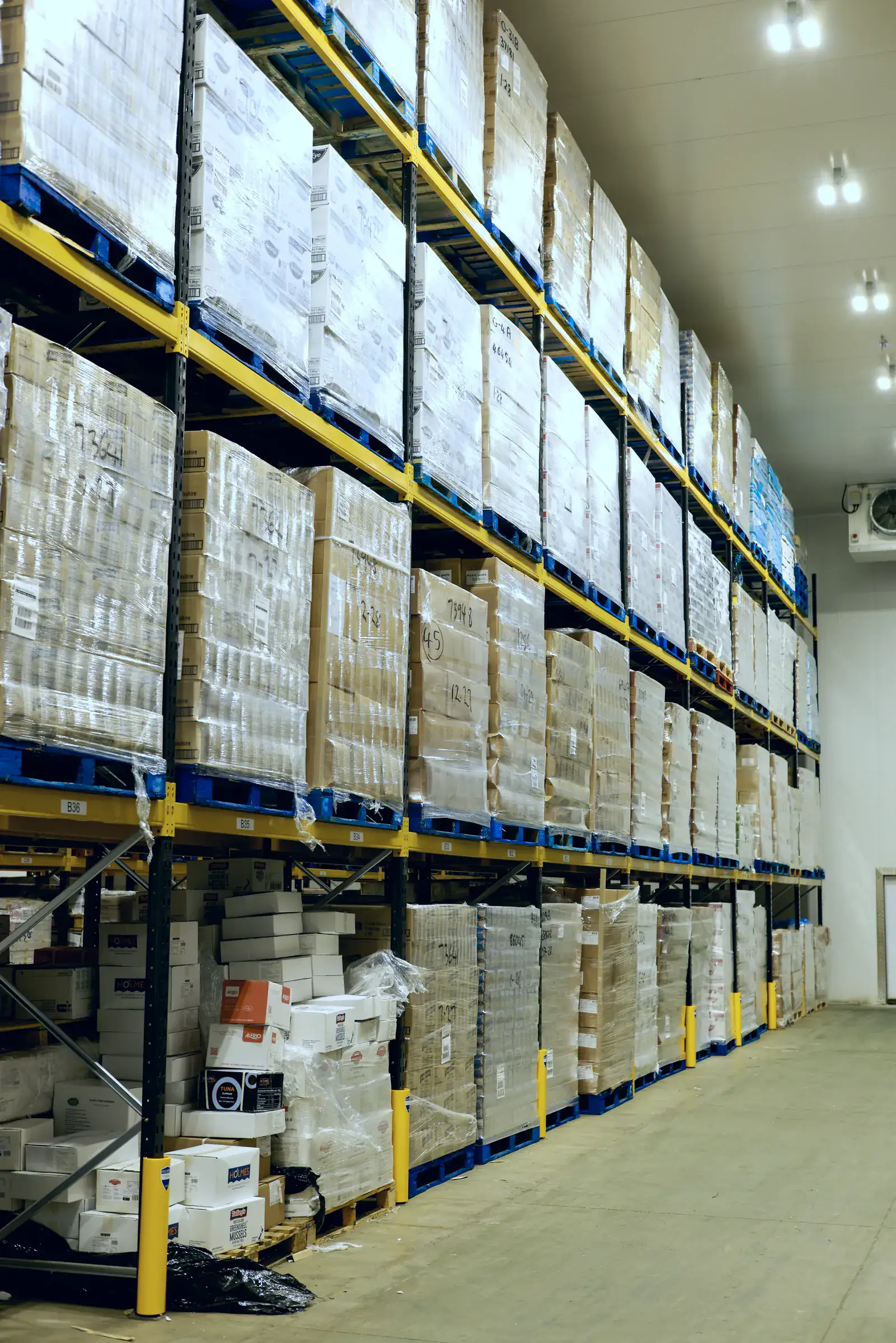
Two rows back to back.
In single deep racking each run is served by its own aisle face. In double deep two runs sit back to back with a spacer between them, and the pair is served from one side.
The first pallet into a location goes to the rear, the second goes in front of it. Retrieval reverses that: the front pallet comes out first. So each location is last in, first out, and 50 percent of your pallets are directly accessible at any time.
- Back to back runs joined by row spacers
- Pallet stops or rear beams at the back position
- Height selectors or cameras help the driver place at the rear
- Same frame depths and beam lengths as adjustable racking
Double deep racking specification.
The racking dimensions follow adjustable pallet racking. The aisle and the truck are what change.
| Attribute | Typical |
|---|---|
| Storage depth | Two pallets per location |
| Selectivity | 50 percent |
| Rotation | LIFO within each location |
| Aisle, telescopic reach truck | 2.9 to 3.4m |
| Aisle count | Roughly half of single deep |
| Upright frame depth | 900mm or 1100mm per row |
| Beam length | 1500mm to 5000mm |
| Beam pitch adjustment | 50mm to 75mm increments, by manufacturer |
| Truck | Reach truck with telescopic or pantograph forks |
| Lead time, new | 4 to 8 weeks from order |
Double deep racking. Typical ranges; final figures from the racking and truck manufacturers' data.
- Storage depth
- Two pallets per location
- Selectivity
- 50 percent
- Rotation
- LIFO within each location
- Aisle, telescopic reach truck
- 2.9 to 3.4m
- Aisle count
- Roughly half of single deep
- Upright frame depth
- 900mm or 1100mm per row
- Beam length
- 1500mm to 5000mm
- Beam pitch adjustment
- 50mm to 75mm increments, by manufacturer
- Truck
- Reach truck with telescopic or pantograph forks
- Lead time, new
- 4 to 8 weeks from order
When double deep is the wrong answer.
Double deep is a middle option. It is the right one only when your stock genuinely comes in pairs and the truck is in the budget.
One pallet per SKU
No telescopic truck
Strict FIFO
Very high pallets per SKU
Narrow aisle is possible
Slower cycles
Who it suits.
Operations with at least two pallets per SKU, a reach truck fleet that can include telescopic forks, and a floor that is short of aisles rather than short of height.
Typical users are food and drink producers, packaging and paper stockists, and distribution sites with medium sized SKU ranges where most lines run to several pallets. It is also a common step for an adjustable racking site that has outgrown its floor but is not ready for guided trucks.
Against the neighbouring systems.
Double deep sits between single deep selectivity and deep lane density. These are the comparisons that usually settle it.
| Attribute | Double deep | Adjustable | Narrow aisle | Push back |
|---|---|---|---|---|
| Selectivity | 50% | 100% | 100% | Per lane |
| Density | Medium | Low | Medium | High |
| Rotation | LIFO | Either | Either | LIFO |
| Aisle | 2.9 to 3.4m | 2.7 to 4.2m | 1.6 to 1.9m | 2.9 to 3.4m |
| Truck | Telescopic forks | Counterbalance or reach | Guided VNA | Standard |
Double deep racking against its nearest alternatives.
- Selectivity
- 50%
- Density
- Medium
- Rotation
- LIFO
- Aisle
- 2.9 to 3.4m
- Truck
- Telescopic forks
Read adjustable pallet racking, narrow aisle racking and push back racking, which goes deeper without a specialist truck. All nine are compared on pallet racking systems.
Beams, spacers and protection online
Beams, row spacers, decking and upright protection for existing racking are available from the racking and shelving department at palletrackingwales.shop. Double deep layouts start with a survey of your stock and trucks.
- Racking & shelving (opens the online store in a new tab)
- Storage (opens the online store in a new tab)
- Safety & premises (opens the online store in a new tab)
- Trucks & trolleys (opens the online store in a new tab)
- Steps & ladders (opens the online store in a new tab)
- Lifting, drum & cylinder (opens the online store in a new tab)
- Workshop & environment (opens the online store in a new tab)
- Office & mailroom (opens the online store in a new tab)
Double deep racking questions.
Two rows of adjustable pallet racking placed back to back on each side of an aisle, so pallets are stored two deep from a single aisle. It roughly halves the number of aisles compared with single deep racking, using the same frames and beams.
A reach truck with telescopic or pantograph forks that can extend to the rear position. A standard reach or counterbalance truck cannot reach the back pallet. Telescopic reach trucks typically work in a 2.9 to 3.4m aisle, slightly wider than the 2.7 to 3.2m of a standard reach truck.
50 percent. Half the pallets, the front ones, are directly accessible from the aisle. To reach a rear pallet the front pallet in that location must be moved first, unless both are the same product.
LIFO within each location. The last pallet placed, at the front, is the first one out. Across the warehouse you can still rotate stock by location, but within a double deep position the rear pallet waits for the front one.
At least two pallets of each product, and ideally an even number, so both positions in a location hold the same SKU. With a single pallet per SKU, half your stock sits behind something else and every retrieval becomes a double handle.
It depends on the building, but halving the aisle count lets more racking fit into the same floor. The gain is less than drive-in and more than single deep adjustable racking. A survey gives you a position count for both layouts over your own floor.
Often, because the frames and beams are the same type of component. Runs are re-spaced back to back, spacers are fitted and the layout is re-rated against the manufacturer's data. The biggest change is usually the truck, not the racking.
Because it makes the racking quote look higher once included. A reach truck with telescopic or pantograph forks is a real budget line, whether bought or hired, and the residual lift capacity at full extension is lower than at normal reach. We put the truck in the conversation at the start.
Send us your fleet list with your stock profile.
Pallets per SKU tell us if double deep fits. Your trucks tell us what it really costs. We will price the racking and the truck change together, alongside the layouts that need neither.