
Pallet racking in Carmarthen for the food, dairy and farm supply trade of West Wales.
Carmarthen is the market town for a county built on grass, milk and livestock. The warehouses around it hold what that economy needs and makes: chilled dairy and meat, ambient groceries for the catering trade, feed, fencing and animal health stock for the farms of the Tywi valley and beyond.
We design, install and inspect pallet racking for those stores, from Cillefwr at Johnstown to Parc Pensarn and out to the food park at Cross Hands. The questions we hear here are about rotation, chilled space and shift patterns, so that is where this page starts.
- Drive from Seven Sisters
- About 1 hour
- Road distance
- Around 40 miles
- Survey lead time
- Within 5 working days
- Two-way shuttle range
- −40°C to +50°C
Where Carmarthen keeps its stock: dairy, meat, feed and the A40 corridor.
Carmarthen sits where the M4 has already ended. The motorway stops at Pont Abraham, the A48 dual carriageway carries traffic on to the edge of town, and the A40 then splits west towards Whitland and Pembrokeshire and north east up the Tywi towards Llandeilo. That geography decides how warehouses here work. Stock arrives in full loads from the east and leaves in smaller drops to farms, shops, kitchens and creameries across three counties, so most stores pick far more cases than they ship full pallets.
The county has processed milk for a century. Carmarthen had a creamery by 1928, Whitland once dried milk on an industrial scale, and dairy plants in the Teifi valley still turn hundreds of tonnes of milk a day into cheese. Meat processing, bakery and chilled food cluster at the Cross Hands Food Park, which employs around 1,500 people. Around the town itself, the livestock centre at Nantyci and the agricultural merchants that serve it keep feed, minerals, wire and vet supplies moving all year, with sharp peaks at lambing and silage time.
The buildings vary widely: older steel portal sheds on Cillefwr, newer units at Parc Pensarn, and large temperature controlled halls at Cross Hands. Floor slabs, eaves heights and chilled areas differ from site to site, so we survey each one before quoting.
Cillefwr Industrial Estate, Johnstown
Trade counters, joinery and kitchen manufacture, and small distributors a short run from the A40 dual carriageway.
Parc Pensarn
Retail warehousing and motor factors beside the A48 junction, with stockrooms that mix long span shelving and pallet locations.
Cross Hands Food Park
Meat processing, food wholesale and chilled production in large temperature controlled buildings 13 miles east of town.
Carmarthen Livestock Centre, Nantyci
The county mart off the A40, surrounded by merchants holding bagged feed, fencing and animal health stock.
Whitland and the Teifi valley
Milk processing and cheese making to the west and north, where chilled and ambient packaging stores sit next to production.
Racking services for Carmarthen food, dairy and agricultural stores.
These are ordered by how often Carmarthen operators ask for them. Food and dairy sites lead with rotation and chilled storage; farm merchants and trade counters lean on adjustable racking and shelving.
Racking safety duties for Carmarthen food and agri sites.
PUWER 1998 places the duty on the business that uses the racking, and HSG76 sets out what good management looks like. In practice that means naming an appointed person responsible for racking safety, keeping a record of regular visual checks by trained staff, and booking an annual expert inspection by a SEMA Approved Rack Inspector. In Carmarthen food plants this sits beside BRC or retailer hygiene audits, and auditors increasingly ask to see the racking report as part of site condition, not only cleaning schedules.
Cold rooms bring their own risks. Frost on beams hides damage, condensation marks hide corrosion, and pickers in thermal gloves are less likely to notice a bent bracing member. Merchants have a different pattern: a quiet winter, then a rush of feed, fertiliser and fencing deliveries in spring when relief drivers and borrowed telehandlers are in the yard. We help Carmarthen duty holders set check frequencies to match those peaks, and train staff to log, report and offload damaged locations before the inspector arrives.
Date coded stock in Carmarthen: rotation, chilled space and the cold chain.
West Wales dairy and meat travel a long way after they leave the plant. Product from Carmarthenshire heads east along the A48 and M4 to depots in South Wales and England, so shelf life used up in storage is shelf life the retailer never sees. That makes rotation the first question we ask on any Carmarthen food site: how many lines, how many pallets of each, and how many days of life the customer will accept on arrival.
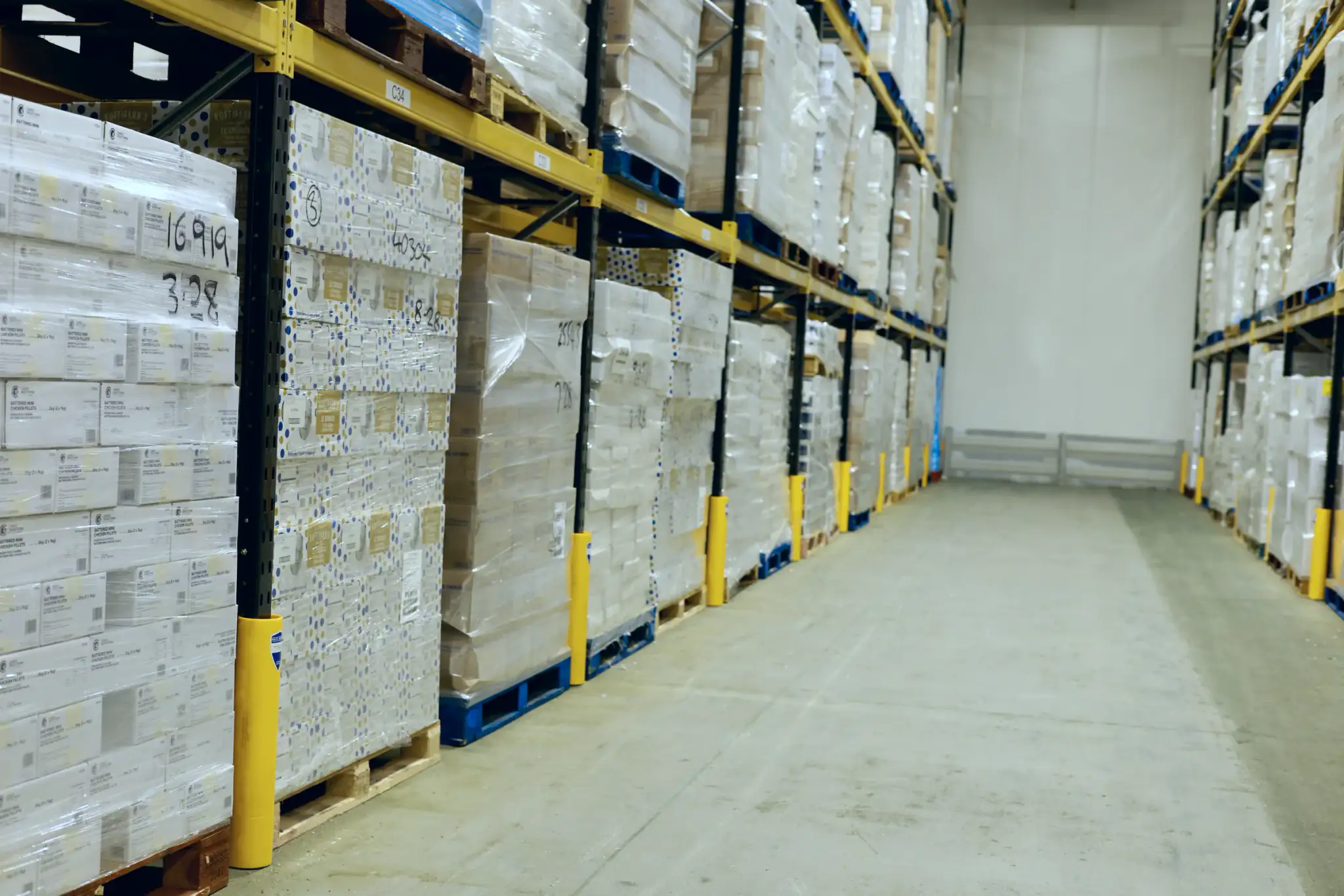
The answer usually splits the store in two. A small number of fast lines, such as standard cheese blocks, milk powders or bulk chilled cuts, suit deep lanes, either gravity fed pallet live or a two-way shuttle that keeps the cold room dense. The long tail of slower lines stays in adjustable racking with good bay labelling, so pickers find the right batch at the first location they check. Getting that split right usually saves more refrigerated floor than any change of racking type alone.
First in, first out by design
Dense chilled blocks
Clear batch locations
Lead times to plan around
Getting to Carmarthen and planning work around your site.
From Seven Sisters we head down to the M4, run west to the end of the motorway at Pont Abraham and take the A48 into Carmarthen, around 40 miles and about an hour. For Cross Hands it is closer to 45 minutes. That puts Carmarthen inside a normal working day for surveys and inspections, and our installation crews can start early without overnight stays on most jobs.
Food plants rarely stop, so we plan around them. Inspections can run on a weekend or a scheduled hygiene shutdown, and installs in chilled rooms are phased bay by bay so product can be moved and the doors kept closed. For merchants we avoid mart days and spring delivery peaks where we can, and we bring materials on a single load from Seven Sisters to keep the yard clear.
- Carmarthen from Seven Sisters
- About 1 hour
- Cross Hands from Seven Sisters
- About 45 minutes
- Weekend and shutdown working
- Available
- Mezzanine steelwork on site
- 1 to 3 weeks
A typical Carmarthen project: re-planning a chilled store for rotation.
A typical job here starts with a food or dairy business that has outgrown its cold room. Product sits in block stacks on the floor, the oldest pallets end up at the back, and short dated stock is written off every month. We survey the room, record the cooling plant, door and drain positions, and map the lines by volume and shelf life before proposing a layout.
The usual result combines pallet live lanes or a two-way shuttle for the fastest lines with adjustable racking for the rest, fitted with clear bay location labels. Ambient packaging and ingredients often move out to a separate racked area so the chilled space only holds product that needs it. Installation is phased so the site keeps despatching throughout, and the finished store is handed over with load notices and an inspection schedule.
Standard racking and shelving delivered to Carmarthen
Bays, beams, shelving, protection and handling kit are in stock on the online store and delivered to Carmarthen. Designed systems still come through the free survey, because a layout has to be measured before it can be priced.
- Racking & shelving (opens the online store in a new tab)
- Storage (opens the online store in a new tab)
- Safety & premises (opens the online store in a new tab)
- Trucks & trolleys (opens the online store in a new tab)
- Steps & ladders (opens the online store in a new tab)
- Lifting, drum & cylinder (opens the online store in a new tab)
- Workshop & environment (opens the online store in a new tab)
- Office & mailroom (opens the online store in a new tab)
Questions from Carmarthen.
Usually, yes. We phase the work so one section of the cold room is cleared, racked and handed back before the next section starts. On a typical Carmarthen chilled store that means two to four phases over a few days, with product moved into a holding area or a hired refrigerated trailer while each phase is fitted. Fixings and tools are chosen for low temperatures, and we keep door openings short to protect the room. If your cooling plant needs a full defrost, we can align the busiest phase with it.
It depends on the number of lines and pallets per line. Pallet live lanes are gravity fed, need no power, and suit perhaps 10 to 40 lines each with a steady flow, giving strict first in, first out. A two-way shuttle suits fewer lines in much deeper lanes, 30 to 50 pallets deep, and works from −40°C to +50°C at around 30 pallets per hour. Many Carmarthenshire dairies end up with both: shuttle for the highest volume products and live lanes for the next tier.
We can usually survey a Carmarthen site within 5 working days of your call. Standard adjustable pallet racking is then typically installed 4 to 8 weeks from order, depending on the components and quantities. Shuttle systems take longer, typically 12 to 16 weeks, because the carriers and rails are made to order. Mezzanine steelwork usually takes 1 to 3 weeks on site once materials arrive. If you are working towards a spring peak or a new contract start date, tell us at the survey so we can plan back from it.
Bagged feed and minerals sit well on standard pallet racking, with 1100mm deep frames if your pallets overhang. Fencing rolls, posts and gates are awkward, so many merchants use a few bays of heavier beams at low level, or cantilever racking for long lengths. Animal health, tags and small hardware go on long span shelving at the trade counter. We also look at where your telehandler or forklift turns, because merchant yards near Nantyci often have tight access between the store and the loading area.
Increasingly they do. BRC and retailer auditors look at the condition of the site, and damaged or corroded racking near open product is a foreign body and hygiene risk as well as a safety issue. Having a current SEMA approved inspection report, a log of visual checks and evidence that red and amber actions were closed out gives the auditor what they need. We can time your annual inspection a few weeks before the audit so repairs are complete when the auditor arrives in Carmarthen.
Yes. Cross Hands is on our route from Seven Sisters to Carmarthen, so businesses with more than one site in the county can book inspections back to back. A typical day covers a mid sized food or wholesale store in the morning and a smaller Carmarthen merchant or trade counter in the afternoon. Each site gets its own written report, graded by risk, with photographs of any damage and a list of actions for the appointed person responsible for racking safety.
Yes, where it is safe and compatible. Used racking suits farm shops, contractors and small food producers who need a few bays for packaging or ambient stock. Every component is checked before supply and must match the system you already have, because mixing makes is not acceptable. For standalone items such as beams, decks and Armco barriers, our online store at palletrackingwales.shop lists stock you can order without a site visit. For anything load bearing in a new layout, we recommend a survey first.
Other towns we cover near Carmarthen.
Carmarthen sits between the industrial towns of the Loughor estuary and the ports of Pembrokeshire. We work along the whole corridor, from the steel and engineering firms of Llanelli to the warehouses supporting Milford Haven's energy trade, and up the Amman valley towards our own base.
Plan your Carmarthen store with someone who has stood in it.
Tell us what you store, how cold it needs to be and how fast it moves. We will measure the building, map your lines and come back with a layout and price. Book a free site survey.