Pallet racking in Bristol, from Avonmouth high bay to St Philip's Marsh trade units.
Bristol's heavy storage sits on the estuary. The Avonmouth and Severnside Enterprise Area runs five miles along the Severn and covers around 1,800 hectares, with the docks at its southern end and the big-box distribution parks of Severnside to the north, all within reach of M5 junction 18 and the M49.
We cross the Prince of Wales Bridge to survey, design, install and inspect racking for those sheds, and for the older trade and light industrial units inside the city at St Philip's Marsh and along Feeder Road. Surveys are booked within five working days.
- Drive to Avonmouth from Seven Sisters
- 80 min
- Distance by road
- 72 miles
- Severn crossing tolls
- None since 2018
- Survey lead time
- Within 5 working days
Where Bristol stores its pallets: the estuary sheds and the inner city marsh.
Two very different warehouse economies share the Bristol postcode. Out on the estuary, the enterprise area splits into Avonmouth in the south and Severnside in the north. Its marketing literature describes Central Park alone as a 600 acre distribution development designed to be the South West's largest, able to take single buildings above 750,000 sq ft. Grocery, general merchandise and parcel operators have built there because the M49 links the M5 and M4 within a few minutes of the gate, so a trailer can be in Cardiff, Birmingham or Exeter on one shift.
Those buildings are tall, wide span and run around the clock. The questions we get from them are about clear heights, guided aisle widths, pallets per square metre and how to add pick faces without losing reserve locations. Port traffic adds a second layer: Bristol Port handles grain, animal feed, aggregates, wood pellets and vehicles across Avonmouth and Royal Portbury, and the importers and forwarders around the dock gates hold bagged, palletised and long goods.
Inside the city, St Philip's Marsh is the long-standing industrial pocket east of Temple Meads. Bristol City Council's masterplan plans for at least 110,000 sqm of industrial floorspace there as the area changes, so trade counters, builders' merchants and makers are refitting smaller units rather than leaving.
Central Park, Severnside
Very large distribution units off the M49, suited to high bay wide aisle, VNA and pallet shuttle reserve storage.
Severnside Distribution Park and Western Approach
Regional and national DCs and 3PL buildings turning mixed retail and grocery pallets on multiple shifts.
Avonmouth Dock and the Portway estates
Importers, forwarders and bonded stores holding bagged feed, building products, pallets of imported goods and long lengths.
St Philip's Marsh
Older trade and light industrial units near Temple Meads storing timber, steel stock, catering supplies and spares.
Feeder Road and Netham
Small warehouses and workshops along the Feeder Canal using longspan shelving, cantilever and mezzanine floors.
Racking and storage we install for Bristol operators.
Ordered by what Bristol sites ask us for most often: dense, tall reserve storage on the estuary first, then the extra floor space and inspection work that city units and multi-shift DCs need.
Racking inspections for multi-shift Bristol distribution sites.
Under PUWER 1998 your racking is work equipment, and HSE guidance HSG76 expects the operator to keep it safe. In practice that means naming a person responsible for racking safety, recording visual checks between inspections, and booking an expert inspection at least once a year. On a Severnside site running three shifts, damage can happen at 3am on a Saturday and be loaded over by Monday, so the responsible person needs deputies on every shift who know how to off-load and isolate a bay.
We inspect to the SEMA code of practice and report each defect against the green, amber and red risk categories so your team knows what to fix first. Port users around Avonmouth face a different pattern: forklifts that also work outside, wet tyres on a dock apron and changing customer pallets. For those sites we usually recommend more frequent recorded checks and pair the annual report with rack protection on the worst-hit aisles.
Big-box storage at Avonmouth and Severnside.
The enterprise area exists because the land sits between a deep water port and three motorways. Most of it lies in one tidal flood cell, which is why South Gloucestershire Council, Bristol City Council and the Environment Agency have upgraded around 17km of estuary defences from Lamplighter's Marsh to Aust. That work protects around 2,500 homes and businesses and is intended to open more plots for development, so new high bay buildings will keep arriving on Severnside.
For racking, a new estuary shed is a blank canvas with a lot of height. The decision that sets the cost of the building for 15 years is aisle strategy: wide aisle counterbalance at 3.5 to 4.2m, reach at 2.7 to 3.2m, or guided VNA at 1.6 to 1.9m. We model all three against your pallet count, throughput and truck fleet before you commit, and we design for the building's floor slab and sprinkler layout rather than a generic catalogue bay.
Aisle strategy before steel
Dense reserve with shuttle
Mezzanine pick and pack
Phased fit-out on a live site
Getting to Bristol from Seven Sisters.
From the yard we take the A465 to the M4, cross the Prince of Wales Bridge and leave at junction 22 for the M49, which puts us at the Avonmouth and Severnside estates in about 80 minutes outside the rush hour. Central Bristol, St Philip's Marsh and Feeder Road add another 15 to 20 minutes via the M5 and M32. The crossings have been toll free since December 2018, so Bristol is priced as a normal day visit, not an overnight trip.
Site surveys and single inspections are done as day visits. On larger fit-outs our installers stay near the motorway at Cribbs Causeway for the duration, which lets us start early, work weekends, and fit around night shifts or a store go-live date. We can also book inspection and protection work at the same time so you only plan one disruption.
- Seven Sisters to Avonmouth
- 72 miles
- To St Philip's Marsh
- About 95 min
- Out of hours installs
- Nights and weekends
- Shuttle lead time
- 12 to 16 weeks
A typical Bristol project: high bay reserve for a new Severnside unit.
A typical job here starts with a developer's shell: a new unit on Severnside with a clear height well above what the tenant's old building had. The tenant wants as many reserve locations as possible without losing the ground level pick faces. We survey the slab and sprinkler layout, run wide aisle, reach and VNA options against the pallet profile, then present the trade off between locations and truck spend.
The installed scheme often mixes systems. Fast lines sit in wide aisle racking near the dock doors, slow reserve goes high in guided aisles, and a mezzanine over the marshalling area carries packing or returns. Installation is phased so the tenant can receive stock into the first completed zone while we finish the rest, then we hand over load notices and set the first annual inspection date.
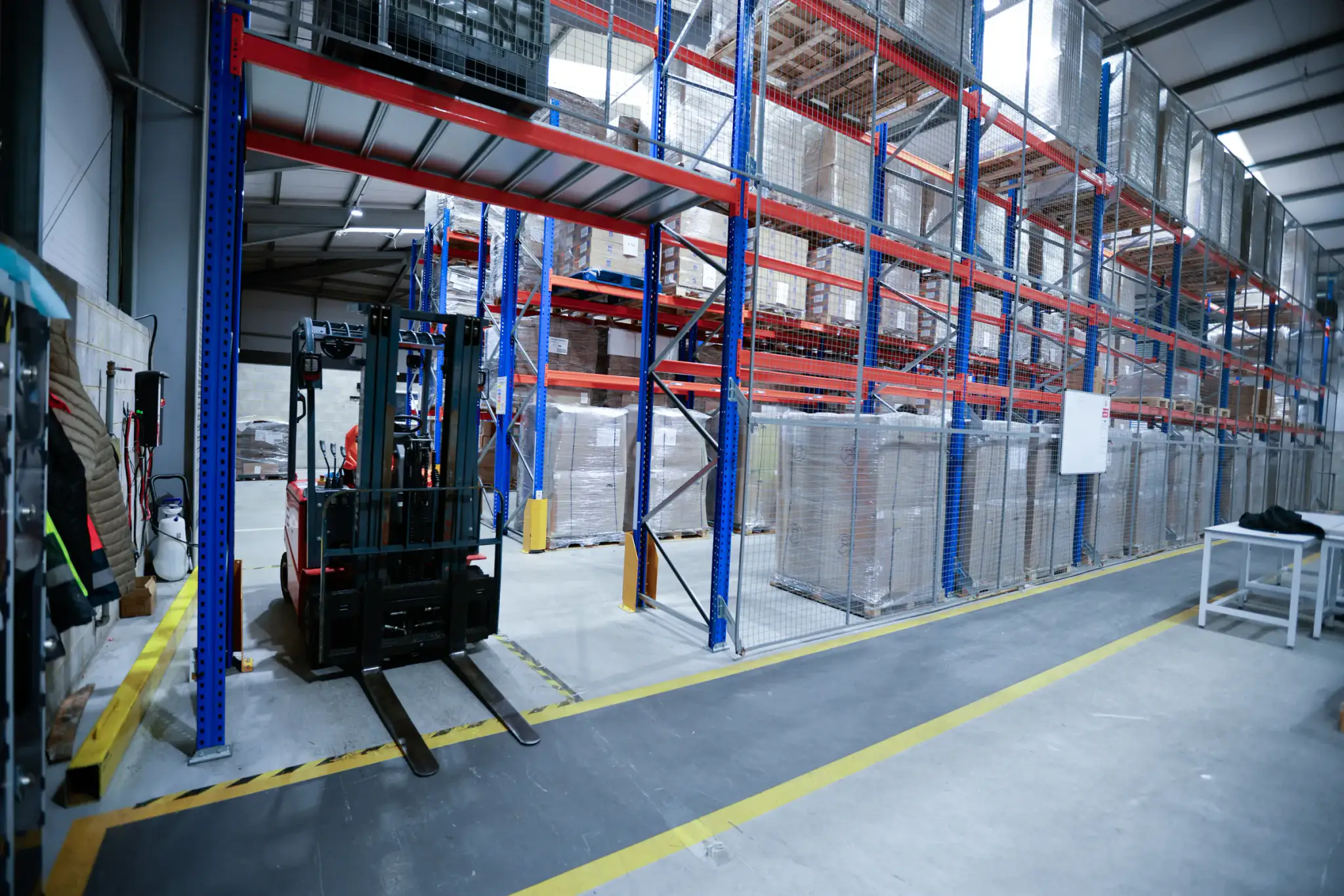
Standard racking and shelving delivered to Bristol
Bays, beams, shelving, protection and handling kit are in stock on the online store and delivered to Bristol. Designed systems still come through the free survey, because a layout has to be measured before it can be priced.
- Racking & shelving (opens the online store in a new tab)
- Storage (opens the online store in a new tab)
- Safety & premises (opens the online store in a new tab)
- Trucks & trolleys (opens the online store in a new tab)
- Steps & ladders (opens the online store in a new tab)
- Lifting, drum & cylinder (opens the online store in a new tab)
- Workshop & environment (opens the online store in a new tab)
- Office & mailroom (opens the online store in a new tab)
Questions from Bristol.
Yes. The best time to plan VNA is before the floor is finished, because guided aisles of 1.6 to 1.9m need a flat slab and either wire or rail guidance fitted to it. We work from the developer's drawings, confirm clear height and sprinkler positions, and produce a layout showing locations per level and per aisle. On a Bristol estuary shed we normally run counterbalance, reach and VNA versions side by side so you can compare location numbers and truck cost before ordering. Racking itself is typically installed 4 to 8 weeks from order.
Our base is at Seven Sisters near Neath. The route is A465, M4 east, the Prince of Wales Bridge, then the M49 into Avonmouth, roughly 72 miles and about 80 minutes outside peak traffic. Because the Severn crossings have been toll free since December 2018, there is no extra charge for Bristol visits. Surveys are booked within five working days of your call, and on long installs our team stays locally so the daily drive does not eat into working hours.
Yes. Mezzanine floors are among the most searched storage terms in Bristol, mainly from city units around St Philip's Marsh, Feeder Road and Bedminster that have height but not floor area. We survey the slab and columns, design the floor around your use, whether storage, packing or offices, and handle building regulations drawings. Steelwork usually takes 1 to 3 weeks on site once approvals are in place, and we can fit pallet gates, stairs and shelving on the new level at the same time.
Yes. Many Severnside and Avonmouth buildings never stop, so we plan the inspection by zone and work through quieter periods, often nights or Sunday mornings. Your team clears the aisle we are in, we inspect and move on, and nothing else stands down. The written SEMA report grades each defect green, amber or red with a location reference, so your night shift can off-load any red risk bay immediately and your maintenance team can plan amber repairs within the following weeks.
Adjustable pallet racking with a generous beam pitch range is usually the answer. With frames at 900 or 1100mm deep and beams from 1500 to 5000mm, levels can move in 50 to 75mm steps when a new customer's pallets are taller or heavier. For long goods such as timber or pipe arriving through the port, cantilever runs along one wall work well. We also recommend protection on the end frames, because port forklifts often work outside and come into the building fast.
It depends on how many pallets you hold per line. Shuttle suits operators with high volumes of a limited range, such as drinks or grocery reserve. Lanes run 30 to 50 pallets deep at up to 1500kg per pallet, and two-way shuttles are rated from −40°C to +50°C, so they work in frozen chambers. Because lanes replace aisles, cold store volume you pay to chill is used much harder. Lead time from order to handover is usually 12 to 16 weeks.
Yes. Leases on the estuary and in the city turn over, and tenants are often asked to clear racking before handover. We survey what is there, check its condition and make an offer to buy it, then dismantle it as part of the move. Usable stock can be reinstalled at your new site with new load signs, or resold through palletrackingwales.shop. Any reused racking is inspected before it goes back into service.
Other areas near Bristol.
Bristol sits at the hinge between South Wales and the West of England. The same Severn crossing that brings us to Avonmouth puts Newport and Cwmbran on our way home, while Gloucester and the M5 corridor are a short run north of Severnside.
Planning racking for a Bristol warehouse.
Send us your drawings, clear height and pallet profile and we will come to site within five working days. Book a free site survey or book an inspection for an existing building.