Pallet racking in Barry for the docks, the chemical coast and the airfield.
Barry is a working port first. Chemical liquid bulks, steel, scrap and timber cross the dock quays, and the units behind them on the Atlantic Trading Estate and along Hayes Road store what those trades need: drums, IBCs, long steel, spares and packaging.
We design, install and inspect racking for those stores, plus the aerospace and engineering sheds at Bro Tathan and Cardiff Airport a few miles west. Salt air off the Bristol Channel shapes our specification here, so galvanised steel and external barriers come up on most Barry surveys.
- Drive from Seven Sisters
- About 1 hr 10 min
- Road distance
- Roughly 52 miles
- Survey lead time
- Within 5 working days
- Typical install
- 4 to 8 weeks from order
Barry warehouse space: docks, chemicals and an airfield.
Associated British Ports describes the Port of Barry, nine miles west of Cardiff, as a key facility for the region's chemical industry. An independent liquid bulk terminal operates around 45,000 cubic metres of tankage on the estate, and the quays also handle steel, scrap, containers, dry bulks and aggregates. That mix sets the tone for storage in the town: heavy unit loads, mixed pallet sizes, hazardous liquids that need segregation and long products that never sit well on standard beams.
Inland of the docks, the 9.22 acre Atlantic Trading Estate is reached from Wimbourne Road or from Hayes Road off the B4267 Sully Moors Road. Its units are a blend of trade counters, fabrication shops and small warehouses, many with open yards. Further east along the coast towards Sully sits the silicones and specialty chemical manufacturing that the port was largely built to serve, with its own suppliers, packaging firms and maintenance contractors in the surrounding sheds.
West of town, the Cardiff Airport and Bro Tathan Enterprise Zone adds a different profile: aircraft parts, tooling, engine components and automotive assembly stock that needs tracked locations and careful handling rather than bulk density. ABP and partners are also promoting around 100 acres of port land as the Barry Clean Growth Hub, so new process and energy occupiers are likely to need fresh storage designs over the next few years.
Port of Barry and Barry Docks
Port-side warehousing for steel, timber, project cargo and chemical packaging, with external laydown on open hardstanding.
Atlantic Trading Estate
Mixed units with yards: fabricators, trade suppliers and small distributors storing pallets, bar and sheet.
Hayes Road and Sully Moors Road corridor
Plant hire, chemical supply and contractor depots holding drums, IBCs, valves and pipe spools.
Bro Tathan, St Athan
Aerospace maintenance, aircraft lifecycle and automotive assembly with controlled parts stores and tooling.
Cardiff Airport, Rhoose
Airside and landside stores for ground equipment spares, catering supplies and freight.
Barry Clean Growth Hub
Around 100 acres of port land marketed for low carbon and energy transition occupiers.
Racking and protection we fit in Barry, ranked by demand.
The order below reflects what Barry sites actually ask for. Dockside and chemical-coast stores lead with outdoor steel and segregated liquid storage; the airfield businesses lean towards shelving and mezzanines for parts.
Racking safety duties for Barry port and chemical operators.
Under PUWER 1998 your racking is work equipment, and HSG76 expects the business to name a person responsible for racking safety, run recorded visual checks and book an expert inspection at least every 12 months. In Barry that duty often sits alongside COMAH, DSEAR or port safety rules, so the person responsible is usually already managing permits and contractor control. We fit our work into that system rather than around it, and we brief your site safety lead before anyone climbs a frame.
The local twist is corrosion. Salt-laden air from the Bristol Channel and fumes from some chemical processes attack baseplates, anchors and the lower metre of uprights faster than in an inland shed. Our inspectors look closely at floor fixings, beam connectors and any coating breakdown, and report them with the same green, amber and red grading SEMA uses for impact damage. That gives your appointed person a clear list: what to watch, what to offload and what to replace now.
Barry storage that survives salt air and chemical drums.
Most racking in South Wales lives indoors. In Barry a lot of it does not. Timber, long steel and pipe sit in open yards behind the docks, and chemical supply firms around Sully and Hayes Road keep drums and IBCs in partly open canopies. Painted steel in those spots starts to rust at the cut edges and baseplates within a few winters. For external and semi external runs we specify hot dip galvanised cantilever and galvanised Armco, and we fix anchors with corrosion resistant hardware so the weakest part of the structure is not the bolt.
Drum and IBC storage has its own rules. Racking has to carry the full weight of filled containers, keep incompatible substances apart and leave room for bunds or sump pallets beneath. We plan beam levels around the containers you actually hold, add drum chocks or steel decking where needed and agree aisle widths with whoever drives the truck, counterbalance at 3.5 to 4.2m or reach at 2.7 to 3.2m. For the aerospace sheds at Bro Tathan the problem is the opposite: low weight, high value and tight traceability, which suits shelving and bay labelling.
Galvanised outdoors
Segregation by design
Barriers that last
Corrosion on the checklist
Getting to Barry from Seven Sisters.
Our vans leave Gwauniarll, drop down the Dulais valley to the M4 at Neath, run east to junction 33 and follow the A4232 and A4050 through Culverhouse Cross and Wenvoe into Barry. That is roughly 52 miles and about an hour and ten minutes outside the rush. For Bro Tathan we leave the M4 at junction 35 and drop through Bridgend on the B4265; for Cardiff Airport we use junction 33 and the A4050 or the A4226 Five Mile Lane.
Port and chemical sites usually need inductions, permits and escorted access, so we book those before the survey date and send method statements in advance. Installs and inspections can run at night, at weekends or across a planned shutdown when the store cannot stop during the day. Inspections for several units on the Atlantic Trading Estate can be grouped into one visit to keep the cost down.
- Motorway junction
- M4 J33
- Drive to Bro Tathan
- About 1 hr
- Out of hours work
- Nights, weekends, shutdowns
- Shuttle lead time
- 12 to 16 weeks
A typical Barry job: dockside drums, yard steel and barriers.
A typical job here is a chemical or industrial supplier near the docks that has outgrown pallets on the floor. Inside the unit, we install adjustable pallet racking for drums and IBCs, with levels spaced for the actual containers, steel decking where loads overhang, and bays grouped so that acids, solvents and inert products sit in separate runs. End of aisle barriers protect the uprights at the busiest corners.
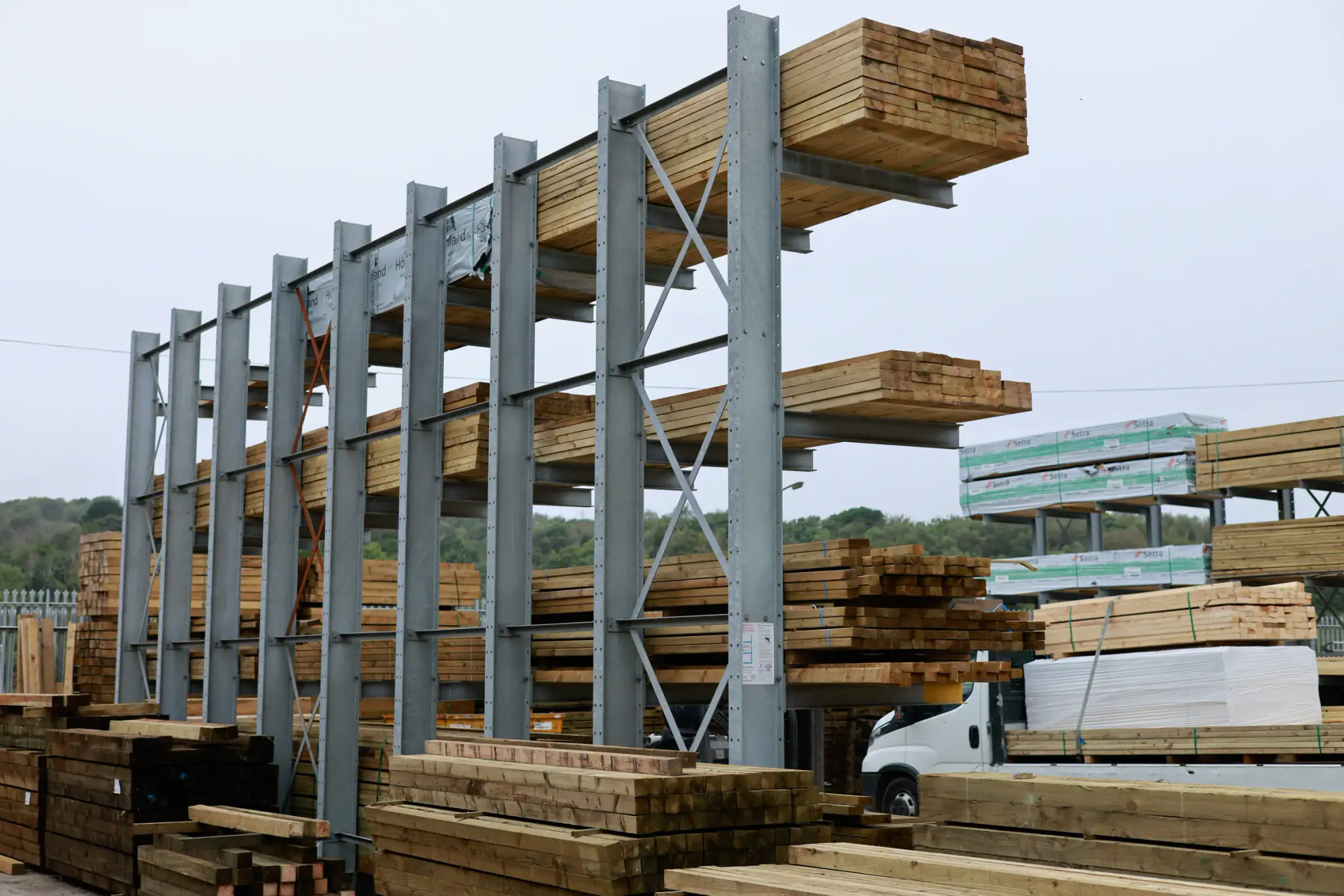
Outside, galvanised cantilever takes the long steel, pipe and timber that used to lie on bearers in the yard, and galvanised Armco keeps HGVs and forklifts off the racking and away from any tank area. The work usually goes in over two or three phases so the business keeps trading, followed by a handover pack with load notices, drawings and a first inspection date.
Standard racking and shelving delivered to Barry
Bays, beams, shelving, protection and handling kit are in stock on the online store and delivered to Barry. Designed systems still come through the free survey, because a layout has to be measured before it can be priced.
- Racking & shelving (opens the online store in a new tab)
- Storage (opens the online store in a new tab)
- Safety & premises (opens the online store in a new tab)
- Trucks & trolleys (opens the online store in a new tab)
- Steps & ladders (opens the online store in a new tab)
- Lifting, drum & cylinder (opens the online store in a new tab)
- Workshop & environment (opens the online store in a new tab)
- Office & mailroom (opens the online store in a new tab)
Questions from Barry.
It will stand up, but it will not age well. Painted steel exposed to salt air off the Bristol Channel tends to rust first at cut edges, bolt holes and baseplates, and that corrosion has to be recorded at every inspection. For yards behind the docks and on the Atlantic Trading Estate we recommend hot dip galvanised cantilever and galvanised Armco for anything outside or under an open canopy. The upfront price is higher, but it removes years of repainting and keeps the structure inspectable.
Yes. We start by listing the containers you hold, their filled weight and how they are delivered, then set beam levels, decking and drum supports to suit. Bays are grouped so incompatible substances stay apart, and we leave room beneath the lowest level for bunds or sump pallets. Your own COSHH and DSEAR assessments still govern what goes where; we make the racking fit those rules. Most Barry and Sully drum stores fit inside a 4 to 8 week install window from order.
We arrange inductions for each site before the visit rather than assuming access. Port of Barry areas, chemical plants and airside zones at Cardiff Airport each have their own requirements, and we send RAMS, insurance details and our SafeContractor approval ahead of time. Once inducted, the same inspector usually returns each year, which helps with continuity. Inspections are carried out by a SEMA Approved Rack Inspector and recorded with photographs and a graded defect list.
A unit with around 200 to 400 pallet locations usually takes half a day on site, and a larger port warehouse can take a full day or more. Corrosion checks at baseplates add a little time compared with an inland shed. You receive the written report, with every defect graded green, amber or red, within a few working days. If several neighbouring units on the Atlantic Trading Estate book together, we can complete them in a single Barry visit.
Aircraft parts and tooling tend to be light, varied and expensive, so the priority is location control rather than pallet density. We usually combine longspan shelving for kits and consumables, with tiers of around 200, 400 or 800kg per level, and selective pallet racking for engine stands and larger assemblies. Every location is labelled so your stores system can trace each part. A mezzanine can double the usable floor in a hangar annex if the building allows it.
Yes. Many stores near the docks run around shipping schedules, so we often install at night, at weekends or during a planned shutdown. We agree the sequence in advance: which bays empty first, where stock goes temporarily and how forklift routes change. Our installers are SEIRS registered, and a supervisor stays on site for every shift. Typical pallet racking projects take 4 to 8 weeks from order, with the on site element usually only a few days.
Outdoors in Barry, galvanised is the sensible choice. Armco comes in standard rail heights of 560, 610, 760 and 1100mm with posts at 3.2m centres, and we pick the height from the vehicles that use the area: low rails for forklifts, taller or double rails where HGVs turn. Painted barrier is fine inside a dry warehouse. Next to tanks, pipe bridges or external cantilever, a galvanised finish holds up to salt spray and fumes for far longer.
Other towns we cover near Barry.
Barry sits at the end of our M4 run east, so many visits combine with work in Cardiff, a short hop up the A4050, or with Bridgend and Pontypridd on the way home. Port and chemical clients often have sister sites at Newport Docks, and those can share an inspection trip.
Plan your Barry store with us.
Tell us what you hold, from drums and IBCs to long steel and aircraft spares, and whether it lives inside or out. We will visit, measure and propose a layout. Book a free site survey.