
Pallet racking in Telford for the M54 estates, where one SKU can fill a whole lane.
Telford was planned as a new town around its industrial estates, and the M54 ties them together: Hortonwood to the north beside MOD Donnington, Stafford Park and T54 near junction 4, and Halesfield in the south towards Madeley. Units here tend to be big, built since the 1970s, and full of repeat product: injection moulded parts, automotive assemblies, packaged food and contract logistics stock.
We design and fit dense storage for that profile, from drive-in blocks to pallet shuttle lanes, and we inspect existing racking across the borough to SEMA guidance.
- Drive from Seven Sisters
- 2 hr 45 min
- Road distance
- About 130 miles
- Survey lead time
- Within 5 working days
- Shuttle lead time
- 12 to 16 weeks
Telford's estates were laid out for manufacturing and now carry the Midlands' freight.
Telford grew from the 1960s and 1970s as a planned town, so its industry sits in large, purpose zoned estates rather than in old mill buildings. Hortonwood, in the north, has filled with long, clear span units for plastics, food, engineering and parcel operators. Next to it, MOD Donnington houses the Defence Fulfilment Centre, an 80,000 square metre logistics building that stores and issues inventory for UK defence. That neighbour has shaped the local labour pool: a lot of Telford warehouse staff know high bay picking, barcode location control and audited stock records.
Stafford Park and the T54 business park sit by M54 junction 4, roughly half an hour from the Black Country and the M6. T54 has drawn automotive supply chain plants, including a large aluminium casting investment, while Stafford Park mixes engineering firms, trade counters and third party warehousing. Halesfield, south of the town centre, is denser and older, with smaller units, lower eaves and many owner occupied workshops.
Much of the recent floor space came through the Telford Land Deal between Telford & Wrekin Council and Homes England, which prepared sites at Hortonwood, T54, Halesfield and Ni.PARK and has delivered more than 209,000 square metres of employment space. New sheds mean new racking layouts, and older units vacated as tenants upsize are refitted for the next occupier.
Hortonwood
Large logistics and food units near Donnington, plus plastics moulders storing resin, finished mouldings and returnable crates.
Hortonwood West
Land Deal plots with newer warehouses and starter units, often fitted out from bare floor slab.
Stafford Park
Engineering, trade distribution and contract warehousing, with mixed pallet, shelving and long load storage.
T54 Business Park, Nedge Hill
Automotive component plants within a mile of M54 junction 4, holding castings, sub assemblies and stillages.
Halesfield
Older, denser estate of workshops and medium units where mezzanines and longspan shelving add usable floor area.
Ni.PARK, Newport Road
Innovation park on the borough's north eastern edge, hosting advanced engineering firms in newer, smaller units.
Racking and storage services for Telford operators.
The order below reflects what Telford sites ask us for most: dense storage for long production runs first, then the inspection and protection work that keeps busy multi shift aisles safe.
Racking safety duties on a Telford site running round the clock.
Under PUWER 1998 your racking is work equipment, and HSG76 expects a named, appointed person responsible for racking safety at every Telford site, whether that is a single Halesfield unit or a shared contract warehouse on Hortonwood. That person organises the regular visual checks, records them, and makes sure a SEMA Approved Rack Inspector carries out an expert inspection at least every twelve months. Many plants on the estates work three shifts and weekends, so damage is often done at 3am and not reported until the day shift arrives. A short, logged check at each shift handover closes that gap.
Telford also has a lot of operators audited by their customers. Automotive suppliers work to their customers' supplier quality requirements, food plants answer to retailer and BRCGS audits, and defence supply chain firms face their own contract checks. An up to date inspection report with defects graded and closed out is one of the first documents an auditor asks for. We schedule inspections around shutdowns and stock takes so the report lands before your audit, not after it.
High volume per SKU: why Telford warehouses suit drive-in and shuttle storage.
Most Welsh sites we work on hold many lines in small quantities. Telford is different. Its plastics moulders, automotive tier suppliers and food producers often run a single part number or recipe for a whole shift or a whole week, then ship it in full loads up the M54 to the West Midlands assembly plants and national distribution centres. That gives a warehouse dozens of pallets of the same SKU, which wastes floor space in selective racking where every pallet needs its own aisle face.
Dense systems fix that. Drive-in racking removes most aisles and stores pallets in deep lanes, while a pallet shuttle does the same with a battery carrier that runs inside the lane so the truck never enters the structure. In a typical Telford unit with 10 to 12 metres clear height, converting part of a selective layout to shuttle lanes can free floor area for a new production cell without taking another lease. The choice comes down to throughput, stock rotation and budget, and we model both before we quote.
Lane depth matched to batch size
First in, first out where it matters
Temperature ranges covered
Building the Land Deal shed from day one
How we reach Telford from Seven Sisters.
Telford is one of our longer regular runs, in Shropshire. The usual route is the A465 to Abergavenny, the A49 north through Hereford, Leominster and Ludlow to Shrewsbury, then the A5 and M54 east to the estates, about 130 miles and two and three quarter hours in a van. On days the A49 is slow we go via the M50, M5 and M6 instead. Because of the distance we group Telford visits: survey and inspection days are planned in batches, and install crews stay locally for the length of a job.
Most plants in Telford cannot stop for racking work during production, so we install at night, at weekends or across planned shutdowns, working in phased sections with bays handed over as they are signed off. Surveys are normally booked within five working days of your enquiry.
- Survey booked within
- 5 working days
- Standard racking install
- 4 to 8 weeks from order
- Out of hours working
- Nights, weekends, shutdowns
- Credentials
- SEIRS installers, SafeContractor
A typical Telford project: replacing selective aisles with a shuttle block.
A typical job in Telford starts with a moulding or food business on Hortonwood or Stafford Park that has run out of floor space. The warehouse holds wide aisle selective racking, but the stock profile shows a few lines making up most of the pallets on site. We survey the building, check slab and clear height, and take the stock data from the warehouse system to work out how many pallets each line really needs.
From there we usually propose a mixed layout: a shuttle or drive-in block for the high volume lines, with selective racking kept for slower and mixed SKUs and for picking. The work is phased so the site keeps shipping, with the old racking taken down and resold where it is in good condition. Once handed over, the installation is added to an annual inspection schedule, and the operators who run the shuttle are trained on the handset and on daily checks.
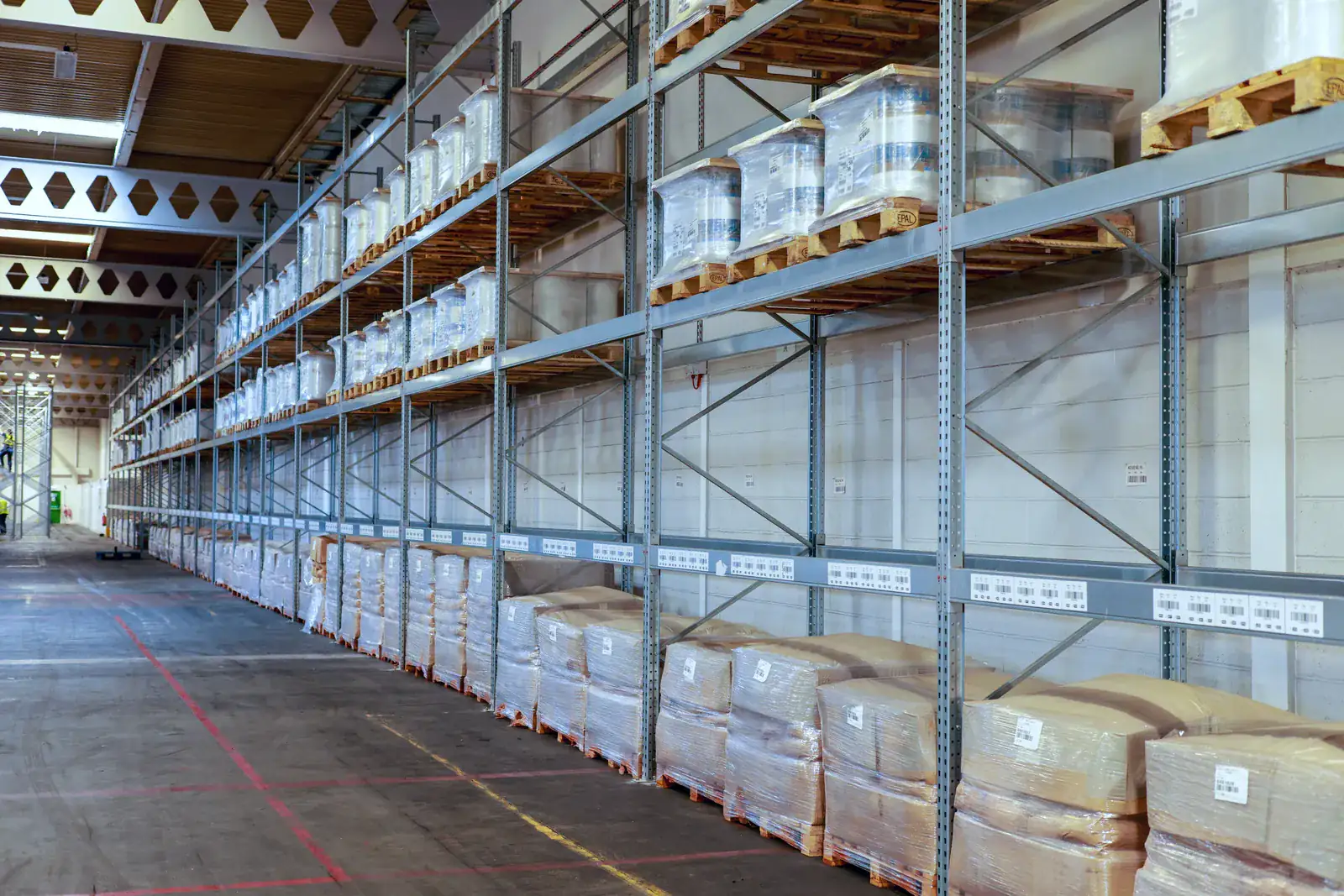
Standard racking and shelving delivered to Telford
Bays, beams, shelving, protection and handling kit are in stock on the online store and delivered to Telford. Designed systems still come through the free survey, because a layout has to be measured before it can be priced.
- Racking & shelving (opens the online store in a new tab)
- Storage (opens the online store in a new tab)
- Safety & premises (opens the online store in a new tab)
- Trucks & trolleys (opens the online store in a new tab)
- Steps & ladders (opens the online store in a new tab)
- Lifting, drum & cylinder (opens the online store in a new tab)
- Workshop & environment (opens the online store in a new tab)
- Office & mailroom (opens the online store in a new tab)
Questions from Telford.
Yes. Telford is about 130 miles from our yard at Seven Sisters, roughly two and three quarter hours by the A465 and A49, and we have worked across Shropshire and the Borders since 2009. We cluster Telford surveys and inspections into planned days, so travel does not add hours to your bill, and installation crews stay locally for the length of a job rather than driving back each night. Survey slots are normally offered within five working days.
It depends on how many pallets of each part number you hold. A shuttle pays back when a few SKUs account for most of the stock and you move a steady flow of full pallets, which is common on Hortonwood and Halesfield moulding sites. Lanes can be 30 to 50 pallets deep, the carrier handles up to 1500kg and moves around 30 pallets an hour. If your stock is spread thinly across hundreds of lines, adjustable pallet racking or narrower aisles will usually work better.
Drive-in racking costs less per pallet position and installs in 4 to 8 weeks from order, but trucks drive into the structure, so it needs careful operators and works last in, first out. Shuttle racking costs more because of the carriers, chargers and rail profiles, and takes 12 to 16 weeks, but trucks stay outside the lanes, which cuts impact damage and supports first in, first out flow. We price both for your Telford building so you can compare.
Yes, and it is the best time to do it. On a new T54 or Hortonwood West building we can design the layout from the drawings, check slab flatness and sprinkler positions against the racking, and install before your stock arrives. That avoids moving pallets twice and lets you plan truck routes and charging areas from the start. Please share the building drawings and your projected stock data at the survey stage.
Yes. Many Telford sites never fully stop, so we inspect in zones, starting with aisles your shift supervisor can clear and moving on as each area is released. Inspections can run at night or at weekends by agreement. Every location is recorded with its defect grade, and red risk items are flagged to your appointed person before we leave site so they can offload and isolate the bay straight away, rather than waiting for the written report.
After an inspection you receive a written report listing every defect by location and risk grade, photographs of significant damage and recommended actions. After an installation you get the layout drawing, load notices for every run and handover records. Automotive and defence supply chain auditors usually want to see the latest expert inspection, your log of weekly visual checks and evidence that red and amber items were closed out, and our paperwork is set out to support that.
Yes. Many Halesfield units were built with enough height for a second level but limited floor area. We survey the building, the slab and the column positions, design the floor around its use, from storage to light assembly, and handle building control. Steelwork typically takes 1 to 3 weeks on site after design approval. Stairs, handrails, pallet gates and any fire protection required for the use are included in the design rather than added later.
Other towns we cover near Telford.
Telford sits at the eastern end of our Borders and Shropshire coverage, and we often combine visits here with work in Shrewsbury, 15 miles west along the A5, and with sites in Oswestry, Wrexham and Hereford on the same routes back towards South Wales.
Plan denser storage for your Telford unit.
Send us your stock profile and building drawings and we will compare drive-in, shuttle and selective layouts for your site on the M54 estates. Book a free site survey.