
Pallet racking regulations in the UK. What the law asks, in plain terms.
No single act is called the racking regulations. The duty comes from general health and safety law, and the detail comes from HSE guidance and European standards adopted in the UK. This guide sets out which is which, what an inspection regime looks like, and the records you should be able to show.
Published · 9 minute read
The short answer.
Pallet racking is work equipment, so the Provision and Use of Work Equipment Regulations 1998 (PUWER) apply to it. That means it must be suitable for its use, maintained in a safe condition, inspected so that deterioration is found in time, and used only by people who have been trained to use it. The Workplace (Health, Safety and Welfare) Regulations 1992 add duties about the traffic routes running between and around the racking.
The HSE explains how to meet those duties in HSG76, Warehousing and storage: a guide to health and safety. HSG76 is where the familiar regime comes from: a named Person Responsible for Racking Safety, regular recorded visual checks, and an expert inspection at least every 12 months. The technical detail sits in the European standards for storage equipment, chiefly EN 15635, which covers use and maintenance and defines the red, amber and green damage categories.
This guide is general information for warehouse operators, not legal advice. Your duties depend on your site, your equipment and your risk assessment. Where a decision has legal consequences, take advice from a competent health and safety adviser.
PUWER 1998: racking is work equipment.
PUWER is the regulation most inspectors reach for first. It is not written about racking specifically, which is why it surprises people, but racking falls squarely within its definition of equipment used at work. In practice PUWER asks four things of the employer or person in control of the warehouse.
- Suitability: the racking must be designed for the loads, pallets and handling equipment you actually use. A run rated for 800kg pallets is not suitable for 1,000kg pallets, however solid it looks.
- Maintenance: it must be kept in an efficient state and good repair. Damaged components are replaced, not straightened, because cold-formed steel does not recover its original strength.
- Inspection: where deterioration could lead to danger, the equipment must be inspected at suitable intervals by a competent person, and the results recorded.
- Information and training: the people loading, unloading and working near the racking must know its safe working limits and how to report damage.
A risk assessment ties these together. It identifies who could be harmed (truck drivers, pickers, visitors), how (collapse, falling loads, collisions), and what controls you rely on. For most warehouses the controls are the load notices, a damage reporting route, protection at vulnerable points, operator training and the inspection regime described below.
The Workplace Regulations 1992: aisles and traffic routes.
The Workplace (Health, Safety and Welfare) Regulations 1992 cover the building rather than the equipment. For a racked warehouse the relevant parts are traffic routes, floors and the separation of people from vehicles. Aisles must be wide enough for the trucks using them, kept clear, and organised so that pedestrians and vehicles can move safely.
This is where layout decisions become compliance decisions. An aisle drawn too tight for the truck turns every put-away into a likely strike on the upright. A pedestrian route that crosses the end of an aisle needs barriers or marked crossings. Our racking system comparison lists typical working aisle widths by truck class, and the rack protection page covers the physical measures that keep trucks off the steel.
Floors matter too. The slab must carry the point loads from the racking baseplates, and it must be level enough for the tolerances the racking design assumes. Floor capacity is a structural engineer's judgement for your slab, and EN 15620 sets the tolerances for the racking itself.
Point load capacity required at each baseplate for your racking configuration: Confirmed by your structural engineer
HSG76 and the Person Responsible for Racking Safety.
HSG76 is HSE guidance rather than law, but following it is normally enough to comply with the law, and an inspector will expect you to have either followed it or done something equally effective. Its most practical recommendation is to appoint a Person Responsible for Racking Safety, usually shortened to PRRS.
The PRRS is a named person on your site, often a warehouse manager or health and safety lead, who owns racking safety day to day. They do not need to be an engineer. They do need enough training to recognise damage, enough authority to offload a bay, and enough time to keep the records. Typical responsibilities include:
- Organising and recording the regular visual checks.
- Making sure damage reported by staff is assessed and acted on.
- Arranging the annual expert inspection and following up its findings.
- Controlling changes: no beam levels moved, no bays added, no different loads stored, without checking the design still holds.
- Keeping load notices in place and legible at the end of every run.
Our rack safety awareness training is written for the PRRS and the people who report to them. It gives the team a common language for damage, which is what makes the reporting route work.
The inspection regime: three layers.
HSG76 and EN 15635 describe inspection as layers, each catching what the previous one missed. A warehouse that only has the annual inspection is relying on damage waiting politely for the inspector to arrive.
Immediate reporting
Anyone who causes or sees damage reports it at once. This only works in a culture where reporting a strike is not punished, because the alternative is damage that nobody mentions. Make the route simple: who to tell, and what happens to the bay while it is assessed.
Regular recorded visual checks
The PRRS, or someone trained and appointed by them, walks the racking at a set interval and records what they find. Weekly is common, and the right frequency depends on how busy the site is and how much damage it sees. A high-traffic distribution floor may need more frequent checks than a quiet store. The point is that the checks are recorded, so a trend is visible.
Expert inspection, at least every 12 months
A technically competent person carries out a thorough inspection at intervals not exceeding 12 months, and produces a written report. In practice that usually means a SARI, a SEMA Approved Rack Inspector, who has been trained and assessed against the SEMA code of practice. The report lists each defect, its location, its risk category and the action required. Your duty does not end with the report: the findings must be acted on within the timescales given.
We carry out racking inspections across South and West Wales, and quote any racking repairs from the same visit so the timescales are achievable. If you want a starting point for the weekly checks, the racking inspection checklist is free to download.
EN 15635 red, amber and green.
EN 15635 sorts damage into three risk categories, and every inspection report you receive should use them. Knowing what each one obliges you to do is more useful than knowing the standard's number.
- Green: damage within the allowable limits. Record it and monitor it at the next inspection. No immediate action is needed.
- Amber: hazardous damage that needs action, but not so severe that the bay must be emptied at once. Do not reload the affected location once it is emptied, and repair within the timescale set by the inspector. If amber damage is not repaired in time, it should be treated as red.
- Red: very serious damage. Offload and isolate the affected area immediately and keep it out of use until repaired.
The allowable limits themselves are set out in the standard and assessed on site with a gauge by the inspector. They differ by component and measurement, and they are not something to estimate from a photograph or a rule of thumb. That is deliberate: a visual check finds the damage, and a competent person decides the category.
Allowable damage limits for uprights and bracing on your racking: Assessed on site by your SARI inspector
The standards behind the racking.
Several standards sit behind a racking installation. You do not need to own copies, but it helps to know which one a supplier or inspector is quoting.
- BS EN 15512: structural design of adjustable static pallet racking. This is how the manufacturer calculates load ratings.
- EN 15620: tolerances, deformations and clearances. It sets how plumb and level the racking must be built, and the clearances between pallets and the structure.
- EN 15629: specification of storage equipment. It sets out the information that should pass between the user and the supplier, such as loads, pallets, trucks and floor, so the design is right.
- EN 15635: use and maintenance, including the inspection regime and the red, amber and green categories.
- EN 15878: terms and definitions, so that everyone means the same thing by upright, frame and beam level.
- BS EN 15095: power-operated mobile racking and shelving, carousels and storage lifts. It applies if you run mobile pallet racking.
SEMA, the Storage Equipment Manufacturers' Association, publishes codes of practice that interpret these standards for UK use. The installers who build racking should be registered under SEIRS, the Storage Equipment Installers Registration Scheme.
CDM 2015: installing, altering and removing racking.
The Construction (Design and Management) Regulations 2015 apply to construction work, and installing, altering or dismantling racking is generally treated as construction work. Under CDM the business commissioning the work is the client, and the client has duties of its own: making suitable arrangements for managing the project, providing information about the building, and allowing enough time and resources.
Where more than one contractor is involved, the client must appoint a principal designer and a principal contractor. On a straightforward racking job with a single installer, that installer normally carries the contractor duties, but the client duties stay with you. A competent installer will ask for the information they need, such as floor details, services and site rules, and should provide a construction phase plan and method statement before starting.
Relocations and alterations count too. Moving a run to a new building, or changing beam levels across a block, changes the design condition. The installation, relocation and dismantling page covers how we plan that work around a live operation.
Load notices.
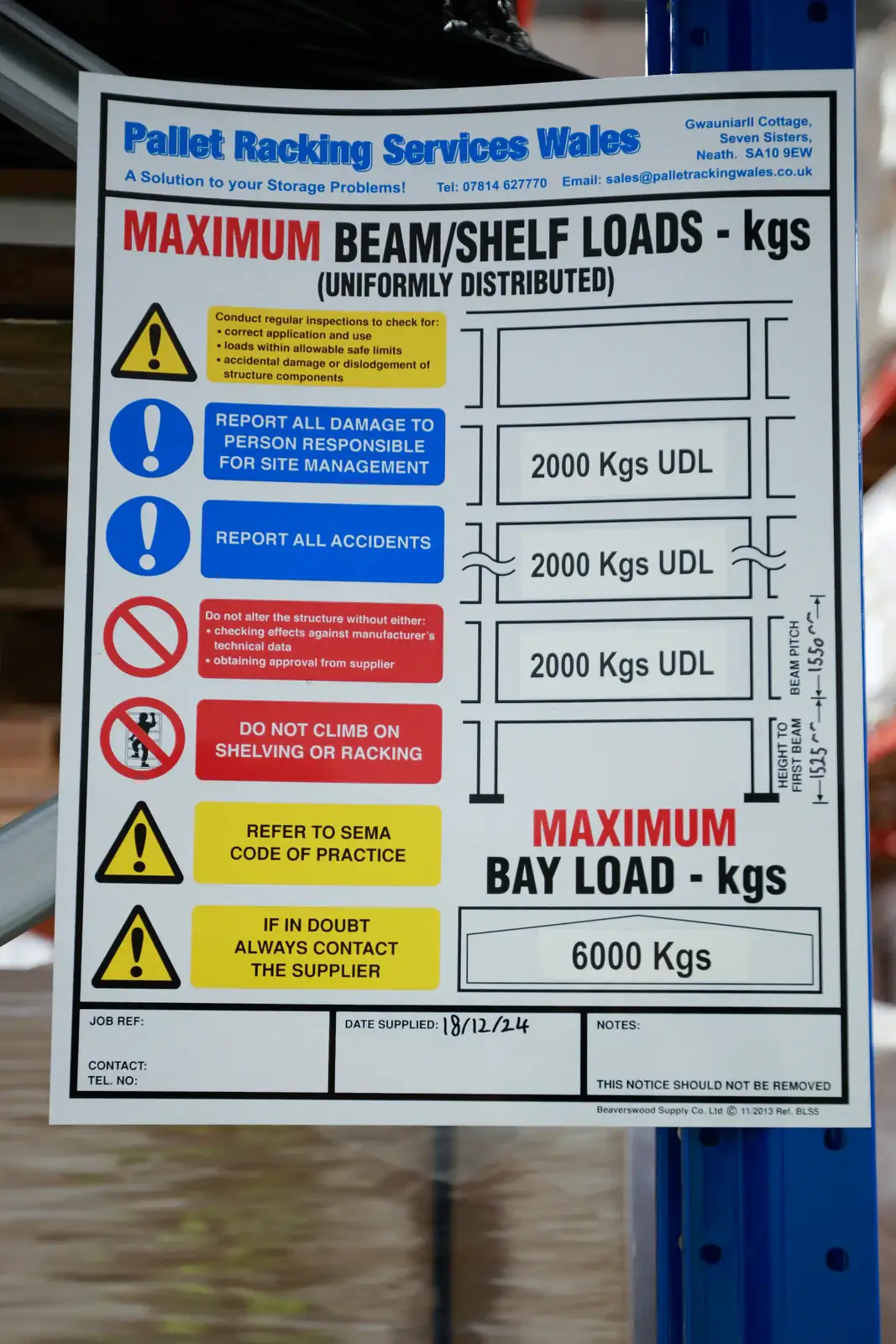
Every run should carry a load notice, fixed where operators can read it, stating the safe working loads for the configuration as built. A load notice normally shows the maximum load per beam level and per bay, the beam level arrangement it applies to, and the supplier's details. The figures come from the manufacturer's design data for that configuration, and they stop being valid if the configuration changes.
Safe working load per beam level and per bay for your configuration: From the manufacturer's design data
The commonest gap we find on inherited sites is racking with no load notice at all, or a notice that no longer matches the beam levels. If you do not know who made your racking, the rack identification guide helps you narrow it down before an engineer rates it.
Records to keep.
If an inspector or insurer asks how you manage racking safety, the answer is in your records. Keep them together and keep them current.
- The name of the appointed PRRS and the date of appointment.
- Your risk assessment for the storage area, reviewed when the layout or loads change.
- Original design information, layout drawings and load notices for each installation.
- The record of each regular visual check: date, who, what was found, what was done.
- Expert inspection reports for at least the last few years, with evidence that findings were closed out.
- Repair records, including what was replaced and by whom.
- Training records for the PRRS, truck drivers and anyone who carries out checks.
- CDM documentation for installation and alteration work.
None of this needs special software. A dated folder per installation, kept up to date, answers most questions an inspector will ask.
Questions people ask about this.
PUWER 1998 requires work equipment to be inspected where deterioration could lead to danger. HSE guidance in HSG76 says racking should have an expert inspection at least every 12 months, in addition to regular recorded visual checks. Following that guidance is the normal way to show you have met the legal duty.
Three layers. Damage is reported immediately. Recorded visual checks are carried out regularly, often weekly, by your Person Responsible for Racking Safety or someone they appoint. An expert inspection by a technically competent person, such as a SARI, takes place at intervals not exceeding 12 months.
A technically competent person. In practice most warehouses use a SARI, a SEMA Approved Rack Inspector, who has been trained and assessed against the SEMA code of practice. Your PRRS carries out the regular visual checks, not the annual expert inspection.
Red is the most serious EN 15635 category. The affected area should be offloaded and isolated immediately and kept out of use until it has been repaired. Amber means repair within the timescale set by the inspector, and green means record and monitor.
Yes. Each run should display the safe working loads for the configuration as built, taken from the manufacturer's design data. If beam levels are moved, the notice may no longer apply and the configuration should be checked before it is reloaded.
Installing, altering and dismantling racking is generally treated as construction work, so CDM 2015 applies. The business commissioning the work has client duties, and where more than one contractor is involved a principal designer and principal contractor must be appointed.
Get the annual inspection in the diary.
An inspection by a SEMA approved rack inspector, a written report with red, amber and green findings, and repairs quoted from the same visit.