
Pallet racking in Ellesmere Port, between the Stanlow flare stacks and the M53.
Ellesmere Port is a town built around process plant and production lines. Stanlow refinery sits on the Manchester Ship Canal frontage and takes its crude by pipeline from Tranmere, the former Vauxhall car factory beside the M53 now builds only electric vans, and the estates at Rossmore, Netherpool and Hooton feed both with parts, packaging, drums and spares.
That mix asks more of racking than a plain distribution shed does. We design line-side buffer stores, drum and IBC racking, spares mezzanines and Armco runs for sites between junctions 8 and 10, and we inspect them on your shutdown calendar, not ours.
- Drive from Seven Sisters
- 3 hr 20 min
- Road distance
- 165 miles
- Industrial junctions
- M53 J7 to J10
- Typical install
- 4 to 8 weeks
Where Ellesmere Port stores its parts, drums and finished goods.
Cheshire West and Chester Council counts 25 employment areas in Ellesmere Port, more than any other settlement in the borough, and six of them run to over 20 hectares: Stanlow, New Bridge Road, Hooton Park, Rossmore, Portside and the Encirc glass works at Elton. The council classes 18 of the 25 as good quality, and almost all of that land is in general industrial or warehousing use, so the storage problem here is rarely about a single big box. It is about hundreds of mid-sized units, each serving a heavier neighbour.
Around Stanlow and the Ship Canal frontage the stock is valves, gaskets, flange sets, pump spares and chemical drums, often stored by contractors who must reach a part at three in the morning during an unplanned outage. On Rossmore and Netherpool, reached off junction 8, units tend to hold kitted automotive components, returnable stillages and packaging for the van plant. Further south, Cheshire Oaks and the Coliseum retail park pull in retail replenishment and click and collect stock, while the newer large distribution buildings at Northside and Link Logistics Park, built since 2010 with direct access to the M53 and M56, run conventional wide aisle and narrow aisle pallet stores.
Older buildings are common. Many units date from the 1960s and 1970s, when the car factory and refinery were expanding, and they come with low eaves, columns on awkward grids and floor slabs that need checking before anyone specifies tall frames or a mezzanine. The council survey also flags flood zones, hazard zones and peaty soils across parts of the industrial area, which is one more reason we look at the ground before the steel.
Rossmore and Netherpool industrial estates
Off M53 junction 8 near the docks: automotive kitting, stillage stores, packaging and trade supply units.
Stanlow and New Bridge Road
Refinery and chemical contractors holding drummed product, pipework spares, scaffold and maintenance stores.
Hooton Park
Former airfield land beside the van plant: engineering workshops, vehicle related businesses and units built into heritage hangars.
Portside Business Park
Canal-side units used for freight forwarding, light manufacturing and bulk material handling.
Cheshire Oaks and Coliseum area
Junction 10 retail cluster with stock rooms, back-of-house shelving and replenishment storage.
Racking services for Ellesmere Port, ranked by what the town asks for.
The order below reflects the calls we get from the Wirral side of Cheshire: automotive buffering first, then inspection for audited refinery and supplier sites, then process plant spares storage, with protection and repairs after. Every scheme starts with a measured survey and a drawing you can show your insurer or site safety team.
Racking safety in Ellesmere Port's permit-to-work culture.
Most operators here already live with permits, isolations and audits, so racking safety fits a familiar pattern. Under PUWER 1998 and the HSE guidance in HSG76, the employer is the duty holder and should name an appointed person responsible for racking safety. That person organises recorded visual checks, weekly in busy stores, and makes sure an expert inspection is carried out at least once every twelve months, normally by a SEMA Approved Rack Inspector. The record matters as much as the check: a supplier audit from a refinery or vehicle manufacturer will ask to see it.
Two local habits cause trouble. Contractor stores near Stanlow are often run by a rotating crew during turnarounds, so damage goes unreported because nobody owns the racking that week. Automotive supply units on three-shift patterns see constant tugger and forklift traffic, and small knocks pile up between inspections. We train a named person on each shift to log damage against bay numbers, which turns your annual inspection into a confirmation rather than a surprise.
Storing for the van plant, the refinery and the Ship Canal in Ellesmere Port.
Ellesmere Port has two very different anchors a few miles apart. The Stellantis plant switched from Astra cars to electric vans in 2023 and now builds compact battery-electric vans for several brands. Its suppliers work to sequenced delivery, so their racking behaves like a buffer: pallets and stillages arrive, wait a few hours and leave. Pick faces need to be low and clearly labelled, empty packaging returns need its own lane, and every metre of aisle counts. Many units also now charge electric yard tugs and fleet vans, which puts chargers next to traffic routes that were never planned for them.
On the other side of junction 9, Stanlow refinery sits on the south bank of the Manchester Ship Canal and supplies around a sixth of UK road fuel. The firms that support it store drummed chemicals, lubricants, IBCs and heavy spares. That stock needs racking chosen with your COSHH and DSEAR assessments in mind, drip trays or bunded areas below, and barriers that stop a reversing vehicle long before it reaches a drum.
Sequenced buffer bays
Charge point protection
Drum and IBC racking
Outage-ready spares stores
Getting to Ellesmere Port from Seven Sisters.
We drive up the Heads of the Valleys road to Abergavenny, take the A49 through Hereford and Shrewsbury, then the A483 past Wrexham and the A55 round Chester onto the M53. It is about 165 miles and three hours twenty minutes, so surveys in Ellesmere Port are planned as a full day, often grouped with Chester and Deeside visits in the same week. You will get a confirmed date within five working days of your call.
Installs run on a stay-over basis: the crew lodges locally and works consecutive days, which keeps disruption short. For automotive suppliers that cannot stop a line, we work evenings and weekends, and for refinery contractors we fit around turnaround schedules and site induction requirements. Inspections can be booked as an annual visit timed to your quietest month.
- Route
- A465, A49, A483, A55, M53
- Survey booked
- Within 5 working days
- Site day
- Full day, grouped with Chester
- Out of hours
- Evenings, weekends, shutdowns
A typical Ellesmere Port job: a contractor's drum and spares store.
A typical job here is a contractor unit near the refinery that has outgrown a jumble of ad hoc shelving and pallets on the floor. We survey the building, check the slab and eaves, and propose a split layout: wide aisle pallet racking for drums and IBCs over a bunded zone, longspan shelving for gaskets and valves, and a run of Armco between the yard door and the drum bays.
The second phase is often a small mezzanine over the workshop for slow-moving spares, freeing ground space for a forklift charge bay with its own barriers. Everything is labelled, load notices go on each bay, and the appointed person is shown how to carry out and record visual checks before we leave site.
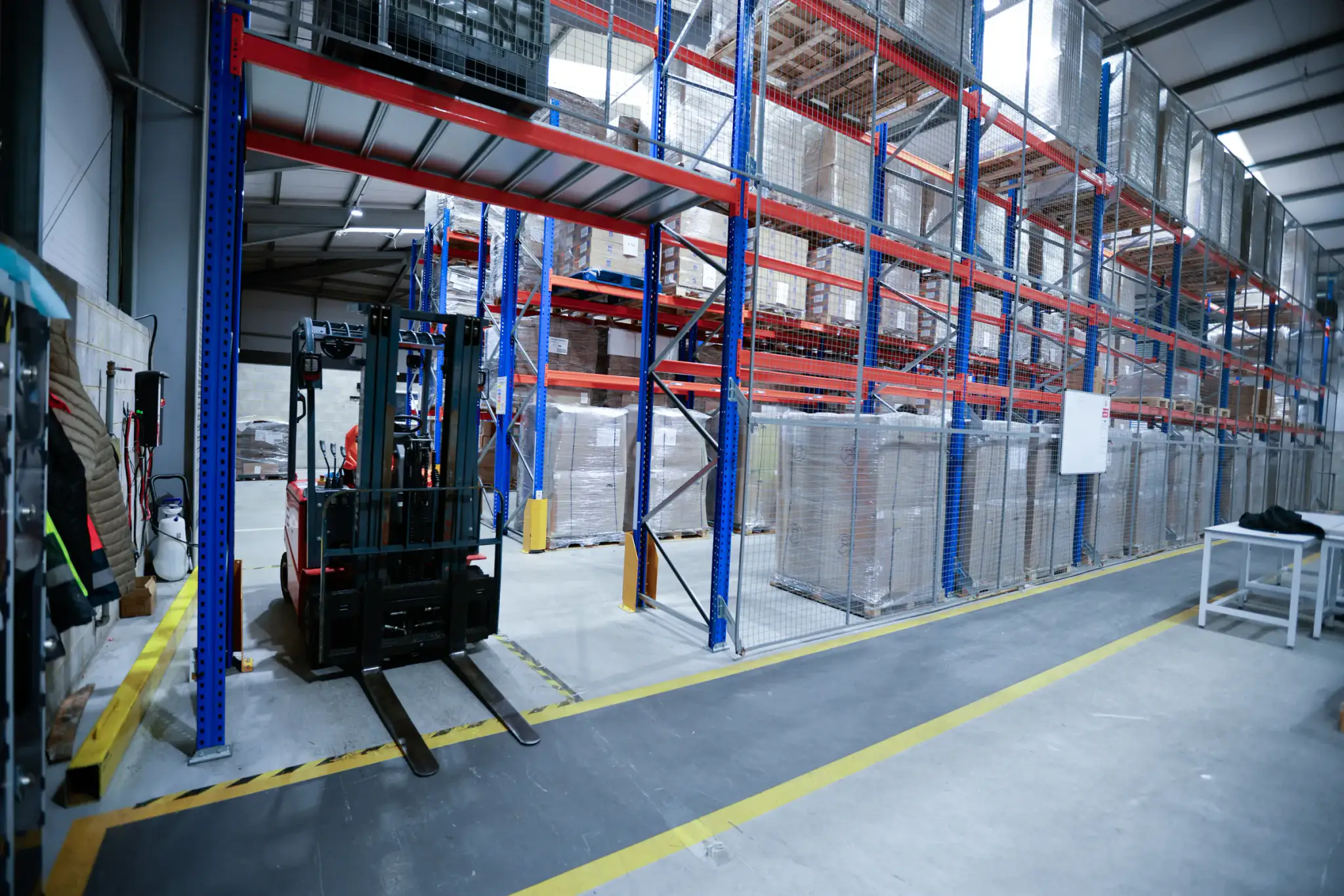
Standard racking and shelving delivered to Ellesmere Port
Bays, beams, shelving, protection and handling kit are in stock on the online store and delivered to Ellesmere Port. Designed systems still come through the free survey, because a layout has to be measured before it can be priced.
- Racking & shelving (opens the online store in a new tab)
- Storage (opens the online store in a new tab)
- Safety & premises (opens the online store in a new tab)
- Trucks & trolleys (opens the online store in a new tab)
- Steps & ladders (opens the online store in a new tab)
- Lifting, drum & cylinder (opens the online store in a new tab)
- Workshop & environment (opens the online store in a new tab)
- Office & mailroom (opens the online store in a new tab)
Questions from Ellesmere Port.
Yes. Most automotive supply units in Ellesmere Port cannot pause sequenced deliveries, so we phase the work. We usually clear and rebuild one run of bays at a time, working evenings or weekends, while live stock is moved to temporary floor lanes or a neighbouring run. The number of visits depends on how many bays you can release at once. We agree the phasing plan with your logistics lead before ordering, and the racking is delivered 4 to 8 weeks from order so the dates can be fixed well ahead.
For 205 litre drums and 1000 litre IBCs we normally specify standard pallet racking with the stock on suitable pallets, plus drip trays or decking where your risk assessment calls for it, positioned over a bunded floor zone. Frames are typically 1100mm deep for IBC pallets. We do not set chemical segregation rules ourselves: those come from your COSHH and DSEAR assessments and your site's fire strategy. Our job is to make the racking layout follow them, with clear load notices and barriers at the aisle ends.
Start with the vehicle routes. We map where HGVs, vans and forklifts turn, then position Armco or bollards so a reversing vehicle meets steel before it reaches a charger. Armco comes in 560, 610, 760 and 1100mm heights on 3.2m post centres, and the height is chosen to match the bumper or fork height of the vehicles involved. Many Ellesmere Port units are adding chargers to yards built in the 1970s, so we also check that the barrier still leaves turning room.
We can, but it is usually better to inspect just before a turnaround, while stores are full and damage is easy to see, or just after, when bays can be offloaded for repairs. Our inspectors complete site inductions in advance and work under your permit system. Most contractor stores are inspected in a single visit, and the written report with red, amber and green categories follows within five working days.
Often, yes. Many units on Rossmore and around Netherpool have enough clear height for a single mezzanine with usable headroom above and below, but we measure the eaves before promising anything. The deciding factors are the slab and the column grid. We check both at survey, and the mezzanine will need Building Regulations approval. Once approved, the steelwork itself is usually erected in 1 to 3 weeks.
Yes. Ellesmere Port is about 165 miles from our base in Seven Sisters, roughly three hours twenty minutes via Hereford, Shrewsbury and Chester. We plan surveys as dedicated days and group them with nearby work in Chester, Deeside and Wrexham. Installation crews stay locally for the length of the job. The distance does not change our lead times: surveys within five working days and installs 4 to 8 weeks from order.
Yes. When units change hands near Hooton or the docks, the outgoing tenant often has to strip the racking. We survey it, offer a price for serviceable frames and beams, and dismantle it to a set date so the lease handover is clean. Damaged components are scrapped and recycled. Good second-hand stock can then go back into another local scheme, which shortens lead times for the next buyer.
Other towns we cover near Ellesmere Port.
Ellesmere Port sits at the northern end of our coverage, and survey days here are usually shared with sites across the Dee. Chester is ten minutes south on the M53, Deeside and Wrexham are on the way home, and Oswestry and Shrewsbury sit on the A483 and A49 route back to Wales.
Book a free site survey in Ellesmere Port.
Tell us what you store, which shifts run and when your next shutdown falls. We will plan a survey day, measure the building and send a drawing and quotation for racking, protection or inspection.